

Estimated reading time at 200 wpm: 13 minutes
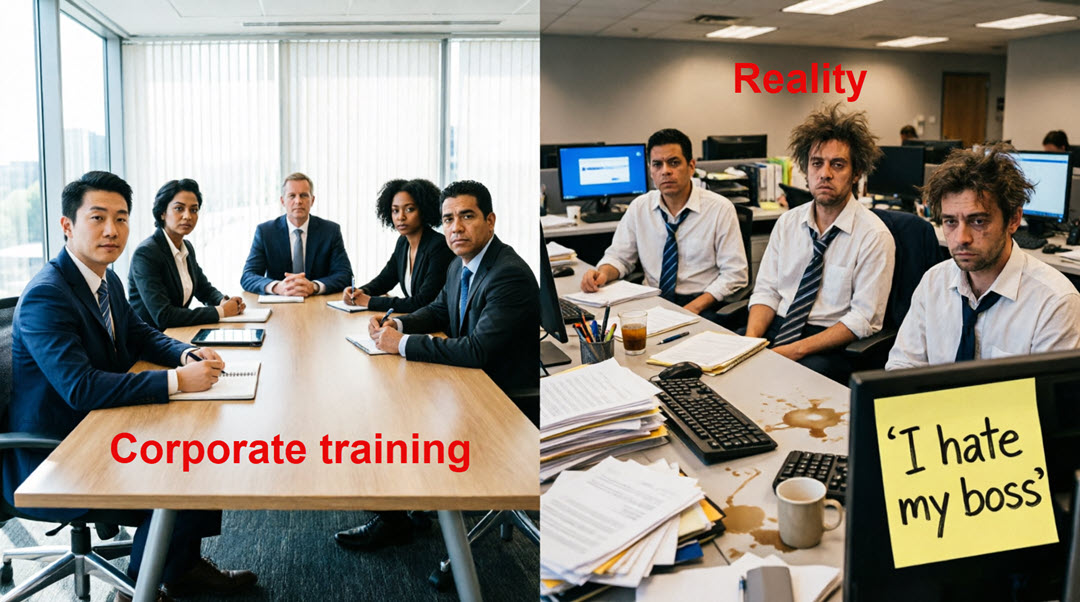
Every NHS trust maintains a mandatory training matrix. Staff are tracked, chased, and occasionally threatened until compliance rates hit the target — typically 85% or above. The annual study day is booked. The e-learning is clicked through. The tick goes in the box. And then, overwhelmingly, nothing changes.
Whether or not you agree our Fat Disclaimer applies
This pattern is not unique to the NHS. In 2016, Beer, Finnström and Schrader published a landmark Harvard Business School paper they titled The Great Training Robbery. Their argument was blunt: billions spent on corporate training each year produce almost no lasting change in behaviour, because organisations treat education as a stand-alone fix while leaving the systems that shape behaviour untouched. The phrase captures something most clinicians already suspect but rarely see quantified.
This article borrows their title — with attribution — because the robbery they described is, if anything, more damaging in healthcare than in business. When a corporate leadership programme fails, a product launch suffers. When clinical training fails, patients are harmed or put at risk. Yet the NHS continues to invest in training models that the evidence base has repeatedly shown to be lacking traction. How? One needs only to study the basic failures of care – that would have been covered in training by NHS Trusts – laid bare in Public Inquiries [See: Nottingham Inquiry and Southport Inquiry ]. Ministers have been pounding their desks bawling “Why are lessons not learned!?“

What follows draws on research the Harvard paper addressed but some that it did not: the cognitive science of skill decay, the meta-analytic evidence on what makes training transfer succeed or fail, the instructional strategies that resist forgetting, and the specific institutional habits of the NHS that perpetuate the cycle. The aim is not to argue against training. It is to argue against the way training is currently commissioned, delivered, and abandoned.
The System Defeats the Individual
The fallacy of programmatic change
Most corporate training fails because leaders cling to a comfortable illusion: that an organisation is simply a collection of talented individuals, and change occurs by training them or tick-boxing that their training has been updated. Beer, Finnström and Schrader call this the fallacy of programmatic change. The deeply ingrained pattern of roles, relationships, culture, and power structures is far more powerful in shaping behaviour than any classroom-acquired capability.
A cautionary tale from the Electronic Products Division
The case study that anchors their paper is worth dwelling on. The Electronic Products Division (EPD) invested in an intensive one-week leadership programme. Virtually every salaried employee in the division attended. Participants described it as powerful and engaging. Pre- and post-survey results suggested attitudes and behaviour had shifted during the programme itself.
Two years later, a new general manager commissioned an assessment. Managers across the division reported that the programme had not changed the organisation’s effectiveness, its culture, or its performance — particularly the rate of new product development, which was critical to the business. The reason was systemic. Beer and his colleagues identified six silent barriers that had blocked any transfer of learning:
- unclear strategy and conflicting priorities,
- an ineffective senior team,
- a top-down leadership style,
- poor coordination across functions,
- inadequate leadership development throughout the organisation,
- and closed vertical communication.
The programme had not failed because the training was poor. It had failed because the organisational context made it impossible for managers to apply what they had learned.
Reverse the logic: fix the environment first
The solution is to invert the traditional sequence. Before a single training event is scheduled, leaders must audit the work environment for those six silent barriers and remove them. The EPD’s successor restructured the division into cross-functional product teams first, then introduced real-time coaching to help staff navigate their new roles, and only after that layered in classroom training to support the structural shift. The change was rapid and sustained.
ASDA’s “driving test” for readiness
The UK grocery chain ASDA applied the same discipline. It developed a store-readiness “driving test” — a diagnostic survey of leadership culture, safety climate, and managerial support — before releasing a single pound for store redesigns or training. Stores that failed the test received organisational development help first. No training budget was approved until the environment was ready. Over a decade, this approach helped drive a tenfold increase in market capitalisation. [Beer et al, p9]
Behaviour belongs to the system, not the person
Three classic studies reinforce this conclusion. Front-line union factory workers promoted to management quickly adopted pro-management attitudes — but the moment market forces pushed them back to the shop floor, they reverted entirely to pro-union stances. Star Wall Street analysts who moved to new firms alone suffered immediate and persistent performance drops; the only exceptions were those who moved with their entire supportive team intact. Dialogue and teamwork training succeeded only in sub-units that already possessed a psychologically safe climate. In every case, the system dictated the behaviour.
The Science of Forgetting
The forgetting curve is steeper than most realise
Professional skill does not fade gently — it plummets. A meta-analysis of 53 studies shows that after a year without practice, proficiency drops by nearly one and a half standard deviations. That is a catastrophic decline for any safety-critical role. A single course, however brilliant, cannot inoculate a clinician against that rate of loss.
Immediately after a course, trainees may apply 62% of what they learned. That falls to 44% within six months and to just 34% after a year. Nearly two-thirds of the behaviour change evaporates before the next appraisal.
Which skills endure and which dissolve
Not all capabilities fade at the same pace. Physical, natural, and speed-based tasks prove remarkably resistant to decay. Cognitive, artificial, and accuracy-based tasks degrade quickly. The reason is neurological: speed-based motor programmes migrate into durable implicit procedural memory, while cognitive protocols sit in fragile explicit declarative memory, easily disrupted by interference and retrieval failure.
Task structure also matters. Although findings on task structure are mixed (and some results may reflect confounding variables in the data), closed-loop tasks with a clear start and finish — like a step-by-step drug calculation — are often viewed as vulnerable to rapid forgetting. Open-loop tasks that demand continuous adaptive responses, such as monitoring changing vital signs, constantly reinforce their own neural pathways and resist decay.
The shrinking shelf-life of professional knowledge
In technology-intensive fields, the half-life of professional knowledge can be less than four years. Practitioners may lose half of their textbook learning before they finish a junior rotation. When busy rotas squeeze out deliberate rehearsal, core competencies erode silently.
AI as an accelerant
A subtler threat is the growing presence of AI in clinical workflows. When AI automates cognitive steps — differential diagnosis, dose calculation, image interpretation — it can obscure the feedback loops clinicians need to detect their own errors. This phenomenon, termed “expert skill decay,” means well-intentioned technology may actually accelerate the loss of hard-won human expertise. A clinician who routinely defers to an AI-generated differential stops exercising the diagnostic reasoning that built the skill in the first place. The forgetting curve does not distinguish between disuse by neglect and disuse by delegation.
The Work Environment as Gatekeeper
Support that lasts a full year
The most meticulously designed course counts for nothing if the workplace actively suppresses what was learned. A large meta-analysis of work environment characteristics found that five support factors have a clear, positive relationship with training transfer:
- motivation to transfer,
- organisational support,
- supervisor support,
- peer support,
- and genuine opportunity to practise.
The immediate correlations are moderate. Crucially, they remain just as strong a full year after the training ends, ranging from 0.25 to 0.57. A supportive consultant, a culture of shared learning, and the chance to perform a new skill on the next shift are not “nice to have” — they are statistically powerful levers that continuously channel behaviour in the right direction.
Cues that trigger, consequences that sustain
The moment-to-moment application of training is governed by two simple mechanisms. Situational cues — a manager’s stated goal, a peer’s question, the presence of the right equipment — act as prompts that trigger the trained response. Consequences — constructive feedback, recognition from colleagues, or simply avoiding criticism — function as operant loops that maintain the behaviour over time. Remove those cues or replace positive feedback with indifference, and even well-rehearsed skills quickly fade.
The triadic model
Training transfer is not a solo act. Structural equation modelling of 273 managers confirmed that three distinct constructs —
- trainee self-efficacy,
- the design of the training intervention, and
- the level of organisational support
— each have a direct, positive causal pathway to on-the-job behaviour change. In plain language, a clinician’s confidence, the quality of the course, and the backing of the department are fused together. Strengthen any one and transfer rises. Neglect any one and the entire edifice wobbles.
What this means in practice
When a doctor returns from a resuscitation course to a department where the consultant rubbishes the new protocol, the crash trolley is missing kit, and debriefing is seen as a sign of weakness, the training investment is lost before the first shift ends. Before signing off on the next simulation course, clinical managers should ask three practical questions:
- Does the immediate supervisor actively model the target behaviour?
- Will the team have immediate, unblocked opportunities to practise on real patients?
- Is the psychological safety strong enough that a nurse can speak up about an error without fear?
When the answer to any of these is “no,” the evidence is blunt: the work environment will defeat the training.
Fighting the Forgetting Curve
Overlearning: practising past the point of mastery
The most reliable countermeasure to skill decay is overlearning — continuing deliberate practice well beyond the first error-free performance. It shifts a skill from fragile declarative memory into durable procedural memory, reducing the mental load during real-world crises. Meta-analytic data show that overlearning builds cognitive automaticity, so the behaviour survives stress, fatigue, and distraction far better than a skill that was merely “passed” once. A resuscitation algorithm that has been overlearned will still be executed correctly when the adrenaline is pumping and the team is shouting.
After-Action Reviews
Structured debriefing after real or simulated events is one of the most powerful tools available. A meta-analysis of 61 studies (Keiser & Arthur, 2021) – 915 teams, 3,499 individuals – found that systematic After-Action Reviews improve performance by an overall effect size of d = 0.79. The effect is largest when the review uses objective performance media — video playback of a trauma call, for example — rather than subjective self-reflection. Teams that watch themselves, identify the gaps, and plan specific adjustments embed skills far deeper than those who simply discuss what they remember.
Interactive beats passive
The format of the training is a decisive factor. A systematic review of continuing medical education found that passive formats — standalone lectures, grand rounds, short formal CME programmes — typically produce zero change in clinical practice. Interactive workshops that use role-play, case discussion, and hands-on practice deliver moderate to large improvements in professional compliance. The Cochrane review of 215 randomised trials confirms the pattern: continuing education meetings probably improve compliance slightly (median risk difference 4%), but the impact on patient outcomes is tiny and highly variable unless the educational design is active and multi-component.
Coaching as the multiplier
Adding structured coaching to interactive training magnifies the effect. In teacher professional development, coaching combined with workshops boosted student achievement by an additional 0.12 standard deviations compared with workshops alone. The My Teaching Partner programme, which provides individualised video-based coaching, produced score gains of up to 0.48 standard deviations — more than an entire school year’s worth of progress. In clinical settings, the principle is the same: a senior clinician who observes, gives real-time feedback, and reinforces new behaviours will secure far greater transfer than any course alone.
Build transfer planning into the course
A simple but often overlooked tactic is to include a formal transfer-planning module at the end of every training event. Meta-analytic evidence from diversity training shows that planning exactly when, where, and how learners will apply their new skills back on the job significantly moderates subsequent behaviour change. Even ten minutes spent writing a concrete action plan — listing the first patient or situation where the skill will be used, and the barrier most likely to get in the way — can anchor the learning and increase the odds that it survives the shift handover.
Conclusion: What the NHS Must Stop Doing
The NHS has perfected a training culture that is almost purpose-built to waste money. Mandatory training matrices measure attendance, not competence. CQC inspections reward compliance percentages, not evidence of behaviour change. Annual study days deliver passive lectures to rooms of staff who have been pulled off clinical duties for the privilege. E-learning modules are designed to be completed, not to teach. The entire architecture is oriented around institutional risk management — proving that training was delivered — rather than around the question that actually matters: did anything change on the wards?
The evidence reviewed in this article says that this model fails at every level. It relies on passive formats that produce near-zero change or change at glacial speed. It ignores the exponential decay of skills. It sends trained staff back into environments that suppress new behaviours. And it treats education as a stand-alone event rather than as one component of a system that must include overlearning, structured debriefing, coaching, and environmental readiness.
None of this is obscure. The research spans decades. The meta-analyses are large and consistent. The Harvard paper that gives this article its title was published nearly a decade ago. The NHS training model has not changed in any fundamental respect.
The evidence base for action-oriented, workplace-embedded training in NHS settings is thin — not because the approach lacks merit, but because no one has been required to produce it. External providers have no incentive to fund research that might render their courses redundant. Trusts have no incentive to measure outcomes beyond attendance. The result is a circular defence: the current model persists because there is no comparative data, and there is no comparative data because no one commissions it.
The remedy is not more training. It is a different logic. Before commissioning the next course, clinical leaders should be required to answer three questions: is the work environment ready to support the new behaviours? Is the instructional format interactive and designed for retention? And is there a plan for coaching, debriefing, and reinforcement after the course ends? If any answer is “no,” the money would be better unspent.
If the NHS and its political masters are serious about value for money, it must either generate that evidence itself — through controlled comparisons of in-house simulation, coaching, and structured debriefing against the bought-in study day — or commission an independent methodology review. The question is not whether the current model can be justified. It is whether anyone will be required to try – in the current ‘command and control’ culture.
Training is not the problem. The robbery is. But the daylight ‘robbery’ is about mindsets. Forget about evidence. Truckloads of evidence will not magically bring change. That’s not how it works. History has shown that NHS cultures don’t usually change without the application of great force. Who will apply the force? Simple: NOBODY!