

Estimated reading time at 200 wpm: 19 minutes
In May 1991, a six-year-old girl was mauled in Bradford. Her name was Rukhsana Khan. The dog was a pit bull terrier. The injuries were terrible, and they were real.
Whether or not you agree our Fat Disclaimer applies
Within weeks, Parliament had a new law. The Dangerous Dogs Act 1991 passed at speed. It named breeds. It ordered destruction. It was meant to settle a fear that had gripped the country through that summer. Three decades on, it is taught to law students as a specimen. Not of good drafting. Of bad.
This article is about how that happens. Not once, but again and again.
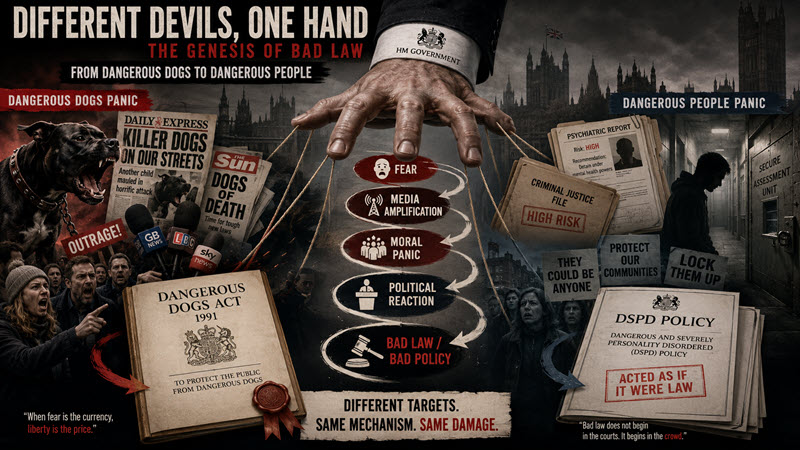
The mechanism works like this: A real harm occurs. The press seizes it. Fear swells past the size of the threat. A villain is named. And then, under pressure to be seen acting, government reaches for a law, or a target, built around the headline rather than the problem.
The claim here is simple. Bad law and bad policy share a genesis. The same forces that rush a flawed statute onto the books also drive a flawed policy through Whitehall. Statute gets the scrutiny of Parliament. Policy often gets none or rather less. So the pattern runs quieter in policy, and sometimes does more damage.
We will start with the stories. The devil dogs. A murder in Kent that reshaped the way mental health law operated. A target for cutting suicide that landed on people who could not deliver it. Only later will we name the machinery that connects them. Those interested in the DSPD part of this article can click 5. A Diagnosis by Decree.
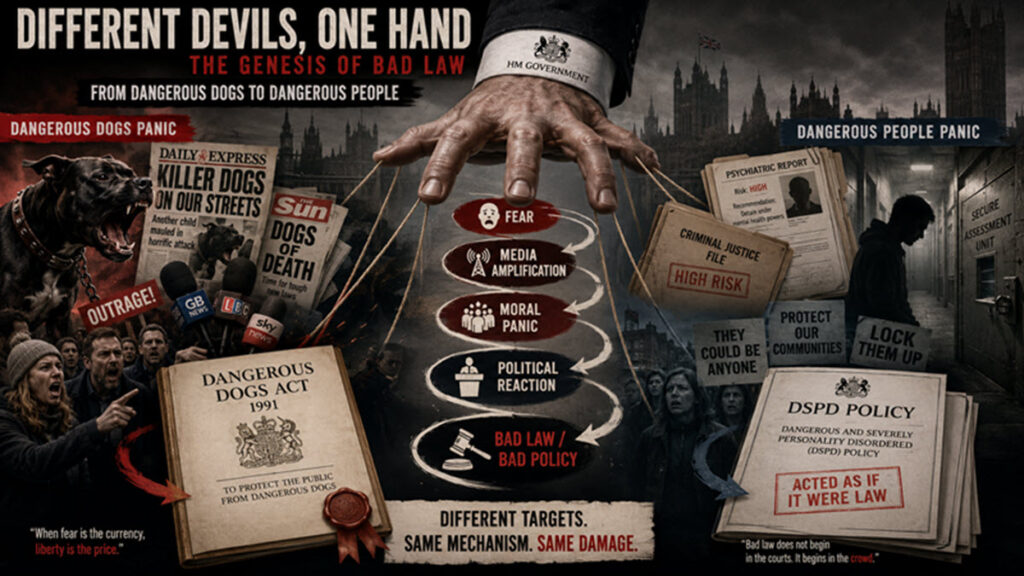
1. The Devil in the Headline
The summer of 1991 belonged to the “devil dog”.
The phrase was everywhere. It ran across front pages in heavy type. Each new attack became national news, and there were more of them to report, because everyone was now looking. A bite that would once have stayed a local matter became fresh proof of a spreading menace.
The dogs were real. So were the wounds. Rukhsana Khan in Bradford. Frank Tempest in Lincoln, savaged so badly the coverage dwelt on every detail. These were not invented cases. That is worth holding onto, because it is the part people forget. The fear had a true seed. What grew from it did not match its size.
Two villains took shape. One was the dog, cast as a beast built for violence. The other was the owner, the wrong sort, keeping a hard dog for menace or status. A national mood formed fast. Something had to be done. Almost nobody stood up to say otherwise.
Kenneth Baker was Home Secretary. He moved quickly, and he said so plainly. The Bill was drawn, debated, and passed in a matter of weeks. It received Royal Assent on 25 July 1991. Section 1 banned four “types” of dog by their breeding: the pit bull terrier, the Japanese Tosa, the Dogo Argentino and the Fila Brasileiro.
Then the trouble started. The law spoke of a “type”, not a recognised breed. That single word bred years of dispute. How do you prove a dog is a “type”? Courts filled with argument over the shape of a dog’s skull and the length of its leg. The original rules demanded destruction with little room for a magistrate to think. That proved so harsh it had to be undone. The Dangerous Dogs (Amendment) Act 1997 handed some discretion back to the courts.
A law passed to calm a fear had to be repaired to work at all. This is the cleanest example of the pattern, which is why it leads. A real harm. A press frenzy. A named devil. A statute rushed out to be seen, not to be sound. And a long tail of mending once the cameras had gone.
Hold the shape of it in mind. You are about to see it again, in a place far stranger than a dog.
2. When Fear Wrote the Statute Book
The dogs were not a one-off. Once you know the shape, you see it across the statute book.
Go back to the early 1980s. The panic then was about “video nasties”. Home video was new. Cheap horror films could be rented without a gatekeeper. Campaigners warned that violent tape was rotting the minds of the young. Mary Whitehouse lent her voice. Newspapers supplied the outrage. The Director of Public Prosecutions drew up a list of titles to charge.
The result was the Video Recordings Act 1984. It built a full classification regime for video. The fright ran well ahead of any firm proof that the tapes did the harm claimed. The law answered the mood, not the evidence.
Move forward a decade. Now the villain was the raver. The acid house scene had spread across fields and warehouses. The music was strange to those in power, and the crowds were large. The answer was the Criminal Justice and Public Order Act 1994. Part of it took aim at open-air gatherings. It reached for a definition of the music itself. Sound “wholly or predominantly characterised by the emission of a succession of repetitive beats”.
Read that again. A statute that must describe a genre by its rhythm has wandered somewhere odd. The same Act swept up travellers, squatters and hunt saboteurs. A single law aimed at a whole cast of folk devils at once.
Then there is Section 28. It arrived in the Local Government Act 1988. It barred councils from the “promotion” of homosexuality. It grew from the fear of the AIDS years, fed by press tales about books on school shelves. In practice it prosecuted almost no one. Its work was done by chill. Teachers grew wary. Support for young people thinned. It stood on the books until 2003, when it was repealed.
Three laws. Three decades. Three different devils. A corrupting tape, a beat in a field, a lesson in a classroom.
The trigger changed each time. The mechanism did not.
3. The Same Hand in Policy
So far, every example is a law. Parliament sat. A Bill was read. There was, at least, a debate to sit through and a vote to win.
Policy needs none of that. A minister can announce a target from a podium. No reading. No vote. No amendment stage where a flaw might be caught. The scrutiny that slows a bad Bill is simply not there. That makes policy the softer route for the same forces. Quicker to launch, and harder to question.
Take suicide. In July 1992, the government published a White Paper, The Health of the Nation. Mental illness was one of its chosen areas. Suicide carried a headline target. Cut the overall suicide rate by at least 15 per cent by the year 2000, against a 1990 baseline of 11 per 100,000. For people with severe mental illness, the aim was steeper still. A reduction of a third.
Virginia Bottomley was the Secretary of State who owned it. She announced it, defended it, and held the system to it. The strategy had been building before she arrived, so she was more the amplifier than the authors. But it was her voice that gave the number its force, and her department that pushed it down the line.
And down the line it went. A target set in Whitehall becomes a stick in a clinic. Trusts answered for it, then teams, then the individual clinician sat with a patient. Yet suicide turns on things no clinician holds. Unemployment. Poverty. Access to the means. A rate set as a national goal was handed to people who could not move it alone.
There is a deeper flaw, and it is worth stating plainly. Suicide is rare at the level of any one team. Rare events jump about from year to year for no reason but chance. The numbers wobble on their own. So a service can be blamed for a “rise” that is only noise, or praised for a “fall” that is only luck. A percentage target laid over that kind of data means very little. It still drove real pressure on real people.
The target did not die with the decade. In 1999, a new White Paper, Saving Lives: Our Healthier Nation, renewed it. The wording shifted. The logic held. The same instinct rolled straight from one government into the next.
No Bill. No vote. No debate. And a burden pushed onto the very people least able to carry it.
4. Naming the Machinery
Now the theory. You have seen it work three times over. Here is what it is called.
Start with the spiral. In the 1960s, the criminologist Leslie Wilkins described a loop he called deviancy amplification. It runs like this. Society reacts to an act it dislikes. The reaction pushes the group further out. Being pushed out, the group is watched more closely. Closer watching finds more of the act. More of the act feeds a stronger reaction. Round it goes, each turn tighter than the last.
The press is the engine of that loop. Sensitised reporting looks for the thing it fears. Looking, it finds it. Finding it, it reports it. The finding confirms the fear that started the search.
Then came Stanley Cohen. In 1972 he gave us the fuller frame, in a book with a title that has outlived most of its rivals. Folk Devils and Moral Panics. Cohen studied clashes between Mods and Rockers at English seaside towns. From them he drew a sequence.
A condition or group is cast as a threat. The media give it a simple, hostile shape. A “folk devil” is named. Right-thinking people close ranks. Those in authority feel the pressure to respond. And then they do.
That is the arc behind every case so far. The dog. The tape. The beat. The number. There is a third term worth holding. Penal populism, named by the criminologist John Pratt. It marks the moment politics enters. Politicians sense the public mood and reach for punishment as a way to ride it. The tougher the stance, the better it plays. Evidence takes a back seat to the applause.
One point matters more than any of these names. It is the point a reader must not miss. Nobody inside the process feels it as a panic.
The minister does not stand at the podium thinking, I am the servant of a moral panic. The drafter does not write, this clause exists because a newspaper was frightened. They feel resolve. They feel duty. They feel that a plain danger has, at last, been met with plain action. The label comes later, from outside, once the whole shape can be seen. That is why you will never find a confession. There is nobody to confess. The people involved were, in their own minds, simply doing the right thing.
Keep that in view for what comes next. Because the next case is the one where the machinery reached furthest. It reached into a diagnosis.
5. A Diagnosis by Decree
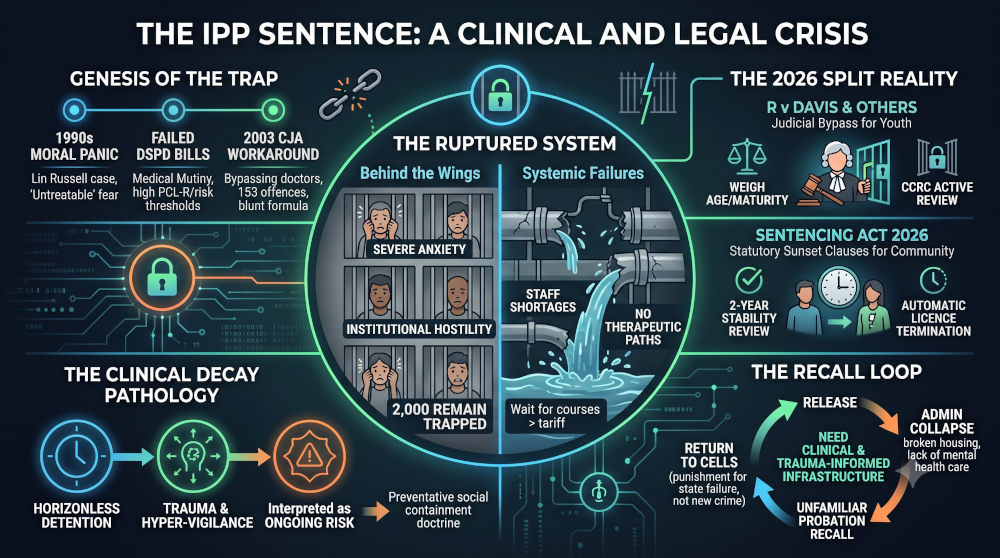
The trigger this time was a murder. In 1996, Lin Russell and her daughter Megan were killed in Kent. Josie, the other daughter, survived a savage attack. In 1998 a man named Michael Stone was convicted of the murders. He had a personality disorder, in the antisocial and psychopathic range. The story that took hold was a specific one. Stone had sought help. He had been judged untreatable. And because he was untreatable, he could not be held. A dangerous man had, in the phrase of the day, slipped through the net. That story had teeth because it named a real gap in the law.
Under the Mental Health Act 1983, detention for psychopathic disorder came with a test. Treatment had to be likely to help. If it was not, the ground for holding the person fell away. So the case did not just stir feeling. It pointed at a clause. Campaigners had a target they could name. The press worked the frame hard. Untreatable, and free. Psychiatry took much of the blame. Jack Straw, then Home Secretary, was openly cross with the profession. The message was blunt. Doctors were using a loophole to wash their hands of dangerous men. A second current fed in. In 1999, the Fallon Inquiry reported on the Personality Disorder Unit at Ashworth, a high secure hospital. It found serious disorder inside the very place meant to contain it. That deepened the sense of a service failing at its core.
6. Enter DSPD now forgotten by many
The DSPD (Dangerous and Severe Personality Disorder) project remains one of the most contentious episodes in modern UK forensic psychiatry. It represents a rare instance where the executive branch attempted to fundamentally alter the purpose of psychiatry—shifting it from a treatment-oriented discipline to a risk-containment arm of the criminal justice system—without successfully passing primary legislation.
The Lead-up: A Political Imperative (1997–2001)
The impetus was born from a series of high-profile, violent crimes committed by individuals with personality disorders who had been released from prison or hospital. The public and media outcry demanded a solution for offenders who were deemed too “dangerous” to release but who did not meet the criteria for “mental illness” under the Mental Health Act 1983.
- The Conceptual Shift: The government proposed a new legal category for those who displayed:
- A severe personality disorder.
- A high risk of committing a serious offence.
- A functional link between the disorder and the risk.
- The Conflict: The proposal sought to allow for the indefinite, preventive detention of these individuals. This immediately collided with the “treatability” test of the 1983 Act, which required that appropriate treatment be available if a patient was to be detained.
The Legislative Failure (2001–2006)
The government’s ambition to rewrite the Mental Health Act faced immense resistance. The Royal College of Psychiatrists, legal scholars, and civil liberties groups mounted a sustained campaign against the “DSPD” category.
- The Ethical Blockade: Critics argued that “dangerousness” is not a medical diagnosis and that detaining people for crimes they had not yet committed (preventive detention) violated the European Convention on Human Rights.
- The Parliamentary Impasse: When the Draft Mental Health Bill was presented, the backlash was so severe that it was eventually withdrawn. The proposed “DSPD” category proved too legally and ethically toxic to secure a parliamentary majority. The government had failed to create a “DSPD Law.”
The “Shadow” Implementation (2001–2013)
Unable to change the law, the government opted for a “policy-led” strategy. They established the DSPD Programme, utilising existing legislative frameworks (both prison sentences and existing MHA powers) to create a de facto detention system.
- Infrastructure: The Home Office and Department of Health jointly funded high-security units (e.g., at HMP Whitemoor and Broadmoor). These were specifically designed to manage the “DSPD cohort.”
- Administrative Coercion: By creating these bespoke units, the government shifted the clinical landscape. Psychiatrists were under immense pressure to admit and “treat” patients within these units to satisfy the government’s risk-management criteria.
- Treatability Re-defined: To justify the detention, the policy insisted that personality disorder was treatable. This effectively bypassed the traditional clinical debates by institutionalising the idea that as long as there is an intensive unit, there is “treatment.”
The Legacy: Practice as Law
Even though the DSPD category never appeared on the statute books, its existence as an operational policy fundamentally recalibrated forensic practice:
- Risk as the Primary Metric: The project institutionalised the use of structured risk assessment tools (such as the HCR-20). What began as a tool for decision-making became the de facto basis for clinical legitimacy. Forensic psychiatry became, in practice, a risk-management discipline.
- The “OPD” Evolution: When the formal DSPD programme closed in 2013, it was not replaced by a return to pre-DSPD normalcy. Instead, it was replaced by the Offender Personality Disorder (OPD) Pathway. This inherited the DSPD’s infrastructure and its focus on risk-informed management, effectively normalising the integration of psychiatric services into the criminal justice pipeline.
- Entrenchment of Coercive Culture: The era taught the state that it does not need a specific Act to control a population if it controls the resources and sets the professional standard. The “treatability” criteria, which were once a protective mechanism for patients, were effectively hollowed out. Today, if a patient is deemed “dangerous,” the question is rarely “is this a treatable mental illness?” but rather “how can we manage this risk?”
Summary
The DSPD project was a triumph of policy over law. It succeeded because it created a reality on the ground—units, funding, and career paths—that made “DSPD” feel like a settled legal fact for the generation of clinicians who worked through it.
Here is the part that should give a reader pause. DSPD was not a clinical diagnosis. You will not find it in the DSM. You will not find it in the ICD. It was built from administrative will – the political administration: a severe personality disorder, a high level of dangerousness, and a functional link between the two. It was assembled by policy, then handed to clinicians as though it were a thing to be treated. In effect it was a politico-legal diagnosis. Many psychiatrists fought for it!
The Mental Health Act 2007 then scrapped the old treatability test and put in its place a broader one, the “appropriate medical treatment” test. It also gathered mental disorder under a single wide definition. The Stone gap was closed.
Then the verdict came in. The units cost a great deal. The evaluations that followed were unkind. The cost per place was very high. The number of people moved through was low. The evidence that the units cut reoffending, or brought lasting clinical change, was thin. By around 2011 the programme was being wound down, folded into a quieter, prison-led model, the Offender Personality Disorder pathway.
This is the pattern at its furthest reach. Not a law about dogs. Not a target on a chart. A political idea dressed as a diagnosis, given wards and beds and staff, then stood down when the evidence would not hold it up.
6. The Case That Complicates
Moving on – on 13 March 1996, a man walked into a primary school in Dunblane. He killed sixteen children and their teacher, then himself. It remains the worst attack of its kind in British history.
The reaction was swift. A public campaign followed, the Snowdrop Petition, gathering names in their hundreds of thousands. Within a year, Parliament acted. Two statutes, the Firearms (Amendment) Acts of 1997, banned private handguns almost entirely.
Look at the shape. A real harm, of the gravest kind. A press response at full volume. A campaign. A statute passed at speed under public pressure. On the face of it, the same arc as the dogs.
So why set it apart? Because the pattern describes how a law is made, not whether it is good. The two are separate questions. A law born in the heat of a panic can still be sound. A law born in calm deliberation can still be poor. The genesis tells you about the process. It does not settle the merit.
Many judge the handgun ban to be sound. Britain has had no school shooting of that kind since. Others contest the causal claim, and the debate on firearms policy is live to this day. I will not try to resolve it here.
That is the point of including it. If every rushed, press-driven law were bad, the argument would be too neat to trust. It would be a trick. The truth is harder. The process can produce a poor law, as it did with the dogs. It can produce a defensible one, as many hold it did after Dunblane. The genesis raises the risk of a bad outcome. It does not guarantee one.
Hold both thoughts at once. That is what makes the pattern worth understanding, rather than merely accusing.
7. Reading the Pattern
Set the cases side by side. A mauled child, and a law that had to be mended. A tape, a beat, a lesson, each met with a statute aimed at a devil. A murder in Kent, and a diagnosis conjured by decree. A number on a chart, pressed onto clinicians who could not move it. And a school in Dunblane, where the same forces produced a law many are glad to keep.
The trigger changes every time. The machinery does not.
A real harm occurs. The press gives it a simple, frightening shape. Fear outgrows the threat. A villain is named. Those in power feel they must be seen to act. And so they reach for a law, or a target, cut to fit the headline rather than the problem.
The lesson is not that action is wrong. Some of these harms demanded a response. The lesson is about the conditions under which we act. Speed is the enemy. So is the sense that doing something, anything, is proof of resolve. So is the comfort of a named devil, which lets us feel the problem is solved once the devil is caught.
Policy deserves the closer eye. A Bill, for all its faults, must survive a reading and a vote. A target need survive nothing but a podium. It can be announced in a morning and pushed down the line by afternoon, with none of the friction that might catch its flaws. The quiet route is the dangerous one.
And remember the thing no report will tell you. Nobody in the room felt it as a panic. They felt duty. They felt resolve. They were, in their own eyes, meeting a plain danger with plain action. That is why the pattern survives. Not because bad people keep making bad laws. Because good people, under pressure, keep mistaking speed for wisdom, and a headline for the truth beneath it.
The dog. The tape. The beat. The diagnosis. The number. Different devils. Mechanisms at work.
A last word on a single word.
Look at the two titles again. The Dangerous Dogs Act. Dangerous and Severe Personality Disorder. The same adjective, doing the same work, a decade apart. “Dangerous” is the panic word. It turns attention from what a thing is to what it might do. A breed becomes a threat. Certain kinds of patient become a thread to society. Both laws classify by predicted harm. The dog need not have bitten. The person need not have offended.
Once the label reads “dangerous”, the case for acting seems to make itself, and the harder questions grow quiet. That is the move to watch for. When a law is built on what might happen, ask who decided, on what evidence, and who carries the cost if the expected outcome is wrong.