


Estimated reading time at 200 wpm: 10 minutes
The ICD-11 Clinical Descriptions and Diagnostic Requirements (CDDR) sets out the diagnostic criteria for schizophrenia under code 6A20 with admirable clarity. At least two symptoms from a list of seven, at least one drawn from the core positive group — persistent delusions, persistent hallucinations, disorganised thinking, or experiences of influence, passivity, or control. Symptoms present most of the time for one month or more. And then, at the end of the essential features, a single sentence: the symptoms must not be a manifestation of another medical condition, and must not be due to the effects of a substance or medication on the central nervous system, including withdrawal.
Whether or not you agree our Fat Disclaimer applies
That sentence is an exclusion criterion. It looks straightforward. In a first presentation — a patient who has never received a diagnosis of schizophrenia — it functions as a necessary gate. If the psychotic picture is entirely attributable to substances or an organic condition, schizophrenia is not diagnosed. That is sensible, and uncontroversial.
Choppy diagnoses
But the same sentence, applied to a patient who has carried a diagnosis of schizophrenia for years, can produce a different result.
Consider this scenario:
- A patient with well-established schizophrenia uses substances and becomes more symptomatic.
- A colleague applies the exclusion criterion rigidly
- The symptoms are now due to substances; therefore schizophrenia cannot be diagnosed.
- The diagnosis is erased. Treatment stops. The patient deteriorates.
This is not merely a hypothetical scenario. It has happened. And the irony is that the CDDR, read as a whole, does not require this outcome. The essential features of 6A20 are drafted for the de novo diagnostic question. Other provisions — scattered across the grouping description, the course specifiers, and the symptom specifier guidance — make clear that an established diagnosis carries forward. The difficulty is that these provisions are not collected in one place. The clinician who reads only the essential features of 6A20, and treats them as a standalone algorithm to be re-run at every presentation, will miss them.
This article examines what the CDDR actually says about the continuity of a schizophrenia diagnosis when substances or organic factors enter the picture. It does not propose new criteria. It assembles provisions already present in the document that, taken together, prevent the exclusion criterion from operating as a guillotine.
A flowchart for the real world
The flowchart is an attempt to represent the diagnostic framework as it operates in practice.
It opens with a question that the essential features of 6A20 do not ask: does this patient already carry a diagnosis of schizophrenia?
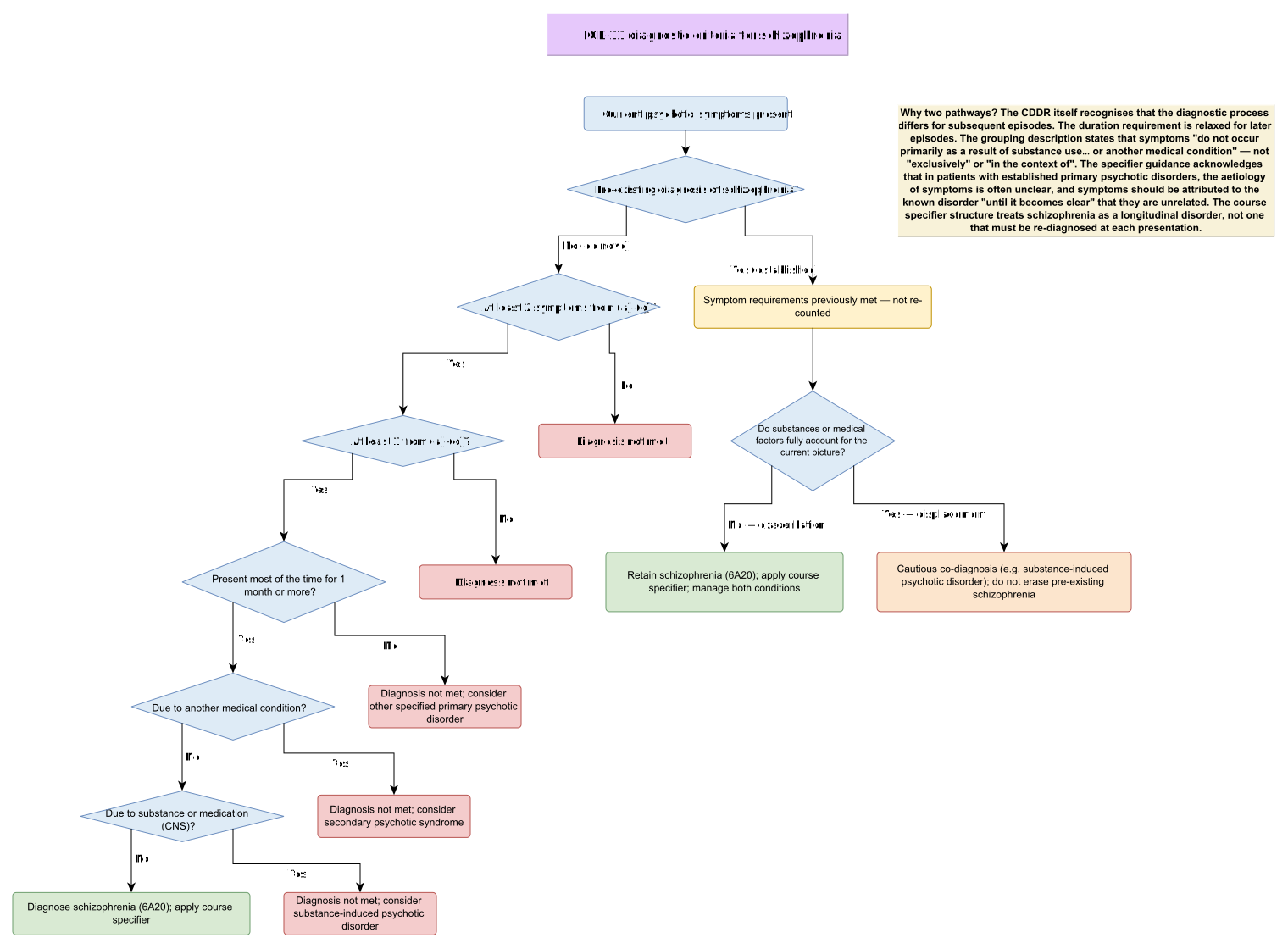
The left-hand path follows the familiar sequence from the essential features: symptom count, the core-symptom gate requiring at least one from (a)–(d), the one-month duration requirement, and the organic exclusion. This is the de novo diagnostic algorithm. If the answer at any gate is no, the diagnosis is not met.
The right-hand path starts from the same place — current psychotic symptoms from the list — but arrives at a different question. It does not ask whether substances or organic factors are present. It asks whether they fully account for the current picture, displacing rather than exacerbating the pre-existing schizophrenia. If the answer is no — exacerbation rather than displacement — the diagnosis is retained and both conditions are managed. If the answer is yes, the clinician may co-diagnose a substance-induced psychotic disorder or secondary psychotic syndrome for the current episode, but the pre-existing schizophrenia diagnosis is not erased.
The distinction between the two paths turns on the word “primarily,” which appears in the grouping description for schizophrenia and other primary psychotic disorders. The CDDR states that symptoms “do not occur primarily as a result of substance use… or another medical condition” — not “do not occur in the context of,” and not “do not co-occur with.” A patient with established schizophrenia whose symptoms are exacerbated by substances is not experiencing symptoms that occur primarily as a result of substance use. The schizophrenia is primary; the substance use is a contributory or exacerbating factor. That single word provides the textual foothold for the right-hand path.
The flowchart is not a substitute for the CDDR, nor for clinical judgement. It is an aid — a visual reminder that the diagnostic process operates differently when a diagnosis is already established. The remainder of this article sets out the CDDR provisions that support that distinction.
What the CDDR supplies for diagnostic continuity
If the exclusion criterion in the essential features of 6A20 were the only relevant provision, the flowchart’s right-hand path would have no textual basis. It would be clinical intuition dressed up as diagnostic reasoning. But the CDDR, read as a whole, supplies several provisions that together support the distinction the flowchart draws.
The relaxed duration requirement
The multiple episodes specifier for schizophrenia contains a note that, read carefully, has implications beyond duration alone:
“Note that the 1-month duration requirement for the first episode does not necessarily need to be met for subsequent episodes“.
This is not a suggestion. It is a formal note within the specifier requirements, and it appears in both schizophrenia, multiple episodes, currently symptomatic and schizoaffective disorder, multiple episodes, currently symptomatic. The CDDR is stating plainly that once the diagnosis is established, the clinician is not required to re-validate the full duration criterion at each subsequent episode.
If the duration requirement is relaxed, the implication is clear: the CDDR does not treat subsequent episodes as fresh diagnostic events that must independently satisfy every gate in the essential features. The diagnosis carries forward. The same logic extends to the exclusion criterion: if the duration gate is not rigidly re-applied, neither should the organic exclusion be — unless the clinical picture has fundamentally changed.
Diagnostic conservatism codified
The symptom specifier guidance contains a passage that is rarely cited in discussions of the diagnostic threshold, but it is directly relevant:
“However, in individuals with schizophrenia and other primary psychotic disorders, the specific etiology of symptoms is often unclear (e.g. whether a mood symptom is due to the psychotic disorder or a result of substance use). In these cases, the relevant symptom should be considered in making the specifier rating until it becomes clear that the pathogenesis of the symptom is unrelated to the primary psychotic disorder”.
This is a principle of diagnostic conservatism. The CDDR acknowledges that when a patient has an established primary psychotic disorder and co-occurring substance use, the aetiology of individual symptoms is frequently indeterminate. The instruction is to attribute symptoms to the known disorder until the evidence decisively points elsewhere.
Strictly, this passage addresses specifier ratings, not the diagnostic threshold itself. But its logic extends naturally. If the CDDR defaults to retaining attribution for individual symptoms, it is inconsistent to argue that the same document demands the entire diagnosis be suspended whenever substances are present. The burden is on displacing the diagnosis, not on retaining it.
Re-emergence is still the same disorder
The “in partial remission” specifier for both first episode and multiple episodes contains a note:
“Note: this category may also be used to designate the re-emergence of subthreshold symptoms of schizophrenia following an asymptomatic period in a person who has previously met the diagnostic requirements for schizophrenia”.
The phrase “re-emergence” is telling. It treats the return of symptoms not as a new diagnostic puzzle but as the same disorder, resurfacing. The specifier system assumes continuity. A patient with known schizophrenia who relapses — whether or not substances are involved — is experiencing a re-emergence of the existing condition. The diagnosis does not need to be earned again.
Co-diagnosis is already in the manual
The CDDR contains several explicit acknowledgements that a new condition can develop alongside a pre-existing psychotic disorder without displacing it. The boundary discussion for delusional disorder states:
“In cases where dementia has developed in someone with an established diagnosis of delusional disorder, both diagnoses may be assigned”.
For post-traumatic stress disorder, the same principle applies: “post-traumatic stress disorder and schizophrenia frequently co-occur, and both diagnoses should be assigned when the diagnostic requirements for each are met”.
And in the catatonia section, the instruction is direct: “Note: the associated mental disorder should be diagnosed separately”.
None of these examples involves schizophrenia and substance-induced psychotic disorder specifically, but the principle they establish is clear and transferable. The CDDR recognises co-occurrence. It does not treat a new diagnosis as automatically voiding an existing one. If dementia and delusional disorder can coexist, and PTSD and schizophrenia can coexist, there is no textual reason to treat schizophrenia and a substance-induced episode as mutually exclusive — provided the schizophrenia diagnosis was properly established and the current picture is not primarily attributable to substances.
The harm of rigid application
None of this is academic. The scenario described in the introduction — a patient with years of well-established schizophrenia whose diagnosis is erased because a colleague applies the exclusion criterion as an absolute gate — produces real harm.
When a schizophrenia diagnosis is removed, treatment typically stops. Antipsychotic medication is discontinued. The care team may be reassigned. If the patient is detained under mental health legislation and lacks capacity to consent to treatment, a second-opinion doctor must be sought to restart medication — a process that can take weeks. During that time, the patient is untreated. The underlying schizophrenia, now unmedicated, worsens. The substance-induced episode may resolve, but what remains is a patient with untreated schizophrenia who has been made more unwell by the gap in care.
The irony is that the rigid reading of the criteria, intended to protect patients from misdiagnosis, ends up harming them. The de novo diagnostic gate, applied to a patient for whom the diagnostic question was answered years ago, becomes an instrument of treatment interruption.
The CDDR does not require this outcome. The provisions described above — the word “primarily,” the relaxed duration requirement, the specifier conservatism, the re-emergence notes, and the co-diagnosis principles — together make clear that an established diagnosis carries forward unless the evidence decisively displaces it. The flowchart’s right-hand path is not a departure from the CDDR. It is what the CDDR, read as a whole, already supports.
Limitations
This flowchart does not address differential diagnosis. The CDDR contains detailed boundary guidance for schizophrenia in relation to schizoaffective disorder, acute and transient psychotic disorder, delusional disorder, mood disorders with psychotic symptoms, and post-traumatic stress disorder. None of these is represented. The flowchart also does not incorporate the cultural considerations that the CDDR sets out in detail, including the increased risk of misdiagnosis in ethnic minority and migrant groups, or the developmental considerations relevant to assessing psychotic symptoms in children and adolescents.
More fundamentally, the attribution question itself — determining whether substances or organic factors “fully account for” the current picture — is inherently difficult. The flowchart identifies the question but cannot answer it. That requires clinical judgement, collateral history, longitudinal observation, and often the passage of time. The flowchart is an aid, not a substitute for any of these.
It is offered as a tool for colleagues — a visual reminder that the diagnostic process operates differently when a diagnosis is already established, and that the CDDR, read carefully, supports that distinction.