


Estimated reading time at 200 wpm: 28 minutes
“Safe and appropriate” sits at the heart of the professional standards that govern prescribing in the UK. The General Medical Council (GMC) makes it clear that doctors must propose, prescribe, provide or manage medicines and devices only when it is safe and appropriate to do so (GMCRx – Prescribing Guidance – para 97).
Whether or not you agree our Fat Disclaimer applies
Nowhere in the GMC’s core guidance is there a single, self‑contained definition of either “safe” or “appropriate”. There is no further guidance on ‘how safe’ or ‘how appropriate’. The GMC has been ‘quietly’ sharpening their guillotine. Most people do not read GMC guidance because the simply hate the GMC. That’s fine – everybody has individual choice in a ‘free and democratic society’, or so they think.
The GMC is not an inspectorate of their own standards. They just sit there waiting for complaints to land in their lap. Then they come alive. Many doctors who are hauled before the GMC get a surprise. How would I know? I was a former GMC examiner and supervisor, and gave expert opinion to the GMC. I’ve seen the whites in doctors’ eyes, when the guillotine is about to strike.
If you hate anything to do with the GMC – exit to play dice with your career. Roll the the wrong numbers to find out what happens next.
Instead, the criteria are distributed across four documents that work together as an interlocking framework:
- GMP – Good medical practice (2024)
- GMCRx – Good practice in proposing, prescribing, providing and managing medicines and devices (2021, updated 2024)
- DMC – Decision making and consent (2020, updated 2024)
- GMCCx – Confidentiality: good practice in handling patient information (2017, updated 2024)
Safe prescribing means you have enough reliable information, a suitable mode of consultation, arrangements for monitoring, and safeguards against harm (GMCRx paras 19–32; GMP para 7d).
Appropriate prescribing means the treatment matches the patient’s condition, is based on evidence, reflects their values and preferences, and makes responsible use of resources (GMP paras 6–7; DMC paras 10, 17–20). These two standards are different—a treatment can be safe but inappropriate, or appropriate but unsafe—and they must both be satisfied.
The four documents do not sit in isolation. A decision made under GMCRx immediately triggers duties in DMC (dialogue, capacity, consent) and GMCCx (information‑sharing), all under the overarching principles in GMP. This cascade is the key to understanding what the GMC expects. Every paragraph reference in this article is traceable to the source documents, so you can check the original guidance whenever you need to.
If you come to an idea that this article is sensationalist or scare-mongering, kindly stop and move on.
The Cascade at a Glance
The GMC’s professional standards are designed as a single integrated framework. GMCRx, the prescribing‑specific guidance, repeatedly points outward: to GMP for the foundational duties of assessment and record‑keeping (GMCRx para 19; GMP paras 6–7), to DMC for the detailed standards on capacity and consent (GMCRx para 41; DMC paras 76–91), and to GMCCx for the framework on sharing information and managing patient objections (GMCRx paras 28–31, 52–57; GMCCx paras 28–33). A clinician who reads only GMCRx will miss critical duties that bear directly on whether a prescription is safe and appropriate.
The diagram below shows how a single prescribing decision triggers duties across all four documents.
Propose, prescribe or provide
a medicine or device
(GMCRx para 19; GMP paras 6‑7)
Access to records · verify by exam · other medicines & providers
and consent
Capacity · patient’s needs & values · benefits, risks, options
after care
GP notification · monitoring · patient objections & safeguards
The cascade works as a sequence of questions that follow from your decision to prescribe:
- Do you have adequate knowledge of the patient’s health? This leads to GMP (adequate assessment, physical examination where needed) and back into GMCRx (history‑taking, verifying information, contacting the patient’s GP) (GMP paras 7a–b; GMCRx paras 26–28, 34).
- Can you establish a dialogue and obtain consent? This leads to DMC (information‑giving, exploring what matters to the patient, assessing capacity, obtaining valid consent) (DMC paras 10, 17–20, 76–86; GMCRx paras 33, 49).
- Can you share information appropriately after care? This leads to GMCCx (implied consent for direct care, managing patient objections, public interest justifications) (GMCCx paras 28–31; GMCRx paras 52–57).
- Are suitable monitoring and review arrangements in place? This leads back to GMP and GMCRx (reviewing medicines, repeat prescribing safeguards) (GMP para 13; GMCRx paras 92–101).
The cascade is not linear—these duties are concurrent and mutually reinforcing. A failure at any point can render a prescribing decision unsafe, inappropriate, or both. The tables that follow set out the specific criteria, organised by clinical moment, so you can find what you need in the time you have.
This website is perfectly independent. No sponsors, no pay per click in the background. Zero influence from anyone.
Safe vs Appropriate
The cascade diagram above shows how a single decision triggers duties in all four guidance documents. The table below summarises what each document contributes.
| Document | Role |
|---|---|
| GMP | Overarching duties: assess adequately, prescribe only with sufficient knowledge, base treatment on evidence, obtain consent, keep records, share information, use resources well |
| GMCRx | Translates GMP into specific, actionable prescribing criteria—the first document to turn to |
| DMC | Detailed standards for dialogue, capacity, and consent—the foundation of both safety and appropriateness |
| GMCCx | Framework for information-sharing—essential because incomplete information can make prescribing unsafe, and overriding a patient’s objections can make it inappropriate |
It should be obvious that a totally inappropriate treatment is likely to be unsafe. The two axes below show how safety and appropriateness are different things, and where they overlap. The graphic is simplified and cannot contain ‘everything’.
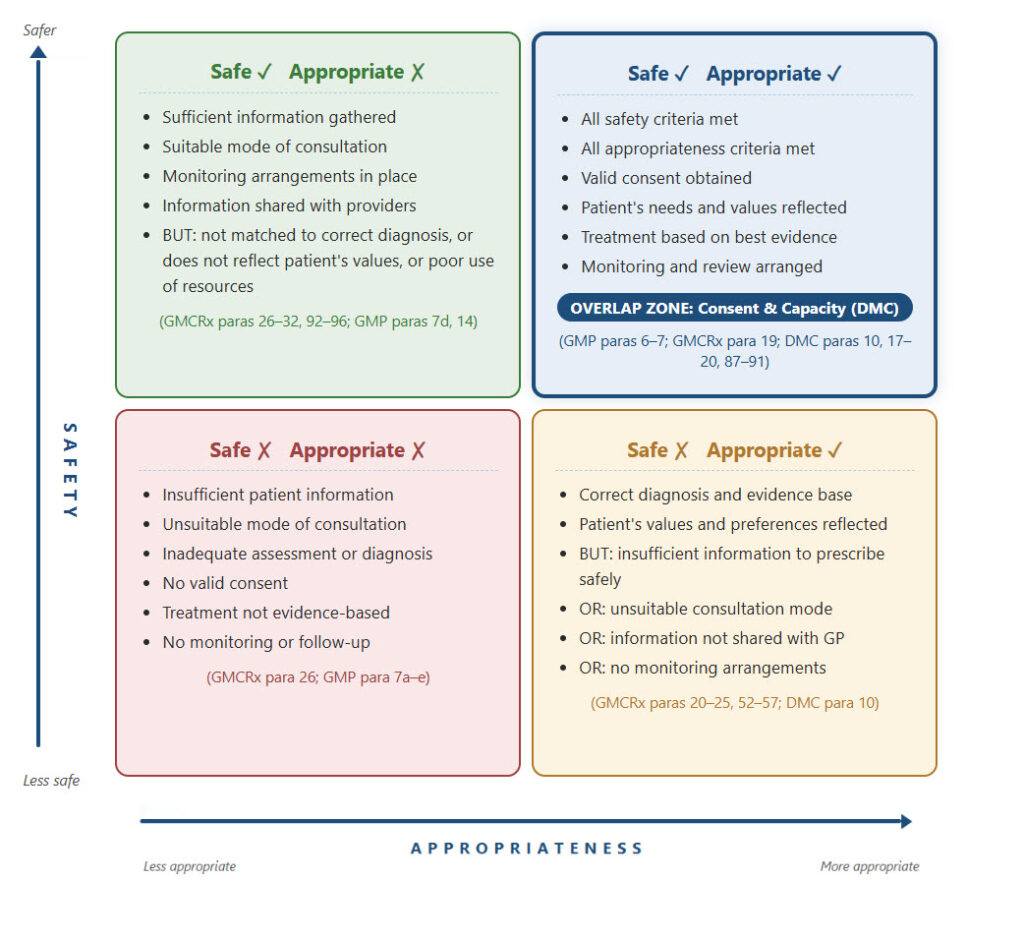
Safe is about avoiding harm: the right information, the right consultation mode, the right monitoring. Appropriate is about getting the treatment right: the right diagnosis, the right evidence base, the right fit with the patient’s values. The overlap zone—where consent, capacity, and information-sharing sit—is where both are applied simultaneously.
Before You Prescribe (according to the GMC)
The foundation of safe and appropriate prescribing is laid before a prescription is signed. The table below sets out the key criteria.
| Factor | Requirement | Source |
|---|---|---|
| Adequate knowledge | You must have adequate knowledge of the patient’s health and be satisfied the medicine meets their needs | GMP para 7d; GMCRx para 19 |
| Adequate assessment | Assess the patient’s condition, taking account of history (symptoms, psychological, social, cultural factors, the patient’s views, needs, and values) | GMP paras 7a–b |
| Physical examination | Carry out a physical examination where necessary; must examine before prescribing injectable cosmetic medicines remotely—this is an absolute prohibition | GMCRx para 25; GMP para 7b |
| Sufficient information | Consider whether you have enough reliable information. This means access to medical records or other reliable sources, ability to verify by examination or testing, and awareness of other medicines the patient may be taking | GMCRx paras 26–27 |
| History-taking | Take an adequate history: previous adverse reactions, current and recent use of other medicines (including non‑prescription, herbal, illegal, and online purchases), and other medical conditions | GMCRx para 34 |
| Evidence base | Treatment must be based on the best available evidence. Be familiar with BNF/BNFC and relevant clinical guidelines | GMP para 7e; GMCRx paras 7, 12, 14 |
| Licensed status | Usually prescribe licensed medicines in accordance with their licence. Unlicensed medicines only where necessary to meet the specific needs of the patient | GMCRx para 103 |
| Mode of consultation | Agree with the patient which mode (face‑to‑face or remote) is most suitable. If you cannot provide safe care through the mode used, offer an alternative or signpost | GMCRx para 20; GMP para 9 |
| Face‑to‑face may be needed | When unsure of capacity, when physical examination is needed, when not the usual prescriber and consent to share information is refused, when concerned about the patient’s environment or pressure from others | GMCRx para 21 |
If you are not the patient’s regular medical professional, you should ask for consent to contact their GP or other treating doctors if you need more information, and to share information with the GP when the episode of care is completed (GMCRx para 28). If the patient objects, you must be able to justify prescribing without that information (GMCRx para 29). If failing to share information could pose a risk to safety, you should explain that you cannot prescribe and signpost to alternative services (GMCRx para 31).
During the Consultation
The consultation itself is where safety and appropriateness converge. The table below sets out what must happen.
| Factor | Requirement | Source |
|---|---|---|
| Dialogue | Establish a two‑way dialogue so both you and the patient can ask questions and get the information needed | GMCRx para 33 |
| Identify cause | Identify the likely cause of the patient’s condition and which treatments are likely to meet their needs | GMCRx para 38 |
| Reach agreement | Reach agreement with the patient on the proposed treatment, explaining benefits, risks, side effects, how and when to take the medicine, duration, and monitoring arrangements | GMCRx para 39 |
| Assess capacity | Start from the presumption that every adult has capacity. But you do not assume capacity and amputate a patient’s leg, so don’t assume capacity and dish out whatever meds you feel like. The MCA 2005, Montgomery 2015 (UKSC), and McCulloch 2023 apply. Capacity is decision‑specific and time‑specific. Be very cautious with unlicenced use of medications (GMCRx 102 to 108). | GMP para 24; DMC paras 76, 81–84; GMCRx para 41 |
| Give information | Give patients the information they want or need: diagnosis, prognosis, uncertainties, options, and the benefits, risks, and likelihood of success for each option | DMC para 10; GMP para 28 |
| Find out what matters | Explore the patient’s wishes, fears, values, and priorities—what activities matter to their quality of life | DMC paras 17–20; GMP para 34 |
| Do not assume | Treat each patient as an individual. Do not rely on assumptions about what they will prefer or consider significant | GMP para 34 |
| Obtain consent | For most prescribing decisions, verbal consent is sufficient, provided the patient has had the opportunity to consider the relevant information | GMCRx para 49 |
| Do not pressurise | Do not put pressure on a patient to accept your advice. Share reasonable alternatives, including taking no action | DMC para 11 |
| Unindicated treatment | If a patient requests treatment you do not think is in their clinical interests, explore their reasons. If after discussion you still think it would not serve their needs, do not provide it, and explain why | GMCRx paras 50–51; DMC para 49 |
Consent is not a one‑off event. Review the decision immediately before providing treatment, and make sure there are clear arrangements for regular review if treatment is ongoing—particularly if time has passed, the condition has changed, or new information has become available (DMC paras 57–58).
After Prescribing
Safe and appropriate prescribing does not end when the prescription is signed. The table below sets out the post‑prescription duties.
| Factor | Requirement | Source |
|---|---|---|
| Monitoring and review | Ensure suitable arrangements are in place for monitoring, follow‑up, and review, taking account of the patient’s needs and any risks from the medicines | GMCRx para 92 |
| High‑risk patients and medicines | Review is particularly important for frail patients, those with multiple illnesses, medicines with serious or common side effects, controlled drugs, and where authoritative guidance recommends blood tests or monitoring | GMCRx para 94 |
| Information‑sharing | After an episode of care, tell the patient’s GP about changes to medicines (with reasons), length of intended treatment, monitoring requirements, and new allergies or adverse reactions | GMCRx para 55 |
| Safe transfer of care | Share all relevant information with colleagues involved in the patient’s care when handing over, delegating, or referring | GMCRx para 52; GMP para 65 |
| Patient objections | If a patient objects to information‑sharing for their own care, explain the potential consequences. If after discussion a patient with capacity still objects to disclosure of information essential for safe care, explain that you cannot refer or arrange treatment without disclosing it | GMCCx paras 30–31 |
| Records | Keep clear, accurate, contemporaneous, and legible records. Include clinical findings, drugs prescribed, information shared with patients, decisions made, and who is creating the record | GMP paras 69–70 |
| Raising concerns | Question any decision or action that may be unsafe. Raise concerns if the system does not have adequate safeguards. Do not prescribe unless it is safe to do so | GMCRx paras 83–84; GMP para 75 |
| Reporting incidents | Report adverse drug reactions via the Yellow Card Scheme. Report medical device incidents to the relevant national body. Contribute to incident reviews and investigations | GMCRx paras 85–87; GMP para 73 |
Special Circumstances
The core duties described above apply in all cases. In certain circumstances, the bar rises. The table below summarises the key heightened requirements.
| Circumstance | Key Heightened Requirement | Key Source |
|---|---|---|
| Unlicensed medicines | Must be satisfied there is sufficient evidence or experience to demonstrate safety and efficacy. Must take personal responsibility for overseeing the patient’s care, monitoring, and follow‑up. Must make a clear record of the reasons for prescribing. Must give sufficient information to allow informed consent | GMCRx paras 102–108 |
| Controlled drugs | Must not prescribe without access to relevant information from the patient’s medical records, except in defined emergencies. Must ensure robust identity checks for remote prescribing. Must not prescribe for self or those close except in emergencies. Must not prescribe for convenience where there is no clinical justification | GMCRx paras 58–65, 68 |
| Remote prescribing | Must be satisfied that the mode of consultation allows an adequate assessment, dialogue, and consent. Face‑to‑face may be more appropriate when capacity is uncertain, physical examination is needed, or the patient is under pressure. Must not prescribe injectable cosmetic medicines remotely | GMCRx paras 20–25, 61–62 |
| Patients lacking capacity | Decisions must be made on the basis of overall benefit. Consult with those close to the patient. Consider which option aligns most closely with the patient’s needs, preferences, values, and priorities, and which is least restrictive of future options | DMC paras 87–91; GMCRx paras 40–43 |
| Repeat prescribing | Must ensure the repeat prescription is safe and appropriate. Must agree a date for review. Must be satisfied that procedures for generating repeats are secure—the right patient, the right dose, monitoring, and competent staff | GMCRx paras 97–101 |
| Prescribing for self or those close | Wherever possible, must avoid. If unavoidable, must make a clear record including the relationship and the reason it was necessary. Must not prescribe controlled drugs except in defined emergencies | GMCRx paras 66–68; GMP para 97 |
Each of these circumstances triggers the full cascade of duties described in the earlier sections, but the standard of care is more demanding.
Paragraphs interconnected with GMCRx, paragraph 97
Emphasis (bold) has been added to every occurrence of must and should throughout.
1. Safe prescribing — at the point of prescribing
GMCRx, para. 4
You are responsible for your decisions and actions, and the steps you take to ensure that prescriptions are appropriate, necessary and safe.
GMCRx, para. 19
You should only propose, prescribe or provide medicines treatments and devices if you have adequate knowledge of the patient’s health, and you are satisfied that the medicines serve the patient’s needs. You must consider: a) the suitability of the mode of consultation; b) whether you have sufficient information to prescribe safely; c) whether you can establish two-way dialogue, make an adequate assessment of the patient’s needs and obtain consent; d) whether you can share information appropriately after an episode of care.
GMCRx, para. 26
You must only propose, prescribe or provide medicines, treatments or devices if it is safe to do so. a. It’s not safe to propose, prescribe or provide medications, treatment or devices if you don’t have sufficient information about the patient’s health or if the mode of consultation is unsuitable to meet their needs. b. It may be unsafe if relevant information is not shared with other healthcare providers involved in the patient’s care.
GMCRx, para. 27
Before proposing, prescribing or providing medications, treatment or devices, you must consider whether the information you have is sufficient and reliable enough to enable you to provide safe care.
GMCRx, para. 31
If failing to share information could pose a risk to patient safety, you should explain to the patient that you cannot propose, prescribe or provide medications, treatment or devices. You should outline their options and signpost them to appropriate alternative services.
GMCRx, para. 37
If it’s not possible to clarify or ask for more information from the patient in the environment you are working, you should consider whether it is safe to propose, prescribe or provide medicines, treatment or devices, and raise concerns as appropriate.
GMCRx, para. 61
If you are involved in prescribing or proposing medicines and treatments remotely, you must also be satisfied that appropriate safeguards are in place to support safe prescribing.
GMCRx, para. 75 [also under Appropriate]
If you prescribe based on the proposal or recommendation of another healthcare professional, you must be satisfied the prescription is needed, appropriate for the patient, within the limits of your competence and that you have enough information to safely proceed.
GMCRx, para. 77 [also under Appropriate]
You will be responsible for the steps you take to ensure that the prescription is appropriate, necessary and safe.
GMCRx, para. 78
If you recommend or propose that a colleague prescribe a particular medicine, treatment or device for a patient, you must consider whether they are able to do so safely. You must be satisfied they have sufficient information, experience and knowledge of the patient and the medicine, treatment or device in order to prescribe.
GMCRx, para. 97 [also under Appropriate]
You must make sure that any repeat prescription you propose or sign is safe and appropriate.
GMP, para. 9 [also under Appropriate]
You must provide safe and effective clinical care whether face to face, or through remote consultations via telephone, video link, or other online services. If you can’t provide safe care through the mode of consultation you’re using, you should offer an alternative if available, or signpost to other services.
GMCCx, para. 31
If, after discussion, a patient who has capacity to make the decision still objects to the disclosure of personal information that you are convinced is essential to provide safe care, you should explain that you cannot refer them or otherwise arrange for their treatment without also disclosing that information.
2. Appropriate prescribing — at the point of prescribing
GMCRx, para. 4 [also under Safe]
You are responsible for your decisions and actions, and the steps you take to ensure that prescriptions are appropriate, necessary and safe.
GMCRx, para. 19 [also under Safe]
You should only propose, prescribe or provide medicines treatments and devices if you have adequate knowledge of the patient’s health, and you are satisfied that the medicines serve the patient’s needs. You must consider: a) the suitability of the mode of consultation; b) whether you have sufficient information to prescribe safely; c) whether you can establish two-way dialogue, make an adequate assessment of the patient’s needs and obtain consent; d) whether you can share information appropriately after an episode of care.
GMCRx, para. 23
Before you propose, prescribe or provide medicines, treatment or devices, you must be satisfied that you can make an adequate assessment, establish a dialogue and obtain the patient’s consent through the mode of consultation you are using.
GMCRx, para. 36
If you need more information to help you decide which options would serve the patient’s needs, you must ask for it before recommending an option or proceeding with treatment.
GMCRx, para. 75 [also under Safe]
If you prescribe based on the proposal or recommendation of another healthcare professional, you must be satisfied the prescription is needed, appropriate for the patient, within the limits of your competence and that you have enough information to safely proceed.
GMCRx, para. 77 [also under Safe]
You will be responsible for the steps you take to ensure that the prescription is appropriate, necessary and safe.
GMCRx, para. 92
Whether you propose, prescribe or provide medications using repeat prescribing or on a one-off basis, you must make sure that suitable arrangements are in place for monitoring, follow-up and review. You should take account of the patients’ needs and any risks arising from the medicines.
GMCRx, para. 97 [also under Safe]
You must make sure that any repeat prescription you propose or sign is safe and appropriate.
GMP, para. 7(d)
In providing clinical care you must: propose, provide or prescribe drugs or treatment (including repeat prescriptions) only when you have adequate knowledge of the patient’s health and are satisfied that the drugs or treatment will meet their needs.
GMP, para. 7(e)
In providing clinical care you must: propose, provide or prescribe effective treatment based on the best available evidence.
GMP, para. 9 [also under Safe]
You must provide safe and effective clinical care whether face to face, or through remote consultations via telephone, video link, or other online services. If you can’t provide safe care through the mode of consultation you’re using, you should offer an alternative if available, or signpost to other services.
3. Systemic factors and escalation
GMP, para. 20
You must give priority to patients based on their clinical need if these decisions are within your power. If inadequate resources, policies, or systems prevent you from doing this – and patient safety or dignity may be seriously compromised as a result – you must follow the guidance in paragraph 75.
GMP, para. 75(b)
If patients are at risk because of inadequate premises, equipment or other resources, policies or systems, you should first protect patients and put the matter right if that’s possible. Then you must raise your concern in line with your workplace policy and our more detailed guidance on Raising and acting on concerns about patient safety.
GMP, para. 75(c)
If you have concerns that a colleague may not be fit to practise and may be putting patients at risk, you must ask for advice from a colleague, your defence body, or us. If you are still concerned, you must report this.
GMCRx, para. 83
You must protect patients from risks of harm posed by colleagues’ prescribing, administration and other medicine, treatment or device-related errors. You should question any decision or action that you consider may be unsafe.
GMCRx, para. 84
You should make patient safety your first priority and raise concerns if the service or system you are working in does not have adequate safeguards. You should not propose, provide or prescribe medicines, treatment or devices unless it is safe to do so.
GMCRx, para. 99
You must be satisfied that procedures for prescribing with repeats and for generating repeat prescriptions are secure and that: a. the right patient is issued with the correct prescription; b. the correct dose is prescribed; c. the patient’s condition is monitored; d. only staff who are competent to do so prepare repeat prescriptions for authorisation; e. patients who need further examination or assessment are reviewed by an appropriate healthcare professional; f. any changes to the patient’s medicines are critically reviewed and quickly incorporated into their record.
DMC, para. 61
If factors outside your control mean that patients aren’t given the time or support they need to understand relevant information, and this seriously compromises their ability to make informed decisions, you must consider raising a concern.
4. Foundational prescribing duties
GMP, paragraph 7(d): In providing clinical care you must: propose, provide or prescribe drugs or treatment (including repeat prescriptions) only when you have adequate knowledge of the patient’s health and are satisfied that the drugs or treatment will meet their needs
GMP, paragraph 7(e): propose, provide or prescribe effective treatment based on the best available evidence
GMCRx, paragraph 19: You should only propose, prescribe or provide medicines treatments and devices if you have adequate knowledge of the patient’s health, and you are satisfied that the medicines serve the patient’s needs (see GMP paragraphs 6-7). You must consider:
a) the suitability of the mode of consultation you are using, for example face to face or remote, taking account of any need for physical examination or other assessments (see paragraphs 20 to 25)
b) whether you have sufficient information to prescribe safely, for example if you have access to the patient’s medical records and can verify relevant information (see 26 to 32)
c) whether you can establish two-way dialogue, make an adequate assessment of the patient’s needs and obtain consent (see paragraphs 33 to 37)
d) whether you can share information appropriately after an episode of care (see paragraphs 52 to 57).
GMCRx, paragraph 26: You must only propose, prescribe or provide medicines, treatments or devices if it is safe to do so
a. It’s not safe to propose, prescribe or provide medications, treatment or devices if you don’t have sufficient information about the patient’s health or if the mode of consultation is unsuitable to meet their needs.
b. It may be unsafe if relevant information is not shared with other healthcare providers involved in the patient’s care – for example because the patient refuses consent.
5. Consent and dialogue
GMCRx, paragraph 33: You must establish a dialogue with your patient to help them consider information about their options and so they can decide whether or not to have care or treatment. Good dialogue should give both you and your patient the opportunity to ask questions to get the information you both need.
GMCRx, paragraph 36: If you need more information to help you decide which options would serve the patient’s needs, you must ask for it before recommending an option or proceeding with treatment.
GMCRx, paragraph 38: You should identify the likely cause of the patient’s condition and which treatments are likely to meet their needs.
GMCRx, paragraph 39: You should reach agreement with the patient on the proposed treatment, explaining:
a. the likely benefits, risks and impact, including serious and common side effects
b. what to do in the event of a side effect or recurrence of the condition
c. how and when to take the medicine and how to adjust the dose if necessary
d. how to use a medical device
e. the likely duration of treatment
f. any relevant arrangements for monitoring, follow-up and review, including further consultation, blood tests or other investigations, processes for adjusting the type or dose of medicine and for issuing repeat prescriptions.
DMC, paragraph 10: You must give patients the information they want or need to make a decision. This will usually include:
a. diagnosis and prognosis
b. uncertainties about the diagnosis or prognosis, including options for further investigation.
c. options for treating or managing the condition, including the option to take no action
d. the nature of each option, what would be involved, and the desired outcome
e. the potential benefits, risks of harm, uncertainties about and likelihood of success for each option, including the option to take no action.
6. Safety and escalation when compliance is impossible
GMCRx, paragraph 83: You must protect patients from risks of harm posed by colleagues’ prescribing, administration and other medicine, treatment or device-related errors. You should question any decision or action that you consider may be unsafe. You should also respond constructively to concerns raised by colleagues, patients and carers about your own practice.
GMCRx, paragraph 84: You should make patient safety your first priority and raise concerns if the service or system you are working in does not have adequate safeguards, which are relevant to the nature and mode of the consultation. This includes appropriate identity and verification checks. You should not propose, provide or prescribe medicines, treatment or devices unless it is safe to do so.
GMP, paragraph 75(b): If patients are at risk because of inadequate premises, equipment or other resources, policies or systems, you should first protect patients and put the matter right if that’s possible. Then you must raise your concern in line with your workplace policy and our more detailed guidance on Raising and acting on concerns about patient safety.
GMP, paragraph 75(c): If you have concerns that a colleague may not be fit to practise and may be putting patients at risk, you must ask for advice from a colleague, your defence body, or us. If you are still concerned, you must report this, in line with your workplace policy and our more detailed guidance on Raising and acting on concerns about patient safety.
7. Records
GMP, paragraph 69: You must make sure that formal records of your work (including patients’ records) are clear, accurate, contemporaneous and legible.
GMP, paragraph 70: You should take a proportionate approach to the level of detail but patients’ records should usually include:
a. relevant clinical findings
b. drugs, investigations or treatments proposed, provided or prescribed
c. the information shared with patients
d. concerns or preferences expressed by the patient that might be relevant to their ongoing care, and whether these were addressed
e. information about any reasonable adjustments and communication support preferences
f. decisions made, actions agreed (including decisions to take no action) and when/whether decisions should be reviewed
g. who is creating the record and when.
Further review checks:
- The diagnosis remains sound and adequately assessed (GMP, 7(a)).
- The treatment remains based on the best available evidence (GMP, 7(e); GMCRx, 14).
- You have adequate knowledge of the patient’s current health (GMP, 7(d); GMCRx, 26).
- The consent dialogue has occurred and is documented (DMC, 10; GMCRx, 33).
- The patient’s capacity has been considered (DMC, Principle Five; DMC, 76–91).
- The records support the decision (GMP, 69–70).
- If anything is amiss, you act (GMP, 75; GMCRx, 84).
Quick‑Reference Checklist
The checklist below summarises the key criteria for safe and appropriate prescribing, organised by clinical moment. It is designed to be printed and kept to hand. All criteria are drawn from GMP, GMCRx, DMC, and GMCCx.
Before you prescribe
- Do you have adequate knowledge of the patient’s health?
- Have you adequately assessed the patient’s condition, including history and physical examination where needed?
- Do you have sufficient and reliable information—access to records, verification by examination or testing, awareness of other medicines?
- Is the treatment based on the best available evidence?
- Are you prescribing a licensed medicine in accordance with its licence? If unlicensed, is it necessary to meet the patient’s specific needs, and have the safeguards been met?
- Is the mode of consultation suitable? If remote, would face‑to‑face be more appropriate?
- If you are not the patient’s regular doctor, have you sought consent to contact their GP?
During the consultation
- Have you established a two‑way dialogue and encouraged the patient to ask questions?
- Have you identified the likely cause and reached agreement on the proposed treatment?
- Have you explained the benefits, risks, side effects, and practicalities?
- Have you presumed capacity and assessed it if unsure?
- Have you given the patient the information they need—diagnosis, options, uncertainties, benefits, risks?
- Have you explored what matters to the patient—their values, priorities, and what risks they are willing to take?
- Have you obtained valid consent (usually verbal)?
- If the patient requested treatment you do not think is indicated, have you explored their reasons and explained yours?
After prescribing
- Are suitable arrangements in place for monitoring, follow‑up, and review?
- Have you notified the patient’s GP of changes to medicines, monitoring requirements, and any new allergies or adverse reactions?
- Have you shared all relevant information when handing over or referring?
- Have you kept a clear, accurate, contemporaneous record of your findings, the treatment, the information shared, and the decisions made?
- If you have concerns about safety, have you raised them?
Special circumstances (the bar is higher)
- If prescribing an unlicensed medicine, have you satisfied yourself of the evidence, taken personal responsibility, and made a clear record of your reasons?
- If prescribing a controlled drug, have you accessed the patient’s medical records and ensured robust identity checks (if remote)?
- If prescribing remotely, are you satisfied the mode allows an adequate assessment, dialogue, and consent?
- If the patient lacks capacity, have you made the decision on the basis of overall benefit, consulting those close to the patient?
- If repeating a prescription, have you agreed a review date and ensured the repeat system is secure?
- If prescribing for yourself or someone close, is it truly unavoidable, and have you made a clear record of the relationship and reason?
This checklist is a summary only. The full guidance is available in GMP, GMCRx, DMC, and GMCCx, all accessible on the GMC website.