



Estimated reading time at 200 wpm: 16 minutes
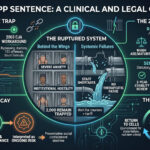
Step onto the residential wings of any British prison today, and you will quickly encounter a distinct class of prisoner. These individuals are not pacing their cells counting down the months to a fixed release date. Instead, they are living in a state of suspended animation, trapped under the legacy of the Imprisonment for Public Protection (IPP) sentence. Officially abolished by Parliament in 2012, this modern penal disaster continues to distort the clinical and operational reality of the prison estate. The individuals remaining under its shadow do not have a release date; they have a “horizonless” sentence, where freedom is conditional upon proving a negative—that they no longer pose a future risk to the public.
Whether or not you agree our Fat Disclaimer applies
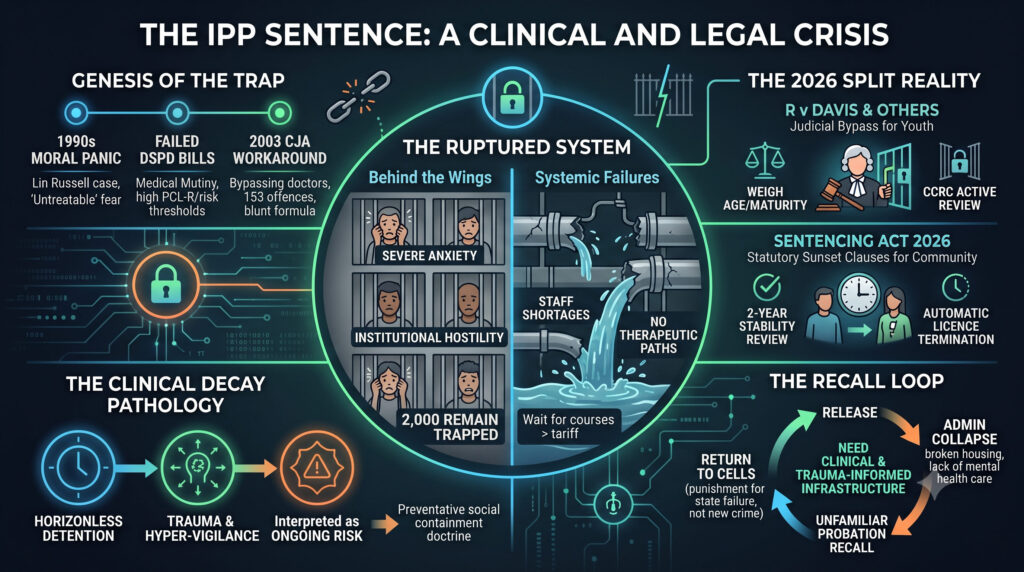
For clinicians working within this environment, the IPP population presents a profound ethical and therapeutic challenge. The sheer longevity of these indeterminate sentences has induced a specific form of institutional decay, characterised by severe anxiety, complex trauma, and deep-seated institutional hostility. Yet, the legal landscape surrounding these prisoners is currently moving faster than at any point since the sentence was scrapped. We are presently witnessing a stark, split reality. Out in the community, two recent statutory reforms have begun to dissolve the lifelong grip of the IPP licence for those who maintain stability: the automatic “sunset clause” introduced by the Victims and Prisoners Act 2024, and the shorter qualifying periods brought in by Section 42 of the Sentencing Act 2026, which came into full force on 1 June 2026.
The Grinding Cogs Behind the Walls
Behind the walls, however, the situation remains heavily logjammed. Roughly 2,300 individuals remain behind bars, split between those who have never managed to secure initial release and a massive, revolving-door population who have been dragged back to custody through highly risk-averse probation recalls. While the senior judiciary has recently opened an unprecedented escape route for a specific younger subset of this legacy cohort via the landmark Court of Appeal ruling in [_R v Davis & Others_ 2026] EWCA Crim 743, the mature adult population is left with no such courtroom bypass. The ongoing tragedy on the landings is not a random administrative oversight or a simple failure of prisoner compliance. It is the predictable, mathematical consequence of a historical choice. To understand why these individuals are still trapped in our prisons, we have to look back to the late 1990s, when a powerful mixture of political opportunism and clinical panic gave rise to a system designed to lock people away not for what they had done, but for what a risk matrix predicted they might do in the future.
1. The Genesis: Moral Panics, Personality Disorders, and the DSPD Track
The architectural blueprint for the IPP sentence was not drawn up in a vacuum; it was forged in a classic late-1990s moral panic. At the turn of the millennium, the intersection of British forensic psychiatry and penal policy became intensely consumed by a highly specific anxiety: how to handle individuals deemed exceptionally dangerous, but legally “untreatable”.
The Watershed of the Stone Case
The watershed catalyst for this panic occurred in July 1996 with the brutal murders of Lin Russell and her six-year-old daughter Megan in a Kent lane. Michael Stone was subsequently convicted of the killings. As the details of Stone’s chaotic history emerged, the public learned that he possessed a severe anti-social personality disorder and a history of explosive violence. He had bounced through psychiatric services for years, yet because his underlying personality structure was deemed impervious to psychiatric cure, he did not meet the strict “treatability test” required for indefinite civil detention under the Mental Health Act 1983. He could not be legally held in a secure hospital, and the criminal courts lacked a mechanism to incapacitate him indefinitely before he acted.
The Rise and Fall of the Standalone Bill
The political response from the newly elected New Labour government was swift, aggressive, and calculated to reassure a highly sensitive tabloid press. In July 1999, the Home Office and the Department of Health jointly published a radical consultation paper entitled Managing Dangerous People with Severe Personality Disorder. This document introduced a brand-new, hybrid administrative category to the British state: Dangerous Severe Personality Disorder (DSPD). The government originally tried to legalise the DSPD framework by introducing a wholesale replacement for the Mental Health Act 1983. They published a highly controversial Draft Mental Health Bill in June 2002, aiming to give the state civil powers to lock up “untreatable” personality-disordered individuals purely for public protection.
However, the Home Office ran into a wall of absolute resistance. The medical establishment, human rights lawyers, and the House of Lords revolted. The Royal College of Psychiatrists, backed by a broad coalition of over 60 mental health organisations, argued that removing the “treatability test” from civil law would completely break the Hippocratic Oath, weaponise medicine, and force clinicians to act as extensions of the prison service. The British Medical Journal later recorded that the medical community slammed the proposed legislation as an “unethical, unworkable, and ineffective” public order bill disguised as healthcare. Because of this massive backlash, the standalone Bill was quietly dropped from the Queen’s Speech in November 2002.
The Parallel Track: Sentencing Law
The government did not defeat that mutiny; it did not need to. The health and civil-detention route had stalled, but the same preventive drive was already finding another outlet. The Criminal Justice Act 2003 was passing through Parliament at that very moment, and it carried its own long lineage of protective sentencing. Into that stream ran the logic the medical profession had resisted: detain a person for the risk they were predicted to pose, not the offence they had actually committed. Because it travelled through sentencing rather than healthcare, the mechanism never had to clear the medical ethics barrier. The result was the IPP sentence—a penal expression of the same drive the failed Mental Health Bill had tried, and failed, to legitimise.l couldn’t.
DSPD was explicitly a political and administrative construct, entirely unrecognised by international clinical diagnostic manuals like the DSM or ICD. It shifted the threshold of detention away from clinical treatability and firmly onto mathematical, actuarial risk management. Under this framework, an individual could be subjected to “indeterminate but reviewable detention” based on an equation requiring a high score on tools like the Revised Psychopathy Checklist (PCL-R) alongside a severe personality disorder and a statistical likelihood of future serious harm. This marked a profound ideological pivot. For the first time in modern British legal history, the state openly embraced preventative detention. Specialised, highly expensive DSPD units were rapidly constructed across the secure estate, including at HMP Whitemoor and Broadmoor Hospital. The institutional conviction that future public risk could be scientifically scored and used to override traditional limits on human liberty was about to bleed directly out of these small, elite psychiatric units and into the mainstream criminal courts.
2. The Blunt Instrument: The Criminal Justice Act 2003 and the IPP Trap
By the early 2000s, the Home Office under Home Secretary David Blunkett was determined to hardcode the preventative philosophy of the DSPD pilot straight into mainstream sentencing law. The primary objective was straightforward: protect the public from serious violent and sexual offenders who did not meet the exceptionally high legal bar for a mandatory life sentence, but who were still judged too volatile to be released on a standard, fixed-term basis. The resulting legislative engine was unveiled in the white paper Justice for All in July 2002, which ultimately crystallised into the infamous Imprisonment for Public Protection (IPP) sentence under the Criminal Justice Act 2003.
The Statutory Presumption of Dangerousness
When the IPP sentence came into active effect in April 2005, it stripped away all the delicate clinical screening that had at least limited the scope of the DSPD units [Imprisonment for Public Protection – Finish the job | Centre for Crime and Justice Studies]. Psychiatric diagnosis or a PCL-R score were no longer needed to be locked up indefinitely. Instead, the statute introduced a rigid, mechanistic formula known as the “statutory presumption of dangerousness”. An IPP sentence required an index conviction for a serious specified offence—one carrying a maximum of ten years or more. But the trap lay in the prior. If the defendant had a single earlier conviction for any of the 153 specified offences—a vast list running from serious sexual assault down to minor street altercations or setting fire to a wheelie bin—the sentencing judge was compelled to assume they were dangerous. An IPP sentence then followed, unless the court found that assumption unreasonable.
The Net-Widening Catastrophe
The net-widening effect was catastrophic. The Home Office had casually projected that fewer than 1,000 individuals would receive the sentence. Instead, the courts handed down an astonishing 8,711 IPP sentences between 2005 and 2013. Because judges had their discretion severely curbed, they frequently handed down minuscule minimum tariffs—the punitive element of the sentence—that were sometimes measured in mere months. However, the open-ended tail of the sentence meant these individuals could only be liberated if they could prove to the Parole Board that their risk had dropped to an acceptable level.
Systemic Paralysis and the Strasbourg Showdown
The prison estate instantly ruptured under the weight of these numbers. Prisons entirely lacked the staff, resources, and psychologists required to run the specific offending-behaviour courses that inmates were legally mandated to complete to demonstrate their rehabilitation [HM Chief Inspector of Prisons and HM Chief Inspector of Probation Joint Thematic Review on the Indeterminate Sentence for Public Protection]. A person with an 18-month tariff could easily sit in a category B secure wing for a decade simply waiting for a space on a single, short psychology course. By 2012, this systemic paralysis led to a massive international legal showdown. In the landmark case of [_James, Wells and Lee v The United Kingdom_ 2012] ECHR 1706, the European Court of Human Rights unanimously ruled that the prolonged detention of IPP prisoners without giving them access to the means of rehabilitation was arbitrary and a direct breach of Article 5 of the European Convention on Human Rights.
Faced with this damning judgment, the government moved quickly to outmanoeuvre the Strasbourg court through a piece of legislative misdirection. Through the Legal Aid, Sentencing and Punishment of Offenders (LASPO) Act 2012, they formally abolished the IPP sentence for all future crimes, satisfying the court’s demand to fix the broken pipeline. However, out of intense fear of being labelled “soft on crime” by the populist press, the coalition government injected a poison pill into the Act: they refused to make the abolition retrospective. The thousands of individuals already trapped under the sentence were left exactly where they were, forced to rely on a broken Parole Board mechanism that the state had just admitted was entirely unfit for purpose.
3. The Modern Acceleration: The Split Gates of 2026
The legal gridlock that characterised the post-2012 era has finally begun to fracture, but it has done so by creating a starkly polarised landscape. As we navigate the summer of 2026, the legacy IPP population is effectively split into two distinct tiers: a fortunate minority who have found an unprecedented judicial escape route, and a larger group whose progression remains bound to the grinding administrative cogs of the prison estate.
The Shattering of Judicial Resistance
The most dramatic structural breakthrough in fifteen years occurred on 23 April 2026. In the landmark conjoined appeals of R v Davis & Others2026 EWCA Crim 743, the Court of Appeal dismantled a barrier that had long seemed impenetrable. For over a decade, senior judges had steadfastly refused to interfere with old IPP sentences, routinely declaring that resolving the crisis was an executive problem for Parliament alone. Davis shattered that judicial resistance. The Vice-President of the Court of Appeal Criminal Division quashed five out of six historic indeterminate sentences, replacing them with standard, finite structures that resulted in immediate, unconditional liberty for several appellants who had served their original tariffs many times over.
The Re-Evaluation of Youth and Maturity
The legal mechanism deployed in Davis establishes a powerful doctrine that is currently opening a selective gate. The court ruled that historic sentencing judges had committed a fundamental error by failing to properly weigh age and maturity when evaluating “dangerousness” under the 2003 Act. The senior judiciary made it clear that fluid, transient traits associated with youth—such as impulsivity and emotional immaturity—should never have been treated as permanent indicators of a lifetime of risk. Furthermore, the court explicitly accepted that the profound psychological decay and institutional blocks caused by the sentence itself were valid reasons to allow these appeals to be brought decades out of time.
The CCRC Pipeline and the Sunset Clauses
The Criminal Cases Review Commission (CCRC) has rapidly weaponised this precedent, actively mining the archives to fast-track a wave of new referrals straight back to the Court of Appeal. This active pipeline specifically targets individuals who were children or young adults under 21 at conviction, and who were handed short minimum tariffs of under three and a half years. The Prisoners’ Advice Service briefing on the April 2026 quashing of IPP sentences and updates from the Criminal Cases Review Commission project timeline (July 2026) explicitly show that the CCRC special project group is actively reviewing over 180 specific cases matching this exact criteria, with expectations that the total pool of legacy prisoners matching the strict under-21 age profile and short-tariff requirements sits between 200 and 300.
Yet, for the remaining 2,000 or so prisoners, this specific courtroom bypass is entirely out of reach. For the mature adult population—those who were well into their thirties or forties when sentenced—and those serving substantial tariffs for exceptionally grave offences, their original adult sentences remain legally watertight. For this larger group, the primary gate is not a judicial correction, but the strict clock set by the Victims and Prisoners Act 2024 and now shortened by the Sentencing Act 2026, which came into full effect on 1 June 2026. The 2024 Act supplied the mechanism that matters: once a released IPP prisoner survives two continuous years in the community without a recall, the licence terminates automatically by law. The lifelong shadow is erased. The Sentencing Act 2026 sharpens this further, cutting the qualifying period before that clock can even start from three years to two, and granting the right to seek a fresh review a year after an unsuccessful one. However, actually reaching that community finish line requires surviving the day-to-day reality of an overstretched prison system—a reality that is currently failing them.
4. The Clinical Reality: Systems Failures and the Recall Loop
To fully grasp the psychological gridlock on the wings today, one must confront a stark reality: the vast majority of IPP prisoners returning to custody are not doing so because they have committed new, serious crimes. Instead, they are being swept up by a highly risk-averse probation mechanism that frequently punishes the systemic failures of the state rather than individual criminal intent. Data highlighted by HM Inspectorate of Probation in their thematic review of IPP recall decisions confirms that the “recall loop” is overwhelmingly driven by administrative collapses, housing breakdowns, and acute shortages in mental health support.
The Collapse of Clinical Trust in the Community
The first major systemic failure is the chronic instability within the probation service itself. Individuals released on an IPP licence require highly consistent, specialised, and trauma-informed supervision to navigate the outside world. In reality, they are routinely subjected to catastrophic staff turnover, often being shuffled between four or five different Community Offender Managers in a matter of months. Without continuity, it is impossible to establish clinical trust. When an individual suffers a predictable mental health dip or a spike in anxiety, they mask their distress out of intense fear that transparency will trigger an immediate return to a cell. When they inevitably miss an appointment or withdraw, an unfamiliar probation officer—lacking context or historical rapport—bluntly triggers an emergency recall under the guise of “risk management”.
The Vacuum of Transitional Care
Furthermore, the transition from decades of horizonless institutionalisation to the modern community occurs within a complete resource vacuum. Basic continuity of care is routinely non-existent; psychiatric and substance-misuse interventions initiated inside prison rarely connect seamlessly with community teams. Traumatised and institutionalised individuals are dropped into the community completely overwhelmed by the mechanics of modern life. When they struggle to cope, the system punishes their decompensation with a cell rather than treating it as a healthcare crisis.
The Pathology of Horizonless Detention
This creates a devastating psychological pathology unique to the IPP cohort. Decades of horizonless detention induce a state of profound, chronic existential anxiety, hyper-vigilance, and deep-seated institutional hostility. The ultimate tragedy of the system is that it interprets the very psychological damage caused by the sentence itself as evidence of ongoing risk. A minor behavioural fluctuation or a flash of frustration born of sheer despair is codified as an escalation in “dangerousness,” resetting their statutory clock back to zero.
The lesson for clinicians and policy-makers alike is stark. While the judicial bypass of Davis & Others offers a selective escape route, and the Sentencing Act 2026 provides a statutory finish line, these gates mean very little if the state continues to use recall as an administrative safety valve for its own operational failures. Until we replace blunt risk containment with robust, clinical, and trauma-informed community infrastructure, the legacy of the IPP sentence will remain an active, self-perpetuating crisis on our wings—forcing clinicians to manage the fallout of a twenty-five-year-old political panic.
Conclusion: The Ghost of the Actuarial State
Ultimately, the Imprisonment for Public Protection sentence stands as a monument to what occurs when populist politics overrides clinical and constitutional integrity. Bypassing the ethical wall erected by the medical community during the DSPD mutiny did not solve a public safety crisis; it merely outsourced an administrative panic to the criminal courts. By forcing a rigid statutory formula to perform preventive social containment under the guise of justice, the state constructed a penal apparatus that was structurally incapable of delivering either rehabilitation or closure. It remains modern British history’s definitive cautionary tale of bad law chasing bad policy down an institutional rabbit hole.
For forensic clinicians, the legacy of this apparatus exposes the fundamental fallacy of the actuarial state. The core illusion of the IPP—that human behaviour can be scientifically scored to predict future violence with absolute certainty—has produced a devastating diagnostic irony. In its desperate pursuit of risk-free containment, the system actively manufactured the very pathology it now uses to justify continued detention. The chronic existential anxiety, hyper-vigilance, and institutional hostility observed on the wings are the direct products of horizonless detention itself, yet the state continues to misinterpret this profound trauma as evidence of ongoing “dangerousness.”
As we navigate the legislative changes of 2026, it is clear that legal trapdoors alone cannot dissolve this crisis. The selective judicial bypass opened by R v Davis & Others and the statutory sunset clauses now in force are vital structural interventions, but they are functionally useless if the community infrastructure remains a vacuum. The ghost of this twenty-five-year moral panic can only be permanently laid to rest when the state stops using emergency recalls to mask its own broken probation and mental health services. Until blunt risk containment is completely replaced by robust, trauma-informed community healthcare, the true finish line for these legacy prisoners will remain entirely out of reach.
