


Estimated reading time at 200 wpm: 27 minutes
A previously published vignette describes an ordinary sequence within a prison in England, centred on what was casually termed ‘feeding time’: prisoners were moved in batches to collect food trays, in a flow that is efficient, familiar, and unremarkable to those within it. Conversation and banter permeated the process. The significance does not lie in any single act, but in the regimentation itself — the sense of individuals moving as objects and referred to like animals.
Whether or not you agree our Fat Disclaimer applies
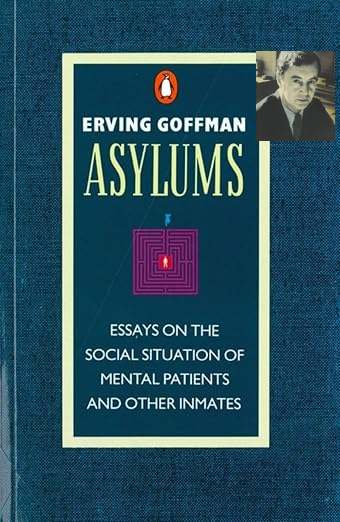
The moment of recognition emerges not from critique of others, but from an awareness of my participation in that same system: part observer, part functionary within it. This matters here because it captures, in lived form, the structural logic that Goffman described in Asylums: Essays on the Social Situation of Mental Patients and Other Inmates — that institutional life as ordered, routine, and identity-flattening without requiring overt coercion. It opens a gateway to Goffman’s work by presenting the phenomenon before it is named.
1. Introduction: why revisit Goffman now
A prior blog post examined prison psychiatry through direct observation, raising the question of whether clinical practice within custodial settings risks becoming diluted into a form of social management, with medication occupying a marginal, sometimes instrumental role. That piece did not begin with theory, but with unease emerging from experience — an unease shaped by the structural conditions of a closed institution.
Goffman’s work becomes relevant at precisely this point. Not as as a framework capable of naming patterns that may otherwise remain diffuse or normalised. The concept of the total institution — a setting in which individuals are contained, routines are imposed, and identity is progressively reshaped — offers a lens through which contemporary practices can be re-examined without assuming intent or attributing fault to individuals.
Despite the passage of time since 1961, the core structural features identified by Goffman have not disappeared. They have, in many settings, become less visible, embedded within administrative systems, professional routines, and organisational cultures that appear benign when viewed in isolation. The risk is not overt coercion, but gradual accommodation — where deviation from ideal practice becomes unremarkable, and where institutional logic quietly reshapes clinical judgement.
This piece does not attempt to prove that modern services replicate the asylums of the mid-twentieth century. Rather, it asks whether elements of the same underlying structure persist in altered form, and whether recognising those elements allows for a clearer understanding of current practice. The purpose is not to reach a verdict, but to sharpen perception.
2. Origins of the work
Erving Goffman was a Canadian-born sociologist whose work reshaped how everyday social life is understood. Rather than studying people through surveys or experiments, he examined how identity is constructed, maintained, and altered through interaction. His writing is widely regarded as foundational within sociology, not because it produced statistical laws, but because it revealed patterns that, once seen, are difficult to ignore.
“Asylums” (1961) is one of his most influential works. It is not a clinical text and makes no attempt to diagnose or treat mental illness. Instead, it examines what happens to people when they enter environments that organise every aspect of their lives. The book became a point of reference across disciplines — sociology, psychiatry, criminology — because it articulated something that practitioners often sensed but had not formally described: that institutions do not simply care for individuals, they reshape them.
Fieldwork context (St Elizabeths Hospital)
“Asylums” did not emerge from abstract theorising but from direct observational study. Goffman spent time at St Elizabeths Hospital in Washington, D.C., a large federal psychiatric institution, where he was able to observe the everyday organisation of life within what he would later term a “total institution”. St Elizabeths functioned as a self-contained social world. Patients were not simply treated there; they lived there, often for prolonged periods. Daily life was organised under a single administrative authority, with movement, activity, and interaction structured by institutional rules. This setting provided Goffman with access to what he described as the “social situation” of mental patients — not their symptoms, but the conditions under which they lived.
Observational methodology (embedded, ethnographic)
Goffman’s method was essentially ethnographic (systematic observation of social behaviour in its natural setting). He did not rely on questionnaires or experimental design. Instead, he examined routines, interactions, and the organisation of everyday practices. His interest lay in what people actually did, how staff and patients related to one another, and how institutional arrangements shaped those interactions. This approach allowed him to describe what he later framed as the “moral career” of the mental patient — the progressive transformation of identity through institutional processes.
A critical feature of this method was the manner in which it was conducted at ground level. Although his presence within the hospital was institutionally authorised, those he observed were not generally aware that he was engaged in systematic sociological research. He presented himself in practical terms as an assistant connected to the hospital’s recreational or athletics programme — a role that provided a plausible, low‑status presence within everyday ward life. This positioning allowed him to move through institutional spaces without prompting guarded or performative behaviour. In effect, the observational field remained largely uncontaminated by the awareness of being studied. This element of concealment has since attracted ethical scrutiny, but it is also central to the force of his account: what he recorded was not behaviour adjusted for observation, but behaviour as ordinarily enacted.
Intellectual backdrop (symbolic interactionism – meaning constructed through interaction)
The work sits within the tradition of symbolic interactionism, in which meaning is understood to arise through social interaction. Goffman’s contribution was to show how, within total institutions, these interactions are not neutral. They are structured, repetitive, and asymmetrical. The institution does not merely house individuals; it organises their conduct, redefines their roles, and, over time, reshapes the self. His concern was not with pathology as such, but with the patterned social arrangements that produce what he termed the “mortification of the self”.
3. The concept of the total institution
Goffman’s central construct is the “total institution”: a place of residence and work where a large number of like-situated individuals, cut off from the wider community for an appreciable period, together lead an enclosed, formally administered life. The definition is deceptively simple. Its force lies in what follows from it. When the same authority organises sleeping, eating, working, recreation, and movement, the boundaries that ordinarily separate roles and settings begin to collapse.
Separation from wider society
Entry into such a setting entails a marked break with the outside world. Contact is limited, regulated, and often mediated by the institution itself. The ordinary supports of identity — family roles, occupational status, informal networks — recede. What replaces them is not absence, but substitution: a new set of relationships and expectations defined within the institution. The individual does not simply relocate; the social context within which the self is maintained is fundamentally altered.
Enclosed, regulated existence
Daily life is organised according to a timetable set by the institution. Activities occur in prescribed sequences and in prescribed places, often in the company of others undergoing the same routine. Surveillance is normalised. Permissions, rather than preferences, govern movement and choice. Importantly, this order is experienced as ordinary by those within it. It does not require constant enforcement; it is sustained by repetition, by habit, and by the gradual alignment of behaviour with expectation.
Convergence of living, working, and social life under one authority
In the wider world, different spheres of life are distributed across different settings and governed by different norms. In the total institution, these spheres are brought together and placed under a single administrative regime. The same authority that controls accommodation also controls work assignments, access to resources, and social interaction. This convergence produces what Goffman described as a distinctive “split” between the staff world and the inmate world, with each operating under different expectations, privileges, and constraints. Over time, this arrangement does not merely organise conduct; it shapes perception — of others, of the institution, and of oneself.
Examples extend beyond psychiatric hospitals to prisons, military training establishments, and other settings where life is conducted within a bounded, rule-governed environment. The relevance of the concept lies not in labelling institutions, but in recognising the pattern: once identified, it becomes possible to see how structure, rather than intention, can exert a quiet but persistent influence on behaviour and judgement.
A simplified taxonomy, adapted cautiously from Goffman’s broader framing, helps to situate these environments:
| Category | Examples | Primary function |
|---|---|---|
| Care for the incapable | Nursing homes, orphanages | Support for those unable to care for themselves |
| Protection from unintended threat | Mental health hospitals | Containment of perceived risk arising from illness |
| Protection from intentional threat | Prisons, detention centres | Containment of those deemed dangerous by action |
| Instrumental institutions | Military barracks, boarding schools | Training or task-oriented development |
| Retreats | Monasteries, convents | Voluntary withdrawal from wider society |
The boundaries between these categories are not fixed. In practice, they may overlap, particularly in forensic settings where care and custody intersect.
4. The moral career of the patient
Goffman described entry into the institution not as a single event, but as the beginning of a “moral career” — a sequence through which the person’s identity is progressively redefined. The emphasis is not on diagnosis, but on what happens to the self as it passes through institutional arrangements. What appears, from the outside, as admission and treatment, is experienced from within as a series of transitions that recalibrate status, expectation, and self-understanding.
Pre-admission identity
Prior to entry, the individual occupies multiple roles within civil society — family member, worker, friend — sustained by networks that confer recognition and continuity. Difficulties may already be present, but identity is plural and negotiated across settings. Crucially, the person retains some control over presentation: how they are seen, and by whom.
Admission shock and stripping processes
Admission introduces what Goffman termed a “series of abasements, degradations, humiliations, and profanations of self”. Personal effects may be removed; clothing standardised; routines imposed. Information about the person is gathered, recorded, and translated into institutional categories. The process is often justified as necessary for care or security, yet its cumulative effect is to unsettle prior identity. The individual encounters a setting in which previous roles carry little weight, and where a new, singular status — patient, inmate — begins to dominate.
Adaptation to institutional life
Over time, conduct aligns with the demands of the setting. Compliance is learned not only through instruction, but through observation of what is expected and what is sanctioned. Goffman distinguished between official expectations and the informal practices that develop alongside them. Individuals may adopt what he called “secondary adjustments” — small, often tacit strategies that preserve a sense of personal space or autonomy within constraints. These are not acts of open resistance, but negotiated accommodations that allow the person to function within the system while retaining fragments of self.
Discharge and re-entry difficulties
Exit from the institution does not simply restore the prior identity. The person leaves with an altered sense of self and with a social label that may persist. Skills for managing an unstructured environment may have attenuated; expectations shaped by institutional routine may not readily translate to the outside world. What appears administratively as discharge is, in experiential terms, another transition in the moral career — one that can be as disorientating as entry.
Taken together, these stages describe not a pathology, but a process. The institution does not merely contain individuals; it participates in the reconstitution of who they are understood to be.
5. Mechanisms of identity erosion
If the total institution provides the setting, and the moral career describes the trajectory, then the “mortification of the self” names the mechanism. Goffman used this phrase to capture how ordinary procedures, justified as administrative or clinical necessities, cumulatively work upon identity. No single act is decisive. The effect emerges through repetition, sequencing, and the alignment of multiple small processes that, together, reframe the person as an object of management.
In practical terms, this process can be recognised through a set of recurring features:
- Prior roles are stripped away and replaced by a single institutional identity
- The person is reduced to records, categories, and administrative descriptions
- Personal possessions and privacy are restricted or removed
- Behaviour is shaped through rules, routines, and expectations of compliance
- Boundaries between the personal and the public are eroded
These are not isolated events, but interlocking processes that, over time, reshape how the individual is seen and how they come to see themselves.
Loss of roles and identity markers
On entry, prior roles are suspended or rendered irrelevant. The individual is addressed and treated primarily in terms of their institutional status. Clothing, routines, and forms of address converge to signal a single identity. What had been multiple selves, distributed across contexts, becomes narrowed to one authorised role.
Reduction to administrative identity
Information about the person is translated into records, categories, and files. Names give way to numbers, diagnoses, and risk descriptors. This is not merely documentation; it is a re-description that privileges what can be recorded and retrieved. Over time, the administrative version of the person can eclipse the person as previously known, guiding decisions and interactions in their place.
Loss of personal property and privacy
Personal possessions — what Goffman termed the “identity kit” — are restricted or removed. Spaces for privacy are limited. Activities that would ordinarily be concealed are conducted under observation or in shared environments. The boundary between the private and the public is thinned, sometimes to the point of disappearance.
Enforced compliance and deference
Rules of conduct are explicit and pervasive. Deference to staff, adherence to timetables, and compliance with procedures are expected and, where necessary, enforced. Even where framed as therapeutic or protective, these expectations establish a patterned asymmetry. Over time, they can be internalised, such that conformity is maintained with minimal overt coercion.
Exposure and boundary collapse
Individuals are brought into proximity with others not by choice but by institutional arrangement. Differences of age, status, and background are flattened within shared routines. Forms of address may become informal or standardised in ways that further erode distinction. Goffman described this as a “contaminative” process, in which boundaries that ordinarily protect identity are breached.
Taken together, these processes do not simply constrain behaviour; they recalibrate how the person is seen and how they come to see themselves. The institution does not need to declare this outcome. It arises from the ordinary running of the place.
6. The medical model and mental hospitalisation
Goffman engaged critically with what would now be termed the “medical model” as it operated within large psychiatric institutions. His concern was not to deny the reality of mental illness, but to examine how the institutional setting reframed behaviour through a clinical lens that could obscure context. Within the hospital, actions were routinely interpreted as symptoms, and the person was increasingly defined through diagnostic categories rather than situational understanding.
The clinical frame as dominant explanation
Behaviour that might, in other settings, be understood as reaction, protest, or adaptation was reinterpreted within a medical framework. The clinical gaze privileged pathology over context. This did not require ill intent; it followed from the institutional mandate to diagnose, categorise, and treat. Over time, the range of acceptable interpretations narrowed, and alternative readings of behaviour lost salience.
Hospitalisation as social process
Goffman treated hospitalisation not merely as treatment, but as a social process that reorganises identity. Admission placed the individual within a system where roles, expectations, and meanings were already established. The person entered a pre-structured world in which their biography was translated into case history, and their conduct into clinical material. What was lost in this translation was the ordinary social context in which behaviour acquires meaning.
The tension between care and control
Psychiatric hospitals were, and remain, sites of care. However, Goffman highlighted how therapeutic aims coexist with custodial functions. Observation, restriction, and routine can serve both treatment and control. The difficulty lies in disentangling these purposes in practice. Measures justified as clinical may simultaneously operate as mechanisms of order. The distinction is not always visible from within the system.
The risk of interpretative closure
Once behaviour is stabilised within a diagnostic frame, it can become resistant to reinterpretation. New information is assimilated into existing categories, reinforcing prior conclusions. This creates a form of interpretative closure in which the person is encountered through an established narrative that is difficult to displace. In this respect, the medical model, as practised within a total institution, can converge with the structural tendencies described earlier.
This is not an argument against psychiatry, but an observation about context. The same clinical frameworks, applied in different settings, may function differently. Within the total institution, they risk becoming part of the very structure that shapes the phenomena they seek to explain.
7. Life inside: the social system of the institution
If the earlier sections describe structure and process, this section concerns texture — what institutional life feels like when it is lived day-to-day. Goffman’s analysis is at its most penetrating here. He shifts attention from formal rules to the lived order that emerges between them: the routines, distinctions, and informal practices that sustain the institution as a functioning social system.
Group-based routines
Life is organised not around individuals, but around cohorts. Activities are carried out in batches — eating, movement, work, recreation — often with minimal variation between persons. This “batch living” is not incidental; it is efficient, predictable, and administratively manageable. Yet its effect is to displace individual preference with collective scheduling. Over time, the rhythm of the group becomes the rhythm of the person. At times this is visible in simple sequences — a line forming without instruction, trays collected in turn, movement unfolding as if rehearsed — moments that pass without comment but reveal the underlying order.
Staff–inmate divide
Goffman described a fundamental division between what he termed the “staff world” and the “inmate world”. These are not merely occupational categories, but distinct social positions with different expectations, privileges, and interpretations of the same environment. Staff operate with authority, mobility, and access to information. Inmates operate within constraint. Each group develops its own language, assumptions, and perspective on what is occurring. The same event may carry entirely different meanings on either side of this divide.
Looping: behaviour redefined as symptom
Goffman described a process sometimes termed “looping”, in which a person’s reaction to institutional conditions is reinterpreted as evidence of the very problem that justifies those conditions. Frustration, withdrawal, or protest may be recorded as symptoms or risks, detached from the context that produced them. The response is then fed back into the system as grounds for further restriction or intervention. In this way, the institution can become self-confirming: behaviour shaped by the setting is used to validate the setting.
Power asymmetry
Authority within the institution is both formal and diffuse. It is exercised through rules, permissions, and sanctions, but also through everyday interactions — tone, timing, and control over small decisions. Much of this power is routine rather than dramatic. It does not require overt assertion. It is embedded in the structure itself: who can move freely, who must wait, who asks, and who grants. Over time, this asymmetry becomes normalised, and with normalisation comes reduced awareness of its presence.
Informal adaptations and resistance (secondary adjustments)
Despite this structure, institutional life is not entirely determined from above. Goffman observed that individuals develop “secondary adjustments” — informal practices that allow for limited autonomy within constraint. These may include minor rule-bending, private exchanges, or subtle reappropriation of space and time. They are rarely confrontational. Instead, they represent a negotiated coexistence with the institution: a way of maintaining some personal agency without directly challenging the system.
Taken together, these elements describe an environment that is orderly, stable, and internally coherent. It functions not because every rule is enforced, but because behaviour, expectation, and structure gradually align. The institution becomes, in Goffman’s terms, a “social system” — one that shapes conduct as much through routine and understanding as through explicit control.
8. Institutionalisation as an outcome
If the earlier sections describe how the institution operates, this section addresses what it produces over time. Goffman used the term “institutionalisation” to capture a gradual accommodation to the environment — not as a single decision, but as a cumulative adjustment in behaviour, expectation, and self-concept. The outcome is not uniform, but the direction of travel is consistent: the person becomes increasingly fitted to the institution that contains them.
Psychological adaptation to structure
Regularity, predictability, and externally imposed order can become the primary organisers of daily life. Decisions that would ordinarily be made independently are replaced by routines that require little personal initiative. Over time, the capacity — and sometimes the inclination — to act outside these structures may diminish. What was initially experienced as constraint can come to be experienced as stability.
Dependency and erosion of autonomy
As the institution assumes responsibility for basic functions — movement, timing, access to resources — a form of dependency may develop. This is not simply behavioural, but cognitive: expectations adjust to what is provided and permitted. Autonomy is not only restricted; it is gradually de-prioritised. Requests replace choices; compliance replaces negotiation. The individual learns what is required to navigate the system, and in doing so may relinquish aspects of self-direction that are less immediately useful within it.
Difficulties with reintegration
When the institutional frame is removed, the absence of structure can be disorientating. Tasks that require planning, initiative, or sustained independent judgement may feel unfamiliar or effortful. Social roles that were previously suspended must be re-entered, often under the weight of a persistent label associated with prior institutional status. Reintegration is therefore not a simple reversal of admission, but another phase in which identity must be reworked in a setting that no longer provides the same scaffolding.
Institutionalisation, in this sense, is not a failure of the individual. It is an intelligible response to a particular environment. The more coherent and encompassing the institution, the more likely it is that those within it will come to reflect its logic.
9. Critiques and limitations of Goffman
Goffman’s work has never been without criticism. From its publication, “Asylums” attracted both admiration and unease. The unease is instructive. It reflects not only methodological concerns, but a deeper discomfort with the implications of what he described. Any serious engagement with the work requires acknowledging these critiques, while also examining what they do — and do not — undermine.
Lack of quantitative robustness
Goffman did not produce statistical evidence. His work rests on observation, interpretation, and description rather than measurement. For disciplines that prioritise reproducibility and numerical validation, this is a limitation. The absence of quantification makes it difficult to generalise in a formal sense. Yet the counterpoint is that Goffman was not attempting to measure prevalence, but to reveal structure. His claims are not probabilistic; they are descriptive of patterns that, once recognised, appear with a certain consistency across settings.
Single-site observation
Much of “Asylums” is grounded in observation at a single institution. This raises legitimate concerns about representativeness. Conditions at St Elizabeths may not have reflected other hospitals, even at the time. However, the enduring influence of the work suggests that readers across different settings recognised analogous features within their own institutions. The question therefore becomes less about whether every detail generalises, and more about whether the underlying structure recurs.
Potential overgeneralisation
Goffman’s framing of the “total institution” has been criticised for flattening distinctions between different types of settings — psychiatric hospitals, prisons, monasteries, military establishments — that differ significantly in purpose and ethos. There is a risk that the concept, applied too broadly, obscures important variation. At the same time, its strength lies precisely in identifying a shared structural logic that cuts across these differences. The tension between specificity and generality remains unresolved.
Under-recognition of therapeutic intent
Clinicians have argued that Goffman underplayed the therapeutic aims of psychiatric institutions, presenting them primarily as systems of control rather than care. This critique carries weight. Institutions do not exist solely to manage; they are also sites of treatment, containment, and, at times, recovery. However, Goffman’s focus was deliberately selective. He was not describing everything that occurs within institutions, but drawing attention to features that are easily normalised and therefore overlooked.
Taken together, these critiques do not invalidate the work, but they do delimit its scope. “Asylums” does not provide a complete account of institutional life. What it offers is a particular kind of seeing. Its continued relevance lies less in empirical precision and more in its capacity to make visible what routine practice can render invisible.
10. Contemporary relevance
The relevance of Goffman’s analysis lies not in claiming that present-day services are replicas of mid‑twentieth‑century asylums, but in recognising how elements of the same structural logic can persist in altered, often less visible forms. Modern institutions are more regulated, more scrutinised, and more explicitly oriented towards rights and recovery. Yet the conditions that organise daily life — containment, routine, categorisation, and asymmetry of authority — have not disappeared. They have, in many cases, been redistributed into systems that appear procedural rather than overtly custodial.
Persistence of institutional logics in modified forms
Contemporary services frequently operate through protocols, pathways, and standardised processes designed to ensure safety and consistency. These are necessary and, in many respects, beneficial. However, they can also reproduce features that Goffman described: the organisation of people in batches, the alignment of behaviour to timetables, and the convergence of multiple aspects of life under a single system of control. The shift is one of presentation rather than of structure. What was once visibly coercive may now appear as administrative necessity.
Subtle versions of identity reduction (documentation, risk frameworks, throughput pressures)
The reduction of the person to an administrative identity persists, albeit in more sophisticated forms. Electronic records, diagnostic coding, risk stratification, and performance metrics create representations of individuals that are portable, searchable, and actionable. These representations are indispensable for coordination, yet they privilege what can be documented over what is lived. Decisions are increasingly mediated by these records. Over time, the administrative profile can guide interaction in ways that echo Goffman’s concern: the person is encountered through categories before they are encountered as a person.
Pressures of throughput and resource constraint further shape this dynamic. Time-limited encounters, abbreviated documentation, and prioritisation of measurable outputs can compress clinical thinking. What is efficient may not always be adequate. The risk is not a deliberate lowering of standards, but a gradual recalibration of what is treated as sufficient within the constraints of the system.
Relevance to prisons and long-stay units
In custodial environments and long-stay settings, these dynamics are more readily observable because the structural features are more pronounced. Movement is controlled, routines are fixed, and roles are sharply delineated. The distinction between staff and those subject to the regime remains salient. Within such environments, clinical practice does not occur in isolation; it is embedded within, and influenced by, the institutional order. The question is not whether practitioners intend this influence, but whether it is recognised.
Goffman’s contribution, in this context, is not to indict contemporary practice, but to provide a vocabulary for noticing. Where routines become unquestioned, where administrative categories dominate perception, and where asymmetries fade into the background, his analysis offers a means of bringing these features back into view. The value lies in recognition rather than conclusion.
11. Translating insight into practice
Goffman’s work does not offer a manual for reform, nor does it prescribe solutions. Its value lies in altering perception. Once institutional patterns are recognised, it becomes more difficult to participate in them uncritically. The translation into practice is therefore not a set of interventions, but a shift in attentiveness — to what is routine, what is taken for granted, and what is quietly shaping judgement.
Protecting identity within systems
The first implication is the deliberate preservation of the person beyond their institutional category. This does not require dismantling systems, but resisting their tendency to reduce. Small acts — the retention of personal identifiers, attention to individual narrative, the refusal to let documentation fully substitute for encounter — become significant. The question is not whether categorisation can be avoided, but whether it is allowed to dominate.
Rebalancing power relationships
Power within institutions is structural, but its expression is relational. Tone, language, timing, and the handling of small decisions all contribute to how authority is experienced. Awareness of this does not remove asymmetry, but it can moderate its effects. The distinction lies between power exercised as routine and power exercised with awareness of its impact.
Designing environments that preserve autonomy
Where systems require standardisation, there remains scope to preserve elements of choice. The capacity to make decisions — however limited — sustains aspects of self that institutional life tends to erode. This is not a matter of grand redesign, but of recognising where flexibility can exist without compromising safety or order.
Avoiding administrative reductionism
Modern systems depend on documentation, metrics, and record-keeping. These are indispensable. The risk arises when they become the primary lens through which individuals are understood. Clinical judgement, observational nuance, and informal knowledge can be displaced by what is recorded and auditable. The challenge is not to reject administrative systems, but to prevent them from becoming the total description of the person.
These are not reforms in the conventional sense. They are adjustments in how practice is conducted within existing structures. Their effect is cumulative rather than immediate, and their success is measured less in outcomes than in the preservation of perspective.
12. Reflective conclusion
The account that precedes does not arrive at a conclusion in the usual sense. It traces a pattern — from observation, through theory, and back into contemporary practice — without claiming resolution. Goffman’s work does not demand agreement. It invites recognition.
Within secure psychiatric settings, that recognition carries particular weight. Clinical practice does not occur in a neutral space. It unfolds within environments where movement is controlled, routines are imposed, and identities are already partially defined by institutional categories. In such contexts, the distinction between care and control is not always clear in operation, even when it is clear in intention. The risk is not that practitioners abandon their clinical standards, but that those standards are quietly reshaped by the structures within which they are applied.
What remains, after the analysis, is not an answer but a shift in how institutional life — and clinical work within it — may be seen. Routines that appear routine begin to influence decisions. Behaviour that arises from the environment may be recorded as illness rather than understood in context. Written records, while necessary, may come to replace direct clinical engagement with the patient. None of this requires neglect or ill intent. It arises from the ordinary functioning of the system.
There is a particular discomfort in that awareness. It does not attach easily to individuals, nor does it lend itself to simple critique. It sits instead at the level of systems — sustained by ordinary actions, reproduced without intention, and rarely examined because they work. For the practising psychiatrist, this raises a quieter question: not whether one is acting appropriately within the system, but whether the system itself is shaping what comes to be regarded as appropriate.
The significance of Goffman’s contribution lies precisely here. He did not expose an aberration. He described a condition that arises wherever life is organised in this way. In secure institutions, that condition intersects directly with clinical judgement. The implication is not that such environments should not exist, but that they should not be mistaken for neutral clinical spaces.
Recognition, once established, is difficult to reverse. The structures remain the same. What changes is the capacity to see them — and, perhaps, to practise within them with a different kind of awareness.