

Estimated reading time at 200 wpm: 4 minutes
It was late on a Friday afternoon. Around 15:25. I was visiting a Segregation Unit — still universally called Seg, though the sign says ‘Care and Support Unit’ — to assess a patient. This is not unusual territory for me. After twenty-five years in forensic psychiatry, I know what Seg is and what it demands.
Whether or not you agree our Fat Disclaimer applies
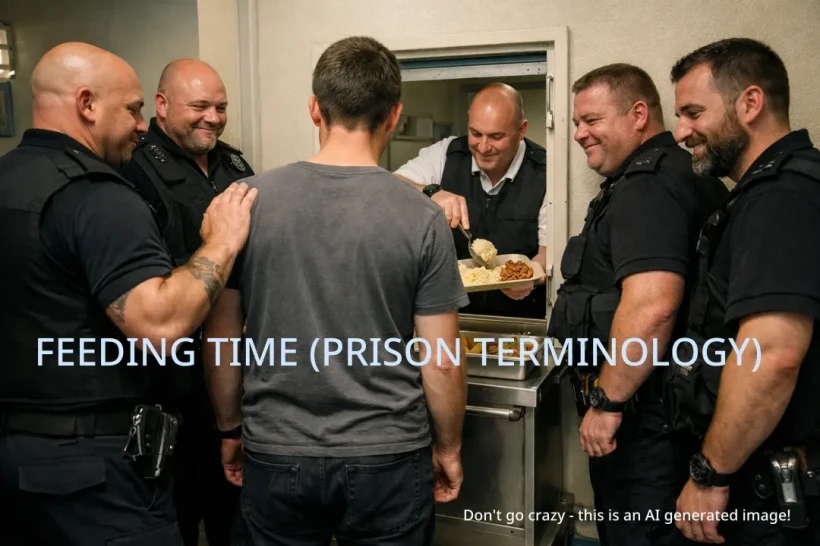
I was told, matter-of-factly, that in five minutes it would be “Feeding time..” and “..we call it early on Fridays“. That bit I did not know. I don’t know if that is a norm across all prisons in the UK. Something had already begun to register. Feeding time? I normally associate such words with feeding animals. I have never in my entire psychiatric career heard that terminology apply to patients or prisoners. The phrase was not said once. It was said more than twice — to me and among the officers themselves. The words were not said in joking way. Matter of fact. Habitual. No irony intended and none detected.
Five prison officers were present. All large men. Physically imposing in the way that this environment both selects for and requires. We’re talking masses of muscle and adipose tissue covering huge bones – stacked over 5 foot 7 inches high. The power differential is not incidental. In Seg — home to some of the most disturbed and potentially violent prisoners in the estate — it is entirely necessary.
The general public and the media don’t see this stuff. I stood and watched – the ‘feeding‘. What followed was a practised operation. Four officers walked to a cell, opened it, and escorted each prisoner in turn — separated by roughly three minutes — to a food trolley stationed behind a secure room opening onto the corridor. A fifth officer from behind the trolley plated food onto a plastic tray. Plastic cutlery. A drink. The prisoner was then escorted back to their cell. Cell locked. Next prisoner. And so this sequence happened six times. I was a privileged observer.

Throughout, there was banter among the officers. Easy, collegial, unreflective. The prisoners moved through that social space without entering it.
Medications, steel gates, and a closed pharmacy
By 16:45 I was in a room labelled ‘Treatment Room’, working at a desk, accessing SystmOne. Two patients needed medications prescribed. Pharmacy — just down the corridor — would be closed at 5pm but I was only to find that out later. I was pressing against that boundary.
I made errors. Returned to correct them. By the time I had the prescriptions right, pharmacy had closed.
There was still a printer in an adjacent ‘Medication room’ on the top border of a square perimeter of corridors. I passed through several steel gates — unlock, lock, prove each gate secure — along a short corridor mapping one side of the building. I printed. I signed.
A pharmacy technician was present in that room. But pharmacy was closed. She could not act on the prescriptions; she’s not qualified anyway.
I asked about the meds — perhaps hoping for some give in the system. She was clear. “Those will be picked up on Monday.“
I said what I was already thinking, “So they won’t get medication this weekend.“
“No.” Said without cruelty. Without hesitation. Without apparent weight. It was like ‘Computer says nooooh..‘
The moment of recognition — “so am I”
She was not being callous. She was being accurate. The system had defined the boundary of her role and she was standing at it. Correctly, by the rules that governed her.
But two patients would go without medication for two days. And I — the clinician, the advocate, the person who had stood in Seg an hour earlier and quietly registered the dehumanising weight of “feeding time” — had just hit the same wall.
It struck me then with some force. She was a cog in the machine’s wheels.
So was I.
I had arrived that afternoon as an observer of institutional process. I left as a participant in it. The walls had shaped my afternoon as surely as they shaped everything else inside them.
Goffman must be rolling in his grave.