


Estimated reading time at 200 wpm: 22 minutes
What is a Ward Round?
Conceptual anchor
A Ward Round is a regular, organised meeting where a team of healthcare professionals discuss and plan a patient’s care. The setting is usually in-patient care. Think of it as an essential effort to make sure treatment is on track and to make any necessary adjustments. It is a time for specialists in a multidisciplinary team to share their insights. For the patient, or their relatives, it is quality time for them to ask questions and provide their perspectives. Good efficient Ward Rounds make for high quality care, reduce stress on staff, and promotes confidence in care delivered. Teams will normally be holistic in their considerations and apply the biopsychosocial model. On occasions external professionals may visit for quality assessments or to assist the team with their insights. The aim is always to work together to ensure the best and safest possible care, tailored to individual patient’s needs.
Whether or not you agree our Fat Disclaimer applies
Note that this is article is opinion and not advice to healthcare organisations.
The Multidisciplinary Ward Round (MDT, WR) in psychiatry represents a highly focused investment of time and requires sound teamwork for all paiients. This is where healthcare organisations can derive much efficiency for their costs, or waste their money by penny-pinching that leads to chaos.
Patients should be invited to participate in their care planning and to received constructive feedback. Beyond the discussions and decisions, the effectiveness of the Ward Round hinges on the subsequent follow-through and actioning of plans. This ensures that desired outcomes are achieved, ultimately putting the patient in a position of advantage in their recovery journey.
Time Management Issues
Given the highly focused and time-intensive nature of Ward Rounds, effective time management is mandatory. Several factors can impact the efficient flow of the round and require careful consideration by the team:
- Information overload: The volume of information presented by various disciplines for each patient can be substantial, making it challenging to process efficiently within allocated timeframe
- Numerous requests: Patients, or their representatives, may present a multitude of requests during the round. Not all of these may have immediate clinical relevance or align directly with the primary focus of the Ward Round’s objectives.
- Patient Rights and Restrictions for detained patients: Supporting the rights of patients, particularly those detained under mental health legislation, while also applying proportionate restrictions, significantly increases the time demands. This includes addressing specific requests such as approval for personal items like laptops or mobile phones, or discussions around visits.
- Section 17 Leave requests: The planning and approval of Section 17 leave, which allows detained patients to have escorted or unescorted time away from the hospital, involve significant discussion and administrative work that can consume precious Ward Round time.
- Risk of distraction: With limited time, there is a risk that the Ward Round can become crowded with various issues and requests that, while potentially important, may distract from other pressing clinical matters central to the patient’s immediate treatment and safety.
- Lack of administrative support: This leads quite often to clinical team members being substituted for secretarial staff, and not focusing well enough on clinical matters. [Explored later in this article]. It can lead Ward Rounds being prologed, as minute-takers clarify what was said or meant.
Strategies for time management
Effective time management is paramount to the success of Ward Rounds, ensuring that precious clinical time is maximised for direct patient benefit and critical decision-making. The following are important:
Effective chairing of Ward Rounds: The role of the Ward Round chair is pivotal in time management. A skilled chair will ensure discussions remain focused, prevent unnecessary digressions, and skillfully guide the team through each patient’s case within the allotted time. This involves strong facilitation, knowing when to move on, and ensuring that all critical points are addressed efficiently.
Pre-Ward Round preparation of patient requests: A considerable amount of Ward Round time can be consumed by patient requests that could be processed in advance. Requests for items such as laptops, mobile phones, or specific purchases (e.g., from Amazon) should be assessed and managed by designated staff before the Ward Round. This includes a preliminary assessment of whether the item is prohibited, or carries certain risks. This ensures that when the request reaches the Ward Round, it is not a “cold” issue but rather a pre-assessed matter requiring only a final consideration and decision.
Streamlining section 17 leave requests: Section 17 leave, particularly for detained patients, requires thorough planning. In accordance with guidance such as paragraph 27.10 of the MHA Code of Practice (MHACOP), these requests should be comprehensively “worked up” well ahead of the Ward Round, except in urgent circumstances. This preparation should include detailed risk assessments, proposed security measures, and clear rationale. Presenting the Ward Round with a well-prepared proposal, rather than initiating the discussion from scratch, allows for efficient review and decision-making.
Nursing prioritisation of issues with patients: Nursing staff play a tremendously important role in patient advocacy and preparation. Before the Ward Round, nurses can engage with patients to discuss their concerns, queries, and requests. Through this discussion, nurses can help patients prioritise which issues are most critical for presentation at the Ward Round, guiding them to focus on matters with the highest clinical relevance or immediate impact on their care. Non-urgent or administrative queries can be redirected to appropriate channels outside the Ward Round, saving valuable time.
Pre-populated Ward Round timetable/agenda: An organised Ward Round timetable or agenda, prepared in advance for each patient, can significantly improve efficiency. This document should list in bullet-point form the key issues to be discussed for that patient, such as:
- Medication review (effectiveness, side-effects, compliance)
- Response or non-response to current treatments
- Current risk assessment and management strategies
- Specific patient requests (e.g., for personal items, visits – pre-assessed)
- Leave matters (e.g., Section 17 leave proposals – pre-worked)
- Physical health considerations
- Psychosocial support needs
This approach ensures that all team members are well aware of the workload and the specific points to be addressed for each patient before the Ward Round session begins, facilitating a more structured and focused discussion.
The Psychiatry Ward Round: Two analogies for care
To better understand its dynamic nature and aims, it can be viewed through two distinct, yet complementary, lenses: the “Pitstop Model” and the “Operating Theatre Model.” These are not the only models. There may well be a spectrum between the two models presented here, often times with significant overlaps.
1. The Pitstop Model: Efficiency and precision for ongoing journeys

Imagine a patient’s journey through mental health treatment as a car racing around a track, albeit not the best analogy because nobody wants to be ‘racing’ patients anywhere.
A Psychiatry Ward Round serves as a vital “pitstop”; a concentrated moment where a specialised team rapidly assesses, refuels, and fine-tunes the “vehicle” (the patient) to keep them moving safely and effectively on their journey.
The primary aim of the Ward Round under this model is to provide swift, coordinated, and effective interventions to optimise the patient’s ongoing progress and address immediate needs.
The following are analogies that will not fully match the way psychiatry works.
Key objectives of the “pitstop” approach:
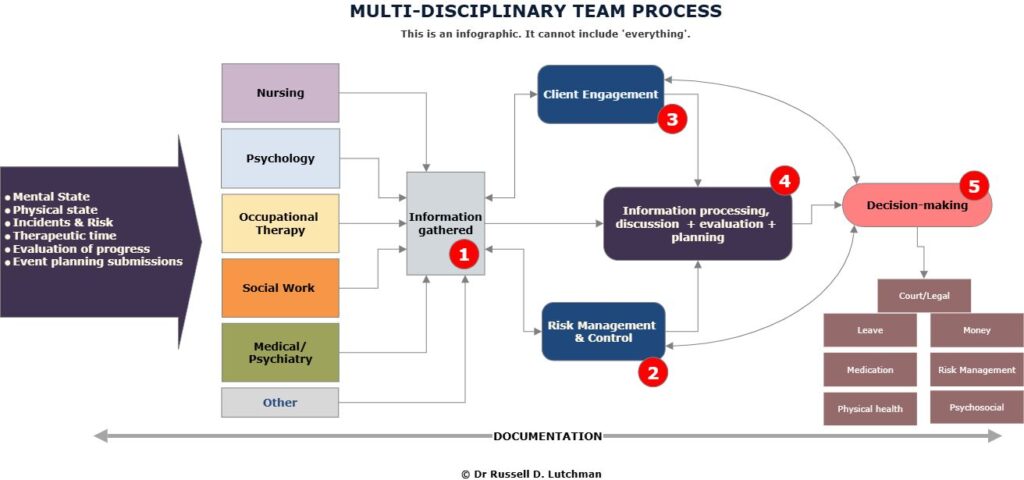
- Objective 1: Rapid Information Gathering (The Initial Check-Up)
- Description: Each member of the multidisciplinary team (nursing, psychology, occupational therapy, social work, medical/psychiatry, and others) efficiently provides their specialised update on the patient’s current mental and physical state, recent incidents, risk factors, therapeutic progress, and any upcoming needs. This is like each mechanic swiftly checking their designated part of the car, ensuring all vital information is presented efficiently and without interruption.
- Objective 2: Collective Risk Assessment & Management (Safety First!)
- Description: The entire team collaboratively discusses and assesses any potential risks. This combined expertise allows for immediate identification of hazards and rapid modification of plans to ensure the patient’s and others’ safety, much like a pit crew chief identifying a critical issue and deciding on immediate adjustments.
- Objective 3: Direct Patient Engagement (The Driver’s Input)
- Description: The Ward Round provides a crucial, structured opportunity for direct feedback to the patient. The team works with the patient to ensure their voice is heard, they understand the proposed changes, and they actively participate in refining the care plan. This is where the “driver” (patient) directly collaborates on the strategy for the next leg of the race.
- Objective 4: Collaborative Decision-Making & Planning (The Strategy Session)
- Description: This is the core of the “pitstop.” The team synthesises all the information, integrating patient input and risk assessments, to deliberate and formulate a precise, actionable care plan. Decisions are made about medications, therapies, support, and necessary adjustments, all aimed at optimising the patient’s performance for the journey ahead.
- Objective 5: Clear Documentation of Plans & Decisions (The Race Log)
- Description: All agreed-upon decisions—whether concerning legal matters, leave, finances, medication changes, ongoing risk strategies, physical health needs, or psychosocial support—are meticulously recorded. This detailed documentation serves as a clear roadmap for all involved in the patient’s continued care, ensuring consistency and accountability as the “car” leaves the pitstop.
2. The Operating Theatre Model: Intense focus for complex cases

For patients who are seriously unwell, or whose conditions are particularly complex, the Psychiatry Ward Round transforms into a highly focused “operating theatre.” In this scenario, the multidisciplinary team operates with intense concentration and precision, much like a surgical team, to make significant, critical adjustments to the patient’s care.
The primary aim of the Ward Round under this model is to perform a focused, high-stakes intervention, leading to precise and impactful adjustments that address critical, complex needs and ensure the patient’s stability and recovery.
The following are analogies that will not fully match the way psychiatry works.
Key objectives of the “operating theatre” approach
- Objective 1: Rapid assessment & diagnosis (The Pre-Op Evaluation)
- Description: The MDT rapidly and thoroughly assesses the patient’s critical condition from all specialised perspectives. This involves an urgent review of all available data to identify the most pressing and complex issues requiring immediate intervention, akin to a surgical team scrutinising scans and vital signs before a procedure.
- Objective 2: Vigilant, collaborative risk mitigation (Maintaining a Sterile Field)
- Description: With heightened awareness, the team collaboratively identifies and meticulously addresses all potential risks. Every decision is weighed against the highest standards of safety, ensuring the environment and interventions are as controlled and secure as possible, mirroring the rigorous protocols of a sterile operating theatre.
- Objective 3: Direct patient Involvement & informed consent (The patient as partner)
- Description: In these critical moments, direct and clear communication with the patient is paramount. The Ward Round provides the crucial setting for the team to provide direct feedback, explain the necessary “interventions,” and secure the patient’s understanding and active participation, ensuring informed consent for major care adjustments.
- Objective 4: Intensive, focused intervention planning (The Surgical Procedure Itself)
- Description: This is the core of the “operation.” The team, functioning with singular focus and collective expertise, processes all information to make significant, precise adjustments to the care plan. This might involve critical decisions about medication adjustments, urgent therapeutic strategies, or complex safety protocols, all performed with the intensity and precision of a surgical team addressing a life-threatening condition.
- Objective 5: Meticulous documentation & post-op care strategy (The Recovery Plan)
- Description: Every decision made and every “intervention” performed is documented with exceptional detail. This comprehensive record serves (analogously) as the “surgical notes” and the “post-operative care plan,” providing clear, precise guidance for all staff involved in the patient’s ongoing recovery. It ensures continuity of the carefully planned care.
Both the “Pitstop Model” and the “Operating Theatre Model” highlight the collaborative, patient-centred nature of the Psychiatry Ward Round, emphasising its role in optimising and adjusting patient care in a structured and professional manner.
Documentation: Capturing and guiding care
When you think in advance about the Coroner, you avoid risk of the Coroner thinkng too much about you!
Effective documentation during a Ward Round is mission-critical for ensuring continuity of care, accountability, and clarity in patient management. It transforms verbal discussions into a robust, accessible record that informs future actions and reviews. Robust documentation at Ward Rounds has good spin-off time-saving effects for other documents: CPA reports, Tribunal and Managers’ appeals reports, Annual Statutory Reports, S61 Reviews of treatment, and clinical summaries of progress.
This website has gone on at extreme length about documentation, so I will spare repetition as much as possible. Teams in Ward Rounds absolutely and without fail need to have robust documentation for ethical and legal accountability.
There is now ‘standard practice’ across many health care organisations where ‘anybody’ can ‘do documentation’. This is 100% wrong! It is fine for professionals to document their individual sessions, but the nature of Ward Rounds is quite different. People assigned to document for Ward Rounds need to be properly trained with the right skill set, and understand the prinicples of documentation. That must shine through in the quality of documentation.
Numerous health organisations across the UK have applied pressure to clinical staff to document at Ward Rounds. This is totally misguided. Why? It’s common sense that if a ward doctor or other member of clinical staff is busy processing information while typing then s/he is not fully engaged. How? His/her brain is busy processing spoken words to be converted into text, instead of thinking about clinical issues of high relevance.
Look at it another way – how would you like if you were under the knife (in surgery on your belly), and the surgeon or the assistant surgeons were busy watching a computer screen and writing up as they went along? Yes – that’s totally ridiculous. Seriously – does it need to be spelt out that in that scenario everyone has to be focused on what they’re doing and thinking. So – some will argue that in psychiatry there are no bellies and knives in a ward round. This sort of argument is called concretisation. Okay – yes there are no knives, blood and bellies etc. But it’s worse! How? The fact that there are no physical tools and information and thought are the intangible things that are being managed, means that even higher degrees of concentration are needed by team members. The person taking minutes is doing a most valuable job by capturing the thought processes and decision-making processes. Unfortunately, from my experience managers of forensic teams are generally clueless as to what actually is happening in Ward Rounds, or what’s at stake. Many of them think it’s ‘some sort of discussion’.
The folly of having team members documenting on the fly are as follows:
- Compromised clinical presence and engagement: When clinical staff are busy documenting in real-time, their attention can be diverted from fully engaging with the patient, observing non-verbal cues, and actively participating in dynamic team discussions. This can lead to a less holistic assessment and even deficient care.
- Increased cognitive load and risk of error: Simultaneously processing spoken information, converting it to text, and critically analysing the clinical situation significantly increases a clinician’s cognitive load. This multitasking can detract from complex clinical problem-solving, potentially leading to omissions, misinterpretations, or less thorough consideration of treatment matters.
- Diminished quality of documentation: Requiring clinicians to document under pressure can result in hasty notes, abbreviations, incomplete thoughts, missing context. All of the latter stands to compromise the clarity, accuracy, and utility of the patient’s record for subsequent reviews or other team members.
- Impact on team collaboration: A clinician focused on a screen during a Ward Round can disrupt the natural flow of discussion, reduce their ability to contribute spontaneously, and hinder the team’s ability to function as a truly cohesive unit. The clinician – treated as a scribe – has to stop typing to contribute meaningfully. This creates a risk that some preceding important point is not documented.
- Perception for patients and families: For patients, their relatives, and professional visitors, seeing a clinician focused on a device during sensitive discussions can create a perception of disengagement – as is quite probably the case.
In essence, the argument against clinical staff performing administrative documentation during Ward Rounds is rooted in the principle that clinical engagement and complex decision-making require undivided attention. Any measure that distracts from this core focus, no matter how well-intentioned for cost savings, risks undermining delivery of high quality care. Naysayers will argue that there is no evidence to support such a view. It is not a matter of evidence – it is a matter of basic common sense.
The utmost basics of documentation for Ward Rounds:
- Capture of important aspects of conversation: The documentation should reflect the salient points of discussions, ensuring that key observations, opinions, and perspectives shared by all multidisciplinary team members are accurately recorded. This includes any significant changes in a patient’s condition, response to treatment, or new developments.
- Documentation of considerations on risk management and controls: A clear and detailed record of discussions regarding risk assessment and the implementation of specific controls is essential. This includes outlining identified risks, the strategies put in place to mitigate them, and the rationale behind these decisions.
- Factors weighed in coming to decisions (the how and why): It is totally necessary to document not just what decisions were made, but also how and why those conclusions were reached. This includes a clear record of the evidence considered, the rationale for chosen interventions, the discussion of alternatives, and the weighing of benefits against risks. This transparency is a must for clinical governance, future reviews, and demonstrating robust decision-making.
- Concerns and inputs from visitors: Any concerns raised by relatives or friends, and their direct inputs or observations, should be explicitly noted. This acknowledges their valuable contribution, demonstrates that their voice has been heard, and ensures that family perspectives are integrated into the formal record and care planning process.
- Clarity of action points (plans): Action points derived from the Ward Round must be documented with absolute clarity, following the SMART model (Specific, Measurable, Achievable, Relevant, Time-bound). This includes:
- Specific actions: What exactly needs to be done?
- Who will do what: Clear assignment of responsibility to individual team members.
- By when: Defined deadlines for completion of tasks. This level of detail ensures accountability and provides a clear framework for the next Ward Round or subsequent team meetings to effectively check if plans have been carried out or are in process, driving the patient’s care forward.
Tips for relatives and approved visitors attending a Ward Round
Relatives and close associates can assist teams in working well for patients. It is often a valuable opportunity when relatives and friends supporting a patient, attend a Ward Round. They can inform the care team on a range of valuable matters. To make the most of this focused time, here are some helpful tips for visitors:
- Understand the purposes: A Ward Round is a dedicated time for the multidisciplinary team to discuss the patient’s progress, review their care plan, and make decisions about their ongoing treatment. It’s a formal meeting, not a general chat. Knowing its purpose helps in focusing on what’s most important.
- Appreciate time limitations: Ward rounds are often tightly scheduled, with many patients to review. The team will allocate a specific amount of time for each case with a small margin of flexibility. Being aware of these time constraints can help keep discussions concise and focused on key points.
- Prepare questions and concerns in advance: Before the Ward Round, take some time to note down any questions, observations, or concerns. Share these with the team before arrival. This ensures that important matters are not forgotten during the meeting. Be aware that the team may not be able to answer all questions within their limited time. The team may collaboratively opt to deal with some high priority issues.
- Communicate in advance where possible: If there are sensitive issues that require significant discussion, it can be highly beneficial to communicate these to a member of the care team (e.g., the patient’s nurse or key worker) before the Ward Round. This allows the team to be prepared, gather any necessary information, and allocate appropriate time to address these matters efficiently during the round.
- Focus on key outcomes: During the round, try to focus on understanding the main decisions and next steps for the patient’s care. The team will aim to clearly communicate the care plan, and preparing your questions helps in clarifying any uncertainties.
- Follow-up: If all issues cannot be addressed in the Ward Round due to time constraints, request to attend on another occasion. Alternatively request for a separate meeting.
How team members should prepare for visitors
Effective participation of relatives and friends in a Ward Round is a two-way street. This part will work equally for professional visitors. Just as family members prepare, the multidisciplinary team also has a vital role in ensuring these interactions are constructive and supportive.
- Resource allocation: The preparation and additional time during the round require dedicated staff resources, which can impact other ward activities or patient care.
- Efficiency is paramount: Because the time is so valuable, the emphasis on preparing to respond in advance to relatives and friends, and the team’s meticulous organisation and coordination, becomes even more critical. Every minute needs to be used effectively.
- Balancing needs: It’s a delicate balance between facilitating valuable family involvement and maintaining the operational efficiency of the Ward Round for all patients.
- Investment for advantage: The investment in this precious time, as mentioned is ultimately aimed at “putting the patient in a position of advantage.” This suggests that the benefits of robust family engagement and preparation are seen as outweighing the significant resource outlay.
This context underscores just how vital and well-orchestrated the entire Ward Round process, including visitor facilitation, needs to be.
Before visitors’ arrival
- Leader’s role in preparation: A designated leader should take charge of key preparatory matters. This includes identifying which relatives or friends wishing to attend, seeking the patient’s consent for their involvement, and coordinating with the relevant members for their attendance.
- Logistical preparation for in-person visits: If relatives or friends are attending in-person, a comprehensive “visitor’s pack” or clear communication should be provided in advance. This includes information on the hospital ward’s exact location within the hospital, parking facilities, access procedures, necessary security checks upon arrival, and a list of any items prohibited on the ward.
- Checking for attendance: The day before visitors attend the Ward Round, it must be confirmed by phone (not email) that visitors are aware of all arrangements and will be attending.
- Technical preparation for remote visits (MS Teams/Zoom): For remote attendance via platforms like MS Teams or Zoom, team members should confirm with visitors that their equipment and internet access are working correctly well before the scheduled Ward Round. Equally, team members must ensure their own equipment and internet connectivity are fully functional and tested to guarantee a smooth and uninterrupted virtual meeting.
- Designate a primary communicator: For each patient with attending relatives/friends, it can be helpful to designate a primary team member (e.g., the consultant or a lead nurse) to guide the discussion with the family. This ensures clear, consistent communication and prevents multiple team members from offering overlapping or conflicting information.
- Review pre-submitted questions and concerns: Prior to the Ward Round, team members should actively review any questions, observations, or concerns that relatives or friends have communicated in advance to the key worker or nurse. This allows the team to gather relevant information, prepare concise responses, and ensure these points are addressed during the limited time.
On the day of the visit
- Ensure punctuality, organisation, and coordination: Drawing from the ‘Pitstop’ and ‘Operating Theatre’ models, the team’s punctuality, clear organisation of information, and seamless coordination of roles are paramount. Arriving on time, having all relevant patient information readily accessible, and demonstrating a cohesive, well-drilled approach instils confidence in patients, their relatives, and friends. This assures them of the team’s professionalism and efficiency in managing care.
- Clarify Ward Round purposes for visitors: Before the round, ensure any visiting relatives or friends understand its formal purpose and the structure of the meeting. Setting clear expectations about how discussions will proceed helps manage their experience.
- Acknowledge time constraints transparently: While acknowledging the importance of family input, clearly communicate the anticipated time allocation for each patient’s review. This helps relatives understand the need for conciseness and allows the team to manage the flow effectively.
- Prepare responses and outcomes: Address key questions and concerns. Team members should prepare a concise summary of the patient’s progress, the proposed plan, and the rationale behind key decisions. Modify outcomes if new information arises. This allows for clear communication of the main outcomes during the round, directly addressing the family’s need to understand the next steps.
- Maintain a supportive and empathetic approach: Recognise that attending a Ward Round can be an emotional experience for relatives and friends. Team members should maintain a professional, empathetic, and patient-centred demeanour, fostering an environment where families feel heard and respected, even within the time constraints.
Conclusion and Takeaway Points
This article aims to provide very rich knowledge of best practices based on over 30 years of experience in psychiatry.
The Psychiatry Ward Round is far more than a routine meeting; it is a profound investment of collective expertise and precious time. Whether viewed as an efficient “pitstop” or a high-stakes “operating theatre,” its success fundamentally relies on a cohesive, well-prepared team, that manages its time.
Well organised and coordinated teams will avoid chaos and confusion. In doing so their work will be efficient and less stressful.
Visits to Ward Rounds by relatives or close associates, needs meticulous preparation, clear communication, and seamless coordination. This transforms Ward Round activities into a powerful catalyst for positive patient outcomes.
Much has been said about documentation. All healthcare organisations need to give effect to proper documentation, especially of Ward Rounds.
Ultimately, this dedicated, collaborative effort is about consistently putting the patient in the strongest possible position to achieve advantage in their recovery journey.