

Estimated reading time at 200 wpm: 6 minutes
The concept of teamwork is vast and well-documented. Countless books, studies, and seminars explore its every nuance. This wealth of information, however, can be overwhelming. It often leads to confusion rather than clarity, leaving teams with plenty of theory but little practical guidance.
Whether or not you agree our Fat Disclaimer applies
Many people understand the importance of teamwork. Yet they lack a simple way to remember and apply the key principles in their daily work. This is where a practical, memorable framework becomes invaluable.
This model will not be found in journals, books, or elsewhere on the internet
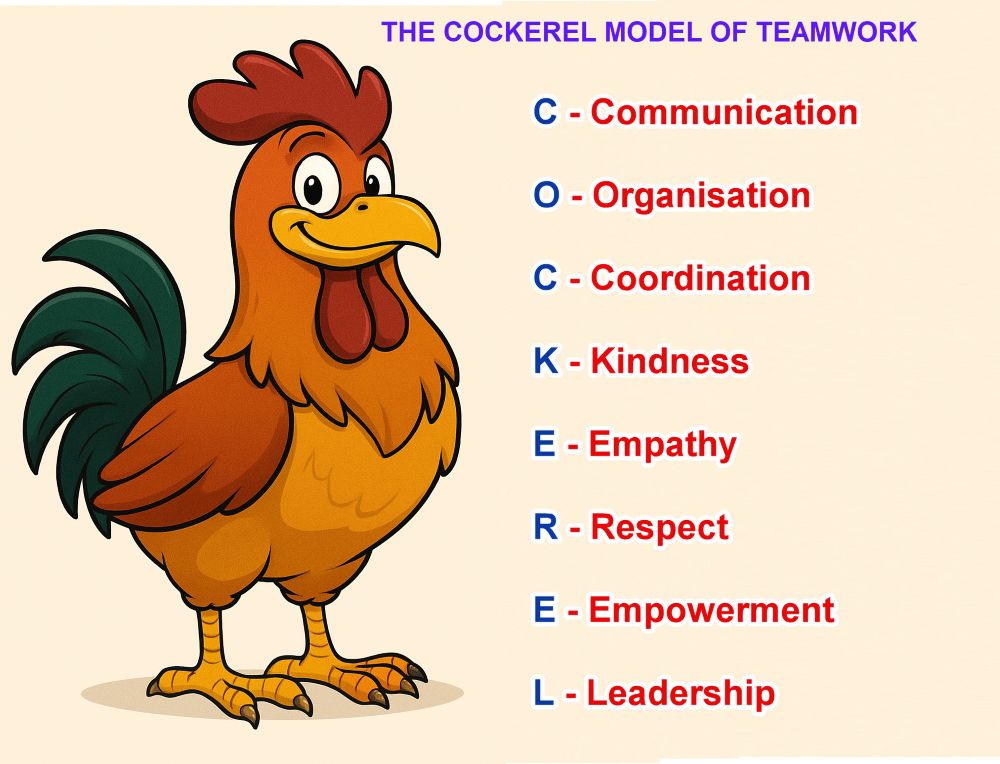
The COCKEREL Model offers a straightforward solution. It distils the most complex theories into a simple, actionable tool. The model is built on eight essential ingredients for successful collaboration. Its strength lies in its simplicity and ease of recall, making it useful for professionals and laypeople alike.
Unpacking the Model
This part will not be detailed with long explanations. Some aspects of the model overlap with others e.g. parts of empathy may overlap with kindness and respect.
C – Communication
Effective communication is the lifeblood of any successful team. It ensures that information is shared accurately and efficiently, preventing misunderstandings and fostering a collaborative atmosphere.
- Clarity: Expressing ideas and instructions in a clear and unambiguous way.
- Active listening: Fully concentrating on what is being said, understanding the message, and responding thoughtfully.
- Openness: Creating a safe environment where team members feel comfortable sharing ideas, concerns, and feedback without fear of judgment.
- Feedback: The ability to provide and receive constructive criticism in a respectful and helpful manner.
- Non-verbal cues: Being aware of body language, tone of voice, and other non-verbal signals that contribute to the overall message.
O – Organisation
A well-organised team has clear structures and processes in place, which allows for efficient workflow and accountability.
- Goal setting: Collectively defining clear, measurable, achievable, relevant, and time-bound (SMART) goals.
- Role clarity: Ensuring every team member understands their specific responsibilities, duties, and how their role contributes to the team’s objectives.
- Planning: Developing a strategic plan for achieving goals, including timelines, milestones, and resource allocation.
- Documentation: Keeping clear records of decisions, processes, and progress to ensure consistency and knowledge sharing.
C – Coordination
Coordination is the art of synchronising the team’s actions to ensure a smooth and efficient workflow, transforming individual efforts into a unified output.
- Workflow management: Structuring the sequence of tasks and activities to optimise efficiency and avoid bottlenecks.
- Timing: Ensuring that individual contributions are made at the right time to support the work of others.
- Adaptability: The ability to adjust plans and actions in response to changing circumstances or unforeseen challenges.
- Resource management: Effectively utilising the team’s available resources, including time, skills, and tools.
K – Kindness
Kindness is the cornerstone of a positive team culture. It fosters psychological safety and encourages a supportive and humane working environment.
- Patience: Showing tolerance and understanding, especially when team members are learning or facing difficulties.
- Appreciation: Recognising and acknowledging the contributions and efforts of others.
- Support: Offering help and encouragement to team members, both professionally and personally.
- Generosity: Willingly sharing knowledge, time, and resources with others for the benefit of the team.
E – Empathy
Empathy is the ability to understand and share the feelings of another. It is crucial for building strong interpersonal relationships within the team.
- Perspective taking: The capacity to see situations from another person’s point of view.
- Emotional awareness: Recognising and understanding your own emotions and those of your teammates.
- Compassion: A genuine concern for the well-being of others, which motivates supportive actions.
- Inclusivity: Actively ensuring that all team members feel valued and that their perspectives are heard and considered.
R – Respect
Respect involves valuing the diverse skills, experiences, and backgrounds of each team member, which is fundamental to a collaborative and inclusive atmosphere.
- Valuing diversity: Recognising the strength that comes from a variety of perspectives, backgrounds, and skills.
- Professionalism: Interacting with colleagues in a courteous and appropriate manner, regardless of personal feelings.
- Trust: Having confidence in the integrity, abilities, and reliability of your fellow team members.
- Consideration: Being mindful of how your words and actions might affect others.
E – Empowerment
Empowerment involves giving team members the autonomy, authority, and resources they need to take ownership of their work and make decisions.
- Autonomy: Granting team members the freedom and flexibility to perform their tasks in a way they see fit.
- Trust in competence: Believing in the skills and capabilities of team members to succeed in their roles.
- Delegation: Assigning tasks and responsibilities effectively, providing the necessary authority to carry them out.
- Encouraging initiative: Fostering an environment where team members feel confident to propose new ideas and take proactive steps.
L – Leadership
Leadership within a team is not always about a formal title. It can be a shared responsibility where different members step up to guide and influence the team’s direction and motivation.
- Vision: Articulating a clear and inspiring vision for the team’s future and its goals.
- Motivation: Inspiring and encouraging team members to perform at their best and remain committed to the team’s objectives.
- Decision-making: Facilitating a process for making sound and timely decisions, whether by consensus, consultation, or executive call.
- Mentorship: Guiding and developing the skills and confidence of other team members.
Conclusion: a practical path to better teamwork
Improving teamwork does not need to be a complex academic exercise. The field is full of dense theories that can be difficult to translate into real-world action. The COCKEREL Model is designed to cut through that noise. It provides a clear and accessible path for any team wanting to improve its effectiveness.
The true value of this model lies in its simplicity. It is not another long list of rules to be memorised and forgotten. It is a single, memorable word that acts as a practical guide for daily team behaviours. The ease of recalling a word like COCKEREL makes it a powerful tool during a busy workday.
The model can be used in several straightforward ways:
- Individuals can use the model as a personal checklist for their own contributions.
- Teams can refer to it during meetings to diagnose challenges or set shared goals.
- Leaders can apply its pillars to build and nurture a supportive and high-performing culture.
Ultimately, the goal is not perfection across dozens of theoretical points. It is about consistently applying a few fundamental principles that make the biggest difference. The COCKEREL Model places the power to build a better team directly into the hands of its members, offering a shared language for success.