

Estimated reading time at 200 wpm: 16 minutes
Most of the time, we think we’re reacting to the world as it is right now, but we’re usually just living out the consequences of a past that refused to fade. A single event—maybe a project that blew up or a warning heard in childhood—somehow stops being just a memory and hardens into a universal law. It creates a state where the clock stops on that specific subject, effectively locking reason in a basement while the rest of the world moves on. This is an attempt to map that weight, exploring how human attitudes and behaviours aren’t just stuck, but are actively defending a “freeze” that replicates itself across every level of our lives.
Whether or not you agree our Fat Disclaimer applies
It is visible in the way certain domestic “truths” survive their own debunking. There is often a lingering discomfort around the microwave oven, a reflexive step back as if the radiation remains the wild, unshielded force people feared forty years ago. It is the same logic that keeps a warm pot of soup sitting on a counter for hours; the warning that warm food destroys refrigerators is a fossilised piece of advice from the era of iceboxes, yet it remains a non-negotiable kitchen law for many. There is a similar, low-level conviction that mobile phones are essentially malignant heaters for the brain, a suspicion that persists regardless of decades of population data. And then smoking tobacco is not too bad because ‘your granny smoked like a chimney until 100’. These aren’t just isolated myths – or rather cultural forms of idiocy. They are the visible surface of a deeper cognitive stasis where the “rules” of a previous generation are still being used to navigate the present.
This calcification moves effortlessly into professional structures, where it stops being called a habit and starts being called a standard. It’s the legacy software suite that remains the backbone of a company because the person who understood its quirks left years ago, and the current team is too terrified of a system-wide collapse to suggest an upgrade. Institutional memory becomes a form of weight, ensuring that the same risks are avoided for decades even when the underlying technology has made those risks obsolete. The result is a persistent drift where companies find themselves brilliantly solving yesterday’s problems. They end up protecting the architecture of a past success at the direct expense of a future one, often without realising that the safety they are maintaining is the primary source of their stagnation.
The link between these kitchen-table rules and corporate debt is more than just a coincidence of habit; it’s a shared origin. It points to a singular mechanism where we stop treating the world as a stream of new data and start treating it as a collection of closed files. If the same “freeze” happens at both scales, we’re likely dealing with a cognitive constant that doesn’t care about the size of the stakes. The analysis that follows attempts to pull back the curtain on this constant. It moves from these visible symptoms toward a more formal breakdown of the mechanics—the specific way we anchor ourselves and the recursive loops that make a state of “Terminal Stability” feel like common sense.
1. The Anatomy of a Static Node: A Case Study in Automated Safety
To observe the recursive nature of inertia, consider the rejection of modern automated pressure cookers. In a historical period (e.g., 1980s to 1990s), a mechanical failure led to a domestic accidents. The process affected Americans disproportionally compared to people in other nations. What happened?
- Fear amplified by media
- Cultural elevation of slow cooking as virtue
- Market-driven substitution and erasure
- Intergenerational knowledge collapse + class stigma
This sequence served as the Initial Anchor in the early 1980s and persisted for about 15 years. [Google is your friend]. The pathways to Initial Anchors are not specific to ‘pressure cookers’ in America’s history. The story is paralleled by similar for microwaves, telephones, electricity, air-travel, and much more. There are several pathways towards anchoring of individuals, groups and larger populations of people.
2. The Scaling of the Anchor (The Fractal Path)
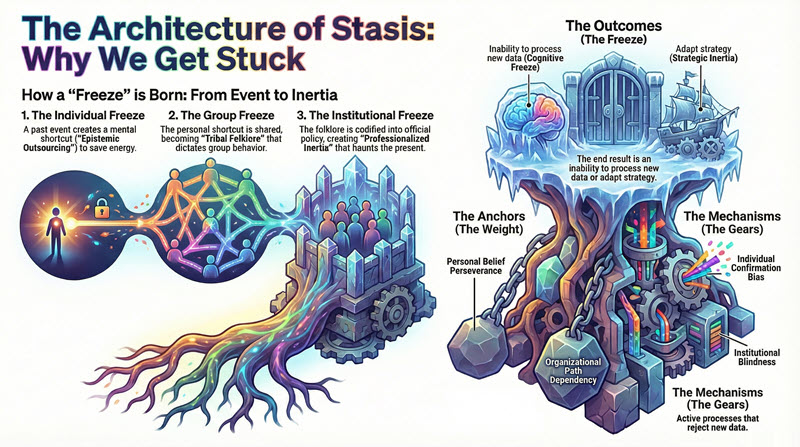
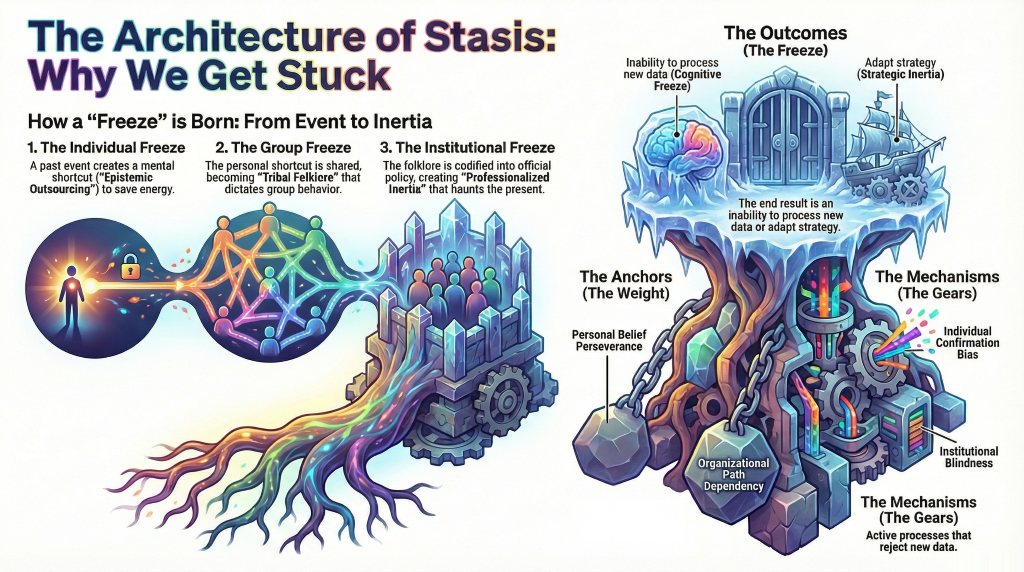
The transition from a single event (or small batch) to a permanent freeze follows a recursive pattern across three scales:
- The Individual (Biological Energy Conservation): The brain, seeking to avoid the high metabolic cost of constant re-evaluation, encodes a simple heuristic: “Automated pressure is a bomb.” This is Epistemic Outsourcing to a past version of the self.
- The Group (Social Cohesion): The individual transmits this “safety rule” to descendants. It becomes Tribal Folklore. For the offspring, the ban is Second-Hand Rigidity; they have no memory of the event, yet they defend the ban as a core value.
- The Institution (Structural Risk Aversion): In a professional environment, the failure is codified into a Standard Operating Procedure (SOP). The ban is now Professionalised Inertia. Even as technology evolves to include redundant safety sensors, the policy remains a Living Ghost, haunting the present.
3. The Structural Mapping of Stasis
The following tables categorise the specific elements that maintain this state of inertia, showing the “twin” concepts that exist in both interpersonal and organisational spheres.
- Table A: The Anchors (The Weight)
- Table B: The Mechanisms (The Gears)
- Table C: The Outcomes (The Freeze)
| Category | Interpersonal Concept | Organisational Concept | The "Anchor" Mechanism |
|---|---|---|---|
| Origin & Source | Genetic Fallacy | Reputational Bias | Evaluation is based on who said it or where it came from, rather than the data itself. |
| Persistence | Belief Perseverance | Path Dependency | A refusal to update a worldview because the initial "imprint" was so strong. |
| Reaction | Psychological Reactance | Status Quo Bias | The aggressive "It’s final!" response used to protect established autonomy. |
| Systemic Lag | Bayesian Stagnation | Hysteresis | The system’s current state is a literal prisoner of its past history. |
| Mechanism | Interpersonal (Psychological) | Organisational (Systemic) | The "Work" it Performs |
|---|---|---|---|
| Data Filtering | Confirmation Bias | Institutional Blindness | Only noticing information that proves the "thing" is still broken. |
| Resource Saving | Heuristics | Standard Operating Procedure | Replacing active thought with a "rule of thumb" or a policy shortcut. |
| Boundary Setting | Cognitive Closure | Settled Strategy | The act of slamming the door to satisfy the need for a final answer. |
| Fear Response | Loss Aversion | Risk Mitigation | Weighing the pain of a repeat failure much more heavily than a new success. |
| Outcome Category | Individual Feature | Organisational Feature | The Nature of the "Freeze" |
|---|---|---|---|
| Intellectual | Cognitive Freeze | Strategic Inertia | The inability to process new data; the "file" is permanently locked. |
| Behavioural | Compulsive Avoidance | Process Calcification | Action is dictated by the avoidance of the "ghost" of the past. |
| Temporal | Anachronistic Living | Legacy Debt | Operating in the present using a mental map drawn in a previous decade. |
4. The Fractal Momentum of Stasis
This isn’t just a series of similar-looking problems; it’s a self-reinforcing engine built on self-similarity across every scale.
Self-Similarity: The aggressive “it’s final” from a single person at the micro level is functionally identical to a boardroom’s refusal to revisit a failed strategy at the macro level. Both exist to protect the system’s current energy state by denying that time has moved on.
The Feedback Loop: The momentum travels upward where an individual’s cognitive freeze informs the group’s tribal folklore, which then provides the “common sense” justification for an organisation’s professionalised inertia. Each layer effectively validates the ones above and below it.
Recursive Fortification: The result is a process where the original logic of a ban is buried under new layers of defence. In this fractal structure, the cost of re-evaluation is always perceived as higher than the cost of inaccuracy. Consequently, every year the stasis remains in place, the cognitive ice becomes thicker. This happens not because the threat remains, but because the architecture of the “no” has become too complex to dismantle. The system isn’t just avoiding a historical failure anymore; it is defending its own internal logic and identity.
5. The Temporal Bottleneck
Inertia creates a Temporal Mismatch. While the external environment moves at high velocity, the internal cognitive state remains in Terminal Stability. The “It’s final” response serves as a Linguistic Firewall, signaling the end of Bayesian Updating. At this junction, Epistemic Arrogance takes over; the internal map is preferred over the physical terrain. Reasoning is not used to evaluate the new evidence; it is used to invalidate the source of the evidence.
6. The Intelligence Trap
The idea that being smart makes you more flexible is one of our most persistent myths. In reality, a high-IQ brain is often just a much better-funded defence department. It’s not that intelligent people don’t see the data; it’s that they have the architectural skill to build a cathedral out of their own justifications. They don’t just “stay stuck”—they craft a version of reality where staying stuck is the only sophisticated choice.
The Bodyguard of the Mind
For most people, being wrong is embarrassing. For a highly intelligent person, being wrong is an existential threat. When your entire identity is built on being the one who sees clearly, the one who is “right,” or the expert in the room, admitting a mistake isn’t just a pivot. It feels like a structural collapse. The brain detects this threat to the ego and instantly deploys reason as a security system. This is where intelligence stops being a tool for inquiry and starts being a “Bodyguard of the Mind.” It will tirelessly scan for tiny flaws in new evidence, not because it wants the truth, but because it needs to keep the “Anchor” safe from being disturbed. It’s a specialised form of self-protection where the logic is sound, but the goal is the preservation of stasis.
The Weaponisation of Reason
When an intelligent person is confronted with evidence that should force a “thaw,” they don’t ignore it—they may process it with a sort of aggressive skill. They use their intellect to perform “surgical strikes” on any data that threatens the freeze. This isn’t a conscious lie; it’s a deep, automated redirect.
- Surgical Dismissal: They will find one small methodological flaw or a single outlier in a dataset and use it to invalidate the entire premise. They have the vocabulary to make “I don’t like this” sound like “This lacks rigorous foundational support.”
- The “Wait and See” Stall: They use their understanding of complexity to argue that the situation is too fragile for a change. They turn “careful consideration” into a permanent holding pattern, using logic to explain why doing nothing is the most responsible action.
- Semantic Reframing: They will change the definitions of the problem until the new evidence no longer applies. By moving the goalposts with intellectual grace, they ensure the Initial Anchor remains relevant even as the physical world changes around it.
- Intellectual Sunk Knowledge: They have spent years, maybe decades, building a reputation on a specific worldview. Admitting they were wrong means acknowledging they’ve been a brilliant advocate for a dead end. The smarter they are, the more beautiful and complex that dead end has become, making it almost impossible to walk away from.
7. The Mathematics of Stasis: The Vector Field Model for the Theory of Everything
To move from behavioural observation to a formal “Theory of Everything,” inertia must be viewed through the lens of cognitive physics. In this model, the “Freeze” is not a choice, but a state of Terminal Stability within a high-energy vector field. Vector field theory is nothing new – but it will be new to some people. It has been properly used for modeling and understanding directional physical phenomena like fluid flow (wind, ocean currents), gravitational and electromagnetic forces, allowing scientists to visualize and analyze movement, forces, and fields across space, with applications from weather forecasting and navigation to electromagnetics and general relativity. The following equations are constructed for a conceptual framework. It is not possible in the human dimension to plug figures in and get an ‘answer’ or ‘diagnosis’.
Vector 1: The Gravitational Sink
The Initial Anchor acts as a singularity. Every new idea introduced into the cognitive space is subjected to a pull toward this centre. In a “Frozen” mind, the gravitational constant is so high that escape is impossible without external catastrophe.
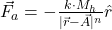
- F_a The force vector pulling the mind back to the anchor.
- M_h Historical mass (the weight/trauma of the original event).
- k Constant representing identity-protective cognition.
- r The current coordinate of the individual’s belief or mental state.
- A The coordinate of the fixed Initial Anchor.
- n The degree of recursive fortification (steepness of the gravity well).
- r^ The unit vector indicating the direction toward the anchor.
Vector 2: The Bodyguard Vector
The Intelligence Trap functions as a cross-product. High intelligence acts as a deflecting force, rotating the energy of new evidence into Sophisticated Motivated Reasoning.

- V The vector of energy deflected away from objective evaluation.
- E The incoming vector of new evidence or data.
- I The intelligence coefficient (the multiplier for the deflection).
- ∇ϕ The gradient of the existing frozen worldview or mental landscape.
- × The cross-product operator, signifying the redirection of force.
Vector 3: The Hysteresis Operator
Representing the Temporal Bottleneck. The system state is heavily weighted toward past observations, where the decay constant approaches zero.

- S(t) The current frozen state of the belief system at time t.
- O(τ) Observations or inputs received at historical time τ.
- λ The decay rate of historical influence; as λ → 0, the past never fades.
- t The current moment in time.
- τ The integration variable representing all moments in the past.
- e The base of the natural logarithm, representing exponential decay.
8. The Breaking Point: Conditions for a Thaw
We like to think we can talk our way out of these freezes, but we usually can’t. Because the “freeze” is built on the idea of safety and identity, better data feels like an attack rather than an invitation. For a system in Terminal Stability to actually change, it usually requires more than just an argument; it requires a breach.
True change often comes through External Catastrophe. If the current stasis becomes more dangerous than the thing being avoided—like a bankruptcy that makes an old legacy system literally unusable, or a regulatory shift that turns a “safe” standard into a legal liability—the potential well collapses. It isn’t a rational update; it’s a forced evacuation.
The only other way out is Identity Decoupling. If the person or organisation can be convinced that their value doesn’t depend on being “right” about the 1970s failure, the Intelligence Trap might lower its guard. But as long as the “no” is a wall that protects the ego, the ice remains.
9. Conclusion
The complexity of this stasis suggests that we aren’t dealing with a simple error in logic. It’s a dense, multi-layered architecture where every piece of the puzzle works to keep the others in place. When a system reaches this level of recursive self-preservation, it stops being a choice and starts being a condition.
This matters because it shifts our perspective on what it actually takes to change. If we want to move again, we have to look past the surface-level arguments and see the gravity of the structure itself. It isn’t enough to provide better data if that data is being fed into a machine designed specifically to deflect it. Complexity here isn’t a complication to be solved, but the terrain we are walking on. Recognising that we are fighting a structural ‘freeze’—not just a bad opinion—is the only way to begin looking for the right tools to break it.
The human brain-mind not uncommonly exerts great effort in defending its squatter’s rights. This is seen from the perfectly sane to the most delusional detained in mental hospitals.
10. Mindmap

11. Glossary of Terms
- Asymptomatic Freeze: A state of cognitive or organisational inertia that feels like stability or “common sense,” masking the fact that progress has stalled.
- Bayesian Updating (Failure of): The breakdown of the process by which a rational actor updates a belief based on new evidence.
- Bodyguard of the Mind: The automated deployment of intelligence to neutralise threats to the ego, effectively stopping inquiry to preserve an anchored belief.
- Chronostatic Cognition: A mental state where the internal clock regarding a topic has stopped, forcing the use of an obsolete historical filter.
- Epistemic Arrogance: The conviction that one’s internal mental map is superior to objective external reality.
- Epistemic Outsourcing: Delegating critical thinking to a past version of oneself or a third-party authority to conserve mental energy.
- External Catastrophe: A forced system collapse (such as bankruptcy or regulatory shift) that makes stasis more dangerous than change, creating a non-rational “thaw.”
- Gravitational Sink: The mathematical pull of the Initial Anchor that makes escaping a cognitive “freeze” increasingly difficult as the individual approaches the core of the belief.
- Hysteresis Operator: The system’s tendency to remain a prisoner of its past states, where current outputs are dictated by historical inputs rather than present conditions.
- Identity Decoupling: The process of separating an individual’s self-worth from their history of being “right,” allowing for the possibility of updating a worldview without existential threat.
- Identity-Protective Cognition: A defensive mechanism where the brain rejects evidence that threatens a core belief linked to self-identity or belonging.
- Initial Anchor: The original historical event or data point that establishes a belief as a fixed centre.
- Linguistic Firewall: Conversational “shut-off” phrases used to halt inquiry and protect a frozen state.
- Living Ghost: A historical policy or fear that persists long after the original threat has disappeared.
- Path Erasure: The psychological deletion of future opportunities because a past failure has made that “road” unmentionable.
- Professionalised Inertia: The codification of past failures into rigid institutional policies (SOPs).
- Rationalised Stasis: Using high-level reasoning to build sophisticated justifications for remaining stationary.
- Recursive Fortification: The layering of new justifications and social capital over an old ban, making the “freeze” increasingly complex and difficult to dismantle.
- Recursive Self-Preservation: The fractal nature of inertia where every scale of the system reinforces the “freeze.”
- Second-Hand Rigidity: The defence of a strict belief by individuals who did not personally experience the triggering event.
- Sophisticated Motivated Reasoning: The use of intellect to actively discredit information that contradicts an anchored belief.
- Strategic Blindness: An inability to perceive new realities because they fall into a “shadow” created by past failures.
- Sunk Knowledge: The intellectual equivalent of sunk costs; refusal to abandon a belief due to invested time and identity.
- Temporal Bottleneck: The point where present-day information is blocked by a static historical judgment.
- Terminal Stability: A state of equilibrium where a belief is so well-defended it will never change without a massive external shock.
- Tribal Folklore: The conversion of personal experience into a collective narrative that dictates group behaviour.