


Estimated reading time at 200 wpm: 15 minutes
Bayesian reasoning is not, in this context, a demand for spurious mathematics. It is a disciplined way of thinking under uncertainty. Its value in forensic psychiatry lies in requiring the assessor to distinguish between the baseline picture, the new evidence, the weight of that evidence, and the updated judgement that follows.
Whether or not you agree our Fat Disclaimer applies
In ordinary professional language, the question is simple: what was already known, what has now emerged, how much should it change the view, and why? [See also: Applying Bayesian Thinking Models in Suicide Risk Assessments]
This matters because high-consequence assessments are often carried out in difficult conditions. Information may be incomplete, contradictory, unstable, concealed, emotionally charged, or strategically shaped. Under such conditions, the risk is not merely that the assessor will make an error. The risk is also that the assessor will mistake a superficial conclusion for a reasoned one.
Bayesian discipline helps counter that danger. It makes the route from evidence to judgement more explicit. It helps guard against overvaluing one striking statement, underweighting the broader history, or allowing the latest presentation to dominate the whole assessment without sufficient justification.
How Bayesian analysis works in clinical judgement
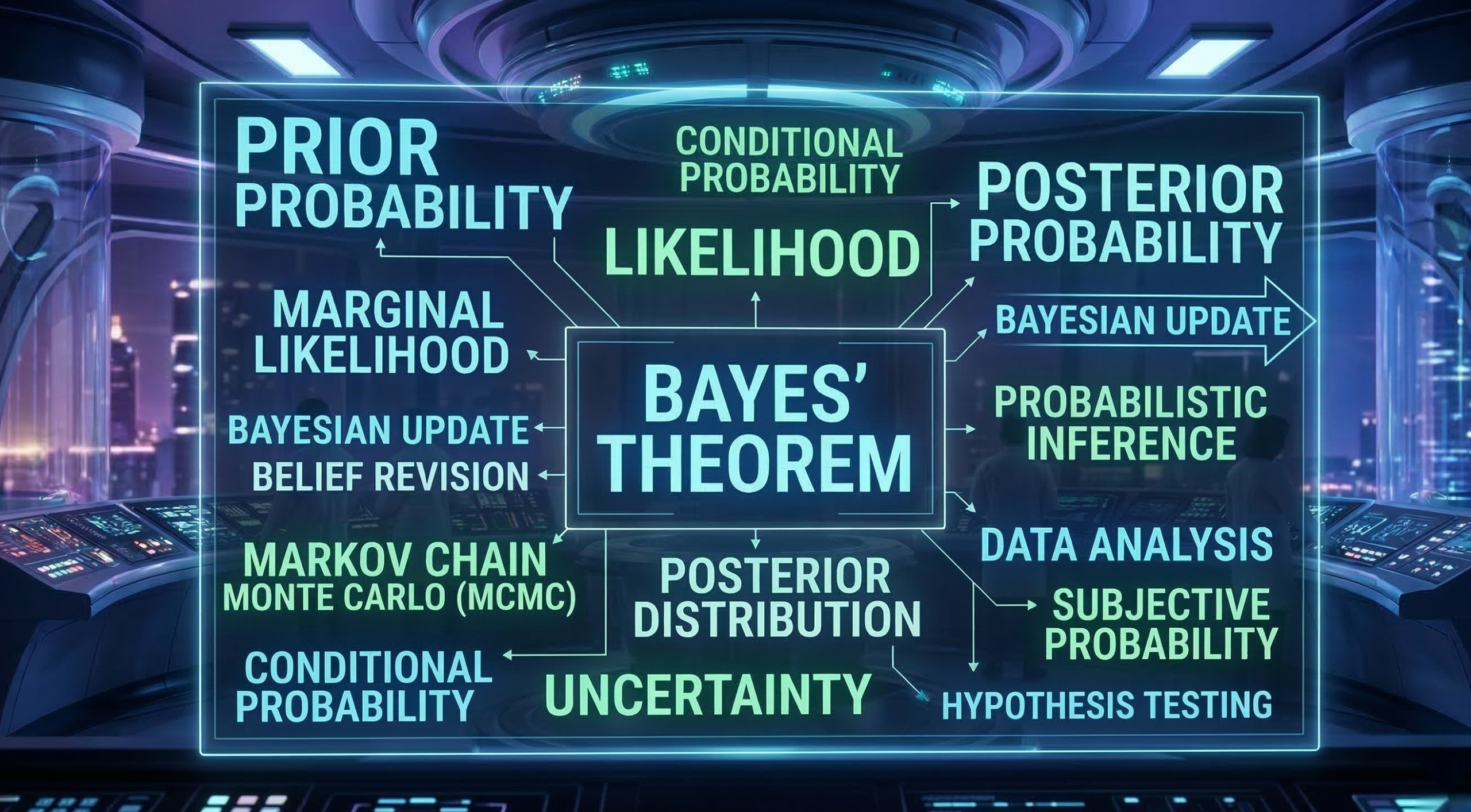
Bayesian reasoning does not treat one statement as decisive. It starts with the prior picture, weighs the new evidence, compares alternative explanations, and then produces an updated judgement.
What Bayesian thinking is not
It is not blind mathematics, not certainty, and not the claim that everything can be reduced to a neat number.
What Bayesian thinking is
A disciplined way of asking how much a new fact should actually change your mind in the light of what was already known.
Prior
What was the risk before the latest statement or event?
History, diagnosis, recent deterioration, preparatory acts, access to means, substance use, collateral information.
Evidence
What new information has appeared?
For example: “I am not suicidal”, a bag of collected tablets, agitation, intoxication, behaviour change, family concerns.
Likelihood
How strongly does that evidence support one explanation over another?
Does the denial meaningfully reduce concern, or is it weak because people may conceal intent, fluctuate, or speak defensively?
Posterior
What is the updated judgement after combining the prior with the new evidence?
Final view: lower, unchanged, or higher concern. Then document why.
The logic in one line
The point is not to worship a formula. The point is to stop one convenient item of evidence from dominating the whole assessment.
Worked example
Prior: A patient has severe depression, previous overdose, recent losses, alcohol misuse, and has been gathering tablets. Baseline concern is already elevated.
New evidence: He says, “I have no plans to kill myself.”
Likelihood question: If he were truly at high risk, could he still deny intent? Yes. If he were genuinely at low risk, could he also deny intent? Yes. Therefore the denial is a limited signal.
Posterior: Concern may reduce slightly, stay unchanged, or remain high depending on the whole context. It should not collapse simply because of the denial.
Common failure
Bad reasoning: “He denied suicidal thoughts, therefore current suicide risk is low.”
That treats a single statement as decisive and ignores the prior picture.
Better reasoning: “Denial of ideation was noted, but this is a weak standalone indicator in the context of preparatory acts, deteriorating mood, past self-harm, and substance misuse.”
That is Bayesian thinking in ordinary professional language.
Simple visual flow
The central logic
The practical logic is straightforward.
The assessor begins with the prior picture. That does not mean prejudice in the pejorative sense. It means the baseline risk or baseline formulation before the latest interview, event, or disclosure. That baseline may already be shaped by diagnosis, past self-harm, violence, substance misuse, chronic instability, help-seeking, family support, prior compliance, or previous disengagement. The assessment may well discover that some priors were erroneous or unreliable – and those will be stated as contributory to any change of ‘belief‘. In other words the priors are anchored at the level of ‘triage’ but may well change.
New evidence then emerges. This may come from self-report, behaviour, collateral information, objective findings, observations, or recent events. Some of it may aggravate concern. Some may mitigate it. Some may appear important but carry little real evidential weight.
The essential task is then to ask not merely whether a factor is present, but how much weight it deserves. Is it reliable? Is it consistent with the wider picture? Does it discriminate between competing explanations? Is it genuinely protective, or merely superficially reassuring? Is it aggravating in a way that materially shifts the assessment, or is it simply another item that fits an already known pattern?
Only after that process can an updated judgement be reached. That updated judgement is not a ritual conclusion. It is the product of structured, comparative reasoning.
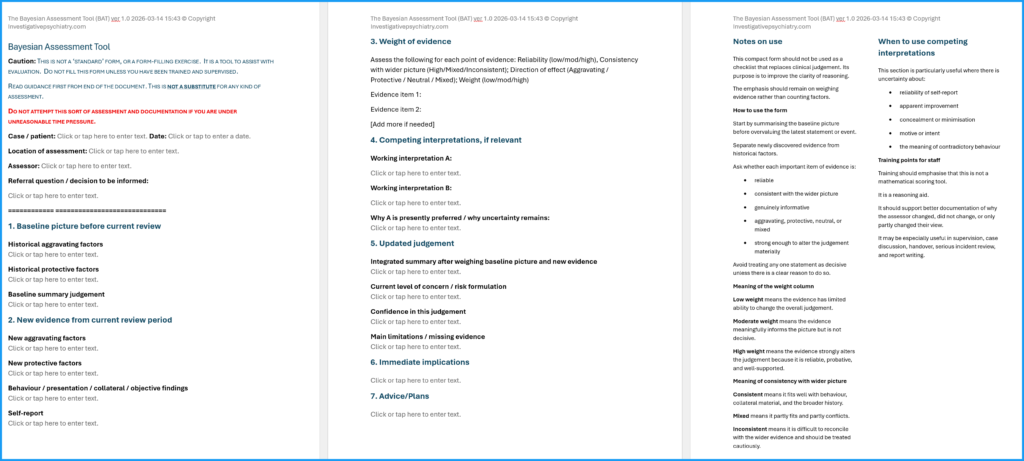
The Bayesian Assessment Tool (BAT)
A full version of the BAT is available on request. This is not a ‘validated’ instrument. It is derived from first principles and common sense. Tough – if the writing is too small for anyone to read.
A compact template approach
A sensible operational form would be compact but robust. The live front page is concise enough for routine use. Guidance on how to use the form can sits on the reverse or as a separate training note.
The front page contains:
- case details
- referral question or decision to be informed
- baseline picture before current review
- new evidence from the current review period
- a section for weight of evidence
- competing interpretations where relevant
- updated judgement
- confidence and limitations
- immediate implications or required action
The reverse side or training note explains what is meant by reliability, consistency, evidential weight, mixed factors, and competing interpretations. That allows the method to be used by teams without cluttering the form itself.
How it works
Historical and newly discovered factors
One of the clearest strengths of Bayesian reasoning is that it allows aggravating and protective factors to be understood dynamically rather than as static checklist items.
Historical factors usually help form the prior. These may include past suicide attempts, prior violence, repeated admissions, long-standing psychotic illness, chronic alcohol misuse, repeated disengagement, or established patterns of instability. Historical protective factors may include stable attachments, previous help-seeking, treatment engagement, family support that has actually functioned protectively, employment, moral commitments, or meaningful future orientation.
Newly discovered factors act as incoming evidence. These may include recent humiliation, gathering of tablets, intoxication, escalating hopelessness, acute stressors, behavioural change, a new expression of intent, or concealed access to means. Newly discovered protective factors may include genuine help-seeking, willingness to accept admission, spontaneous disclosure, actual removal of means, a credible short-term plan for safety, or a supportive person who is immediately and meaningfully available.
The crucial point is that these factors are not simply counted. They are weighed. A long-standing protective factor may carry less weight during a period of acute disinhibition or preparation. A newly stated protective intention may sound reassuring but have limited significance if contradicted by behaviour or collateral information. Equally, a newly aggravating feature may be highly probative or only marginally so. The question is always how much it should alter the prior view.
| Category | Historical factors shaping the prior | Newly discovered factors acting as evidence | Posterior implication for judgement |
|---|---|---|---|
| Aggravating factors | Past suicide attempts, recurrent severe depression, chronic substance misuse, previous psychiatric admission, enduring social instability, longstanding access to means. | Recent humiliation or loss, gathering tablets, intoxication, withdrawal from contact, new hopelessness, writing notes, concealed preparation, agitation. | Baseline concern was already elevated; new evidence may strengthen the conclusion that current risk is materially increased and requires active management. |
| Protective factors | Stable attachment to family, consistent help-seeking, religious or moral objection to suicide, past engagement with treatment, dependable housing or support. | Willingness to accept admission, spontaneous disclosure, genuine help-seeking, removal of means, credible future plans, supportive person available now rather than merely in theory. | Concern may reduce, but only to the extent that the protective factors are credible, available, and strong enough to offset the aggravating picture. |
| Verbal denial | Prior risk may already be high because of history, diagnosis, behaviour, and context. | The patient says there is no suicidal ideation, intent, or plan. | Denial may slightly reduce concern, leave it unchanged, or carry little weight if inconsistent with behaviour, preparation, collateral evidence, or the wider clinical picture. |
| Collateral information | Previous accounts from family or services may already suggest unreliability, concealment, impulsivity, or previous serious episodes. | Family, carers, police, ambulance staff, or ward staff provide fresh observations that either support or contradict the patient’s account. | A coherent collateral account may significantly alter the final judgement because it can strengthen or weaken the reliability of the patient’s presentation. |
| Dynamic interpretation | Historical factors set the starting position; they do not mechanically determine the outcome. | New evidence may be aggravating, protective, mixed, or unstable over time. | The final judgement should reflect weighted interpretation, not mere counting of checklist items. The question is how much the new information should actually change the prior view. |
Why single statements are often weak signals
This framework is especially useful where one item of evidence is liable to be overvalued. A common example is verbal denial of suicidal ideation, intent, or plan.
A denial may be relevant. But Bayesian reasoning asks how relevant it really is in context. If the person were at elevated risk, could they still deny intent? Yes. If the person were at low risk, could they also deny intent? Yes. That means the denial may be only a limited signal. Its presence alone may not justify a substantial reduction in concern, especially where it sits alongside preparatory acts, severe deterioration, intoxication, past self-harm, or collateral contradiction.
This does not mean self-report is worthless. It means self-report must be weighed rather than worshipped. It is one strand of evidence among others, and its value depends on timing, consistency, reliability, and context.
Competing interpretations
Another important discipline is the explicit recognition of competing interpretations. This is one of the most useful Bayesian habits in forensic work.
Instead of drifting into one preferred account too early, the assessor can ask what other live explanations remain plausible. For example, an apparent reduction in suicide risk may be genuine and sustained. Equally, it may be superficial, strategically presented, short-lived, or inconsistent with objective findings. A denial may be broadly reliable, or it may be only weakly informative because it conflicts with behaviour and context.
The point of stating competing interpretations is not to sound artificial. It is to protect against tunnel vision. Once one explanation becomes dominant too early, contradictory evidence is more easily minimised or assimilated. A structured acknowledgement of live alternatives may improve both the thinking and the defensibility of the record.
Mental effort and documentation burden
Stepping back from the method itself brings a more sobering point into view.
If these assessments are taken seriously, as they ought to be, it becomes obvious that they cannot honestly be reduced to a few stock questions, a brisk impression, and a defensive line of documentation. The cognitive effort is substantial because the clinician is trying to reason under uncertainty in the presence of often incomplete, shifting, and sometimes strategically shaped information. All that requires concentration, comparison, restraint, judgement – and a high degree of situational awareness.
The documentation burden follows from the same fact. If the reasoning is complex, the record must show enough of the reasoning to make the conclusion intelligible later – like in a Coroner’s Court. Otherwise the note may preserve a conclusion without preserving how it was reached. That creates clinical danger and weakens later scrutiny.
There is therefore a structural tension in practice. Systems often demand speed, throughput, and standardised completion. Serious assessment demands time, careful thought, and sufficiently articulated reasoning. That tension can lead to notes that look complete on the surface while concealing thin analysis underneath. A better framework does not remove that tension, but it may make the reasoning more disciplined and more visible.
Implications for practice
A Bayesian approach does not need to announce itself noisily in the final report. In many settings, its greatest usefulness may be internal. It structures the clinician’s reasoning without forcing the outward language of the report into overtly mathematical terms.
In practice, this may mean using ordinary headings such as:
- baseline picture
- new evidence
- weight and reliability of evidence
- competing interpretations
- updated judgement
- limitations and confidence
- practical implications
That makes the method more usable and more acceptable while preserving its core discipline.
It may be particularly useful in forensic psychiatry where the work often depends on weighing inconsistent accounts, linking historical and current factors, and explaining why one piece of evidence was not treated as decisive.
A note of caution
The method has real risks if used badly. It can create false precision, pseudo-mathematical authority, and the illusion that uncertainty has been mastered merely because it has been structured. It can also tempt people into factor-counting instead of reasoning.
Its value therefore depends on modesty. It should be used as an aid to disciplined judgement, not as a substitute for it. The language of “prior”, “likelihood”, and “posterior” may be useful conceptually, but in routine work it may often be better translated into ordinary professional language such as “baseline picture”, “weight of evidence”, and “updated judgement”.
Priors can be changed or disregarded, when there is sufficient evidence and reason to do so. As there is a National rash of EUPD post-COVID – and EUPD is about the most poorly diagnosed condition known – caution should be exercised in dismissing it entirely if there is no evidence of a robust assessment that supports it. It is often the case that – based on experience – that ICD-11 Personality Difficulty (which is not a diagnosis) is labelled as some for of Personality Disorder. Misdiagnosis of PD therefore could mean that a significant disturbance of personality is part of the clinical picture.
The same applies to schizophrenia, depression and bipolar. Most GPs and psychiatrists do not use ICD-10 or ICD-11 in a conspicuous way to make diagnoses; they divine the diagnoses out of *thin air. As incompetent as that may be, that does not mean the diagnoses should be easily dismissed (as lacking relevance). [*this is based on vast experience over 35 years in psychiatry.]
Conclusion
The deeper lesson is not simply about Bayes. It is about the seriousness of these assessments.
Once one starts to think in this way, it becomes much harder to pretend that high-consequence psychiatric judgements can be responsibly made through ritual questioning and minimal documentation. The intellectual labour is greater than that. The moral burden is greater than that. The documentary burden is greater than that.
That is not an argument for abstraction or bureaucracy. It is an argument for disciplined thinking, explicit reasoning, and records that preserve the substance of judgement rather than merely its outcome.
In that sense, Bayesian reasoning is valuable not because it turns forensic psychiatry into mathematics, but because it insists that uncertainty be handled with more honesty, more structure, and more care.