


Estimated reading time at 200 wpm: 32 minutes
Daniel was 34 years old and on remand, awaiting trial for a serious offence. He had been in custody for six weeks. His history included two previous suicide attempts by hanging in the community three years earlier, a diagnosis of emotionally unstable personality disorder, and a longstanding pattern of alcohol and polysubtstance misuse. He was lost to contact with his mental health team in the community. The prison where he is housed is notorious for ‘drugs’ being readily available. His first assessment in prison had resulted in a recommendation for in-reach mental health support. [See also: Bayesian reasoning in forensic psychiatry – Investigative Psychiatry]
Whether or not you agree our Fat Disclaimer applies
On a Tuesday morning, a mental health nurse conducted a routine review. The entry in the clinical record was brief. Daniel had been “engaging well.” His mood was noted as “low but stable.” He denied suicidal ideation. He denied thoughts of self-harm. He said he was “fine.” The nurse recorded that no ACCT (Assessment, Care in Custody and Teamwork) was indicated. The duration of the review was not recorded but estimated retrospectively to be eleven minutes. Documentation time was estimated at less than 60 seconds.
What the record did not note was that Daniel had been unusually quiet on the wing for several days. A prison officer had mentioned this to a colleague but did not escalate it. Daniel had declined two meals and had stopped going to the gym, which he had previously attended daily. He had given away a small radio to the man in the adjacent cell the previous evening. He had said it was because the battery was going.
He was found unresponsive during morning checks on Thursday. He had used a ligature fashioned from bedding. He was pronounced dead at the scene.
The subsequent last formal clinical entry read: “Patient denies suicidal ideation. No ACCT required at this time. Will review next week.”
There was no next week. At the inquest, the question was straightforward. The clinician had asked about suicide. The patient had said no. Was that enough?
The above is a fictional composite case. It does not represent any real individual. It is constructed to illustrate a pattern that will be familiar to anyone who has worked in prison mental health services.
The Clinical Habit We Don’t Question
There is a question that runs through most mental health assessments in custody. It is usually asked towards the end. It sounds routine because it has become routine. “Are you having any thoughts of harming yourself or ending your life?” or “Have you recently felt that life is not worth living?” In certain parts of Northern Ireland the author knows that the latter is abbreviated in the records to N(o)TLNWL.
The patient says no. The clinician moves on.
This both laziness and institutionalised indifference, underpinned by poor leadership and management. It is the product of habits that have quietly calcified into something pretends to be clinical reasoning. The logic runs like this: the patient has been asked directly. The patient has denied. Therefore the risk is low. Therefore no special observations (in in-patient settings) and ACCT not applied in prison settings. Therefore the review is closed. The Coroner is no fool – always remember that!
That chain of reasoning contains a hidden assumption — one that is rarely examined. It assumes that denial is a reliable signal. That a “no” from a patient in crisis carries meaningful weight. That asking the question and receiving a negative answer, has actually told us nothing. The assessor stupidly believes that it is a show that they have carried out a duty of care. It is stupidity – and I’ll say it as it is. When stupid behaviour may cost lives, it must be called out.
This is where a different way of thinking becomes valuable – subject to mental health workers leaving their laziness and indifference behind.
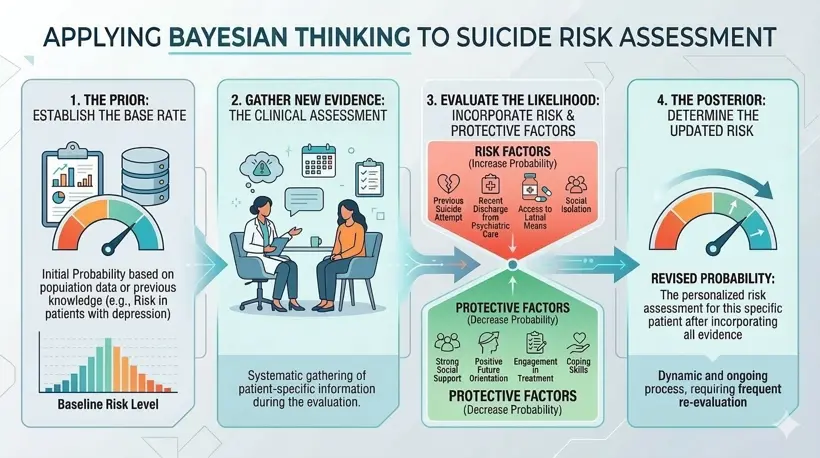
In Bayesian reasoning, every piece of information is evaluated not in isolation but against what was already known. The question is not simply “what did the patient say?” The question is: “given everything I already know about this person, how much do he patient’s responses actually change my assessment?” If the answer is “not much” — because the signal is weak — then the clinical weight given to it should reflect that. I will return to this framework in more detail later. For now, it is enough to flag the problem: we tend to treat denial as though it carries more evidential weight than it does.
In prison settings, the problem runs deeper still.
ACCT — the Assessment, Care in Custody and Teamwork process — is the formal framework for managing suicide and self-harm risk in English and Welsh prisons. Opening an ACCT is intended as a supportive intervention. In practice, from a prisoner’s perspective, it can feel like anything but. An ACCT watch typically means movement restrictions, the removal of in-possession items such as razors and excess clothing, disrupted cell routines, and heightened scrutiny from officers. In some establishments it affects gym access, work allocation, or association time. In a population where small freedoms carry disproportionate significance, these are real costs.
Prisoners are not naive. They understand what an ACCT means. Many have been through one before. The calculus is not complicated: disclose distress, lose privileges. Stay quiet, keep them.
Daniel understood this. We cannot know with certainty what was in his mind during that eleven-minute review. But we know the structural incentives. And we know what is reported of his responses.
The clinician who reviewed him was not negligent in any simple sense. They asked the right question. She recorded the answer. They followed the implicit protocol. What they did not do — and what the system did not prompt them to do — was ask a harder question first: given who this man is, what he has already done, and where he is sitting right now, how much should his denial actually reassure me?
That is the question the rest of this article is designed to help answer.
This is not a tutorial – and certainly not advice!
What the Evidence Actually Says
If the clinical habit described above were simply a cultural quirk — a lazy shorthand with no real consequence — it might be forgivable. The evidence suggests otherwise.
In 2021, Joseph Obegi published a literature review in General Hospital Psychiatry examining how often people who go on to die by suicide, or to make serious attempts, had recently denied suicidal ideation. He reviewed 22 studies published between 2000 and 2021. The findings were uncomfortable reading. [Obegi JH. How Common is Recent Denial of Suicidal Ideation among Ideators, Attempters, and Suicide Decedents? A Literature Review. Gen Hosp Psychiatry. 2021 Sep-Oct;72:92-95. PMID: 34358807]
Across studies looking at people known to have suicidal ideation, approximately half denied it when asked directly. Among those who went on to die by suicide, roughly half had denied suicidal thoughts in the week or month beforehand. The conclusion was blunt: denial of suicidal ideation is, by itself, an inadequate indicator of suicide risk.
That figure — around 50% — tends to provoke two responses. The first is disbelief. Surely patients tell their clinicians the truth? The second, more honest response, is a slow recognition that this is not surprising at all. People conceal. They minimise. They have made a decision. Or they are ambivalent in ways that do not resolve neatly into a yes or a no.
The Obegi figure is not even the most striking in the literature. A retrospective study by Busch and colleagues, examining 76 inpatient suicides, found that 78% of patients had denied suicidal ideation as their last recorded communication before their death. Not half. Three quarters. And these were inpatients — people already in a setting specifically designed to contain and monitor risk. [Busch KA, Fawcett J, Jacobs DG. Clinical correlates of inpatient suicide. J Clin Psychiatry. 2003;64(1):14-19.]
A separate review found that suicidal ideation, as a screening test, has a sensitivity of only 41%. [BJPsych Open. Jan 20219 – McHugh et al] In plain language: if you rely on patients disclosing ideation to identify who is at risk, you will miss nearly six in ten. That is not a screening tool. That is closer to a coin toss weighted in the wrong direction.
None of this is new. The clinical literature has carried these warnings for years. What is striking — and what makes this worth writing about — is how little it appears to have changed practice. The question gets asked. The patient says no. The note is written. The review is closed.
Daniel said he was fine. The literature would not have been surprised.
There is a further dimension that the raw numbers do not fully capture. Denial is not a uniform phenomenon. Some patients deny because they have genuinely stabilised. Some deny because they are embarrassed. Some deny because they are frightened of the consequences of disclosure. And some — a proportion that is difficult to quantify but clinically significant — deny because they have already decided, and they do not want to be stopped.
These are not equivalent. But from the outside, from the perspective of a clinician with eleven minutes and a structured form, they can look identical.
This is precisely why a more systematic way of weighing the evidence matters. Denial is a data point. The question is what it is actually worth — and that depends heavily on everything else that surrounds it. That is the territory we turn to next.
A Different Way of Thinking: Bayes Without the Mathematics
The name alone can close minds. Bayesian reasoning sounds like something that belongs in a statistics lecture, not on a prison wing at 5:35 in the morning. But the underlying idea is not complicated. In fact, it is something experienced clinicians already do intuitively — at least some of the time. The problem is that the intuition is not applied consistently, and in the case of denial, it fails almost entirely.
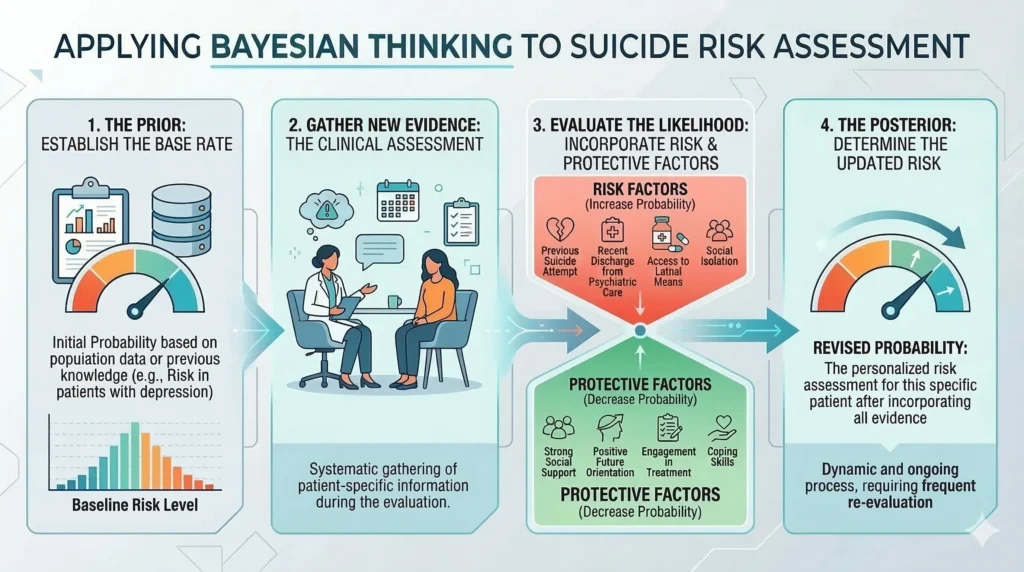
The Concepts
Prior probability
Before you have spoken to the patient, before the question has been asked, you already know things. You know their diagnosis. You know their history of previous attempts. You know the environment they are in. You know the population they belong to.
The prior probability is simply the starting estimate of risk, based on everything known before the new piece of information arrives. It is not a guess. It is a reasoned position based on existing evidence.
Think of it this way. A GP assessing an otherwise well 25-year-old presenting with a single low-mood episode has a very different starting point from a psychiatrist reviewing a 34-year-old remand prisoner with a previous hanging attempt and a diagnosis of emotionally unstable personality disorder. Both might be asked the same question. But the prior — the background level of risk before the question is answered — is entirely different.
The ‘prior’ matters enormously, because it determines how much work any new piece of information has to do.
The signal and its strength
When new information arrives — in this case, a denial of suicidal ideation — the question is not simply “what did the patient say?” The question is: how reliable is this piece of information as an indicator of the underlying truth?
In Bayesian terms, this is captured by the concept of the likelihood ratio — the degree to which a positive or negative finding shifts the probability estimate up or down. A strong signal shifts the estimate substantially. A weak signal barely moves it.
A concrete example from medicine helps here. A highly sensitive and specific diagnostic test — say, a positive HIV antibody test in a high-risk patient — carries enormous evidential weight. It changes your estimate dramatically. By contrast, a mildly raised ESR in an elderly patient tells you very little on its own. It is consistent with many things, including normal ageing. Its likelihood ratio is low. It barely moves the needle.
Denial of suicidal ideation is, evidentially speaking, closer to the raised ESR than to the HIV test. As the previous section showed, it is present in roughly half of people who go on to die by suicide. It is not a reliable negative signal. Its likelihood ratio — the degree to which it should reduce your estimate of risk — is weak.
The posterior probability
After taking the new information into account, a diligent assessor will arrive at a revised estimate. This is the posterior probability. It is what is now believed, having weighed both the prior and the signal together.
If the prior was high and the signal is weak, the posterior will not be much lower than the prior. A strong prior is not easily displaced by a weak signal. The background risk absorbs and contextualises the denial rather than being cancelled out by it.
If the prior was low and the signal is strong, the posterior drops considerably. A healthy patient with almost no risk history who consistently and credibly denies ideation in a context with no confounding incentives presents a genuinely different clinical picture.
The framework does not demand mathematical precision. It demands honest accounting.
Applied to Clinical Practice
With those concepts in place, return to Daniel.
His prior was high. He had a previous hanging attempt. He had a diagnosis associated with significant suicide risk. He was on remand, facing a serious charge, with no community support in place. He was in a custodial setting with documented incentives to conceal distress. Before the nurse asked a single question, the background probability of risk was substantial. That is not speculation. It is a straightforward reading of his clinical profile.
The signal was weak. Daniel said he was fine. Given what the evidence tells us about denial rates in this population — given that three quarters of inpatient suicides involve a recent denial — his “no” did not carry much evidential weight. It was not worthless. It was one data point. But it was a data point with a poor track record in populations like his.
The posterior should have remained high. If the prior is elevated and the signal is unreliable, the revised estimate after denial should not fall substantially. Daniel’s denial should have been noted, weighed, and found wanting as a reason to close the assessment. The clinical question should have shifted: what else is going on? What does the behavioural picture say? What do the officers report? What does his history predict?
Instead, the denial appears to have functioned as a conclusion rather than a single input. The prior was effectively abandoned the moment he said no. The posterior collapsed to low risk on the strength of one weak signal in a high-risk man.
This is not an unusual pattern. It is, in many settings, the default. And it is the default because the framework most clinicians carry into these assessments has no explicit mechanism for weighing a denial against a prior. The question is asked. The answer is taken at face value. The form is completed.
Bayesian thinking does not require a formula. It requires a habit of asking: given everything I already know, how much should this actually change my view? In Daniel’s case, honestly applied, the answer was: not much. Not nearly enough to close the assessment and walk away.
The Personality Disorder Trap
So far, this article has examined one clinical error: treating denial as a reliable negative signal when the evidence says it is not. But there is a second error, and in some ways it is more troubling. It runs in the opposite direction. And it tends to affect a specific group of patients disproportionately.
That group is patients with personality disorder — particularly those with emotionally unstable (EUPD) or borderline presentations (BPD).
If the first error is discounting risk because a patient says nothing, the second error is discounting risk because a patient says too much.
Clinicians working in forensic and custodial settings will recognise the scenario immediately. A patient with a known diagnosis of EUPD or BPD discloses suicidal ideation. Perhaps she has done so before, multiple times. She is distressed, vocal, and persistent. The team has been here before. There is a familiar pattern. And so, instead of the disclosure being treated as a signal that elevates the posterior estimate of risk, it is reframed. The word chosen — and it is chosen quickly, almost reflexively — is attention-seeking.
Once that label is applied, the evidential weight of the disclosure collapses. The patient has spoken. But the clinical system has decided, in effect, not to listen.
What the Evidence Says About Attention-Seeking
The attention-seeking attribution feels intuitive to clinicians who have been worn down by repeated high-distress presentations with very limited resources. But the evidence does not support it as a reliable clinical heuristic.
Research is direct on this point: conscious attention-seeking behaviour in patients with BPD is rare, even though both patients and clinicians may frame suicidal behaviour that way. The framing is common. The underlying reality it claims to describe is not. [Psychiatric Times 2012, Vol 29 No 5 Volume 29 Issue 5, Gregory MD]
The suicide risk figures for BPD are worth stating plainly. Long-term studies place the completed suicide rate at between 8% and 10% — figures comparable to patients with major depressive disorder and schizophrenia. These are not the numbers of a condition characterised by performative crisis. They are the numbers of a condition that kills, quietly and at a rate that the “attention-seeking” attribution does not begin to account for. [Psychiatric Times 2012, Vol 29 No 5 Volume 29 Issue 5, Gregory MD]
There is also a broader pattern worth examining. Research has found that up to 43% of inpatients admitted specifically for suicidality carry a BPD diagnosis. Up to 84% of inpatients with BPD report a previous suicide attempt [Kaurin et al 2022, Black et al., 2004; McGirr et al., 2007; Soloff et al., 1994)]. This is not a niche subgroup. In many forensic and custodial settings, it is the majority presentation.
The Clinician Attribution Problem
Why does the attention-seeking label persist despite this evidence?
Part of the answer lies in the cumulative emotional experience of working with this population. Patients with BPD frequently provoke intense reactions in those around them — this is not a character judgement, it is a well-described feature of the interpersonal dynamics associated with the diagnosis. After repeated encounters that feel, from the clinician’s side, like manipulation or emotional coercion, a defensive response is understandable. The clinician begins to pre-interpret. The diagnosis precedes the assessment.
The consequences of this are well documented. Research has found that clinicians often assign a BPD diagnosis specifically to patients they dislike or experience as difficult, rather than as the result of systematic screening. Pejorative language — “manipulative”, “attention-seeking”, “demanding” — accumulates in clinical records and, critically, in the informal culture of ward teams. A new clinician reading a patient’s notes encounters not a clinical history but a reputation.
And reputations, once formed, shape assessments.
Two Errors, One Direction
Apply the Bayesian framework introduced in the previous section and the problem becomes precise.
A patient with BPD who discloses suicidal intent is presenting a positive signal in a population with an already elevated prior. The posterior probability of risk should rise. Instead (in the tradition), the attention-seeking attribution functions as a mechanism for suppressing that signal — for treating a positive finding as though it carries negative or neutral evidential weight.
The first error involved a high prior being abandoned on the strength of a weak negative signal. This second error involves a positive signal being dismissed before it can do any evidential work at all.
Both errors suppress the posterior. Both errors push the clinical conclusion towards “low risk.” They operate through different mechanisms, affecting different presentations, but they arrive at the same place.
In a population where the base rate of completed suicide is already comparable to schizophrenia, that convergence is not a theoretical concern. It is a patient safety problem.
Daniel’s case involved the first error — denial in a high-risk man. But in many settings, particularly those working with women who have complex trauma histories and EUPD diagnoses, the second error is at least as common. The faces change. The clinical reasoning failure is the same.
What Good Practice Looks Like
It would be easy, at this point, to reach for a checklist. A structured tool. A validated instrument with subscales and cut-off scores. There are plenty to choose from. The START. The HCR-20. The Columbia Protocol. Each has its place, and none of them are the problem.
The problem is the thinking that surrounds them. A checklist completed on autopilot, with denial accepted uncritically and disclosure dismissed reflexively, is not good practice with a paper trail. It is poor practice with a paper trail. The tool does not do the thinking. The clinician does.
Risk Assessment Is Not a Transaction
The dominant model in busy custodial settings has become transactional. A question is asked. An answer is received. The form is completed. The encounter is closed. This model has the appearance of process without the substance of assessment.
A Bayesian approach — even an informal, non-mathematical one — demands something different. It demands that each new piece of information is evaluated in relation to what was already known. This means that the assessment cannot begin with the question. It must begin with the prior.
Before asking about suicidal ideation, the clinician should have already formed a view. What is the baseline risk in this population? What does this individual’s history say? What is the diagnosis, and what does the literature say about that diagnosis and suicide? What is the current context — remand, conviction, recent loss of appeal, impending trial date, relationship breakdown in custody?
These are not supplementary considerations. They are the foundation on which any response from the patient must be interpreted. A “no” from a man with Daniel’s history is a different clinical event from a “no” from someone with no risk history presenting with situational low mood. Treating them identically is not consistency. It is a failure of clinical reasoning.
What to Do With Denial
Denial should be recorded — but its limitations should be acknowledged in the same breath.
Good documentation does not simply state that the patient denied suicidal ideation. It contextualises that denial. It notes the factors that bear on its reliability: the patient’s history of concealment, the environmental incentives to deny, the degree to which the denial is consistent or inconsistent with observed behaviour and the accounts of third parties.
In prison settings specifically, the ACCT dynamic is a structural confound that must be named explicitly. If a patient has previously been placed on ACCT and experienced it as punitive or intrusive, that history is clinically relevant. It shapes the meaning of their current denial. A clinician who does not know this — or who knows it but does not factor it into their assessment — is not working with the evidence available to them.
The behavioural picture matters at least as much as what the patient says. The observations of prison officers — often dismissed as non-clinical — are frequently the most proximate and least contaminated source of information available. A patient who has stopped eating, withdrawn from association, given away possessions, or whose affect has shifted in ways the officers describe but cannot name, is presenting a clinical picture. That picture should carry weight independent of what the patient reports during a structured review.
What to Do With Disclosure
Disclosure in a high-risk patient should not automatically trigger a formulaic response. But it should not be discounted either.
The first clinical task, when a patient with BPD or EUPD discloses suicidal intent, is to resist the attribution reflex. The question is not “is this genuine or attention-seeking?” The question is: given this person’s history and current presentation, what does this disclosure add to my estimate of risk?
In a patient with a known history of attempts, current stressors, and a pattern of escalating distress, disclosure is a positive signal arriving in an already elevated prior. The posterior should rise. The clinical response should reflect that.
This does not mean that every disclosure requires hospital admission or maximum-level observations. Clinical judgement — about degree, context, and available intervention — is still required. But that judgement should be applied after the evidential weight of the disclosure has been honestly assessed, not used as a reason to avoid assessing it at all.
The “we can’t stop everyone” argument, which surfaces regularly in team discussions, is a resource allocation argument dressed up as a risk assessment argument. It may have a legitimate place in a conversation about what interventions are available. It has no place in a conversation about what the evidence actually says about a specific patient’s risk level.
The Role of the Multidisciplinary Team
Individual clinicians do not assess risk in isolation — or should not. The MDT exists, in part, precisely because any single clinician’s perspective is partial.
Good practice means that denial is not processed and closed by one person in eleven minutes. It means that the behavioural observations of officers are formally incorporated. It means that a patient’s history of concealment — if known — is surfaced and discussed. It means that the prior is made explicit, so that the team is working from the same starting point rather than each member forming their own unarticulated estimate.
A team that discusses risk in Bayesian terms does not need to use that language. They simply need to ask: what did we already know about this person, and how much does what happened today actually change that picture?
That question, asked honestly and collectively, is a more reliable foundation for clinical decisions than any single patient’s response to a single question on a single morning.
Daniel’s team did not ask it. His prior was never made explicit. His denial was taken at face value. And the eleven-minute review became, without anyone intending it, the last clinical contact he ever had.
The Governance Point
Everything discussed so far has been about clinical reasoning. This section is about what happens when clinical reasoning fails and someone dies.
It is less comfortable territory. But it is territory that anyone working in custodial mental health needs to understand clearly, because the governance and medicolegal consequences of poor risk assessment documentation are significant — and they fall on individuals as well as institutions.
The Inquest Question
When a prisoner dies by suicide, a coroner’s inquest is mandatory. The process is not primarily adversarial, but it is searching. Evidence is heard. Clinical records are examined. Staff are questioned. And the question that sits at the centre of almost every such inquest involving a mental health contact is a version of the same one: what did the clinician know, what did they record, and was their reasoning adequate?
A clinical note that reads “patient denied suicidal ideation — no ACCT indicated” invites cross-examination in a court along the lines of ‘clinical negligence’. But in the context of a patient with a high-risk profile — previous attempt, EUPD diagnosis, custodial setting, known ACCT incentives — it is a note that invites hard questions. What was the prior risk assessment? Was the denial evaluated against the patient’s history? Were behavioural observations from staff incorporated? Was the denial taken at face value, or was it contextualised?
Always remember: the Courts and regulatory bodies are less stupid that you think they are!
If the answers to those questions are absent from the record, the inference available to a coroner — or a Prevention of Future Deaths report author, or an NHS England reviewer, or a solicitor representing the family — is that no such thinking took place. In documentation, absence is not neutral. Absence is evidence.
The Prevention of Future Deaths Problem
Coroners in England and Wales have a statutory duty to issue a Prevention of Future Deaths (PFD) report when an inquest reveals circumstances that, if unchanged, create a risk of further deaths. These reports are public documents. They are sent to the relevant organisation, which must respond within 56 days.
A review of PFD reports relating to deaths in custody reveals a persistent pattern. The same concerns appear repeatedly across different establishments and different years: inadequate risk assessment, failure to incorporate officer observations, over-reliance on patient self-report, and insufficient documentation of clinical reasoning. These are not rare failures attributable to individual bad actors. They are systemic failures in the way risk assessment is conceptualised and recorded.
The Bayesian framework this article has described is not just a more accurate way of thinking. It is a more accountable way of thinking. A clinician who can demonstrate, through their documentation, that they explicitly considered the prior risk profile, evaluated the reliability of the patient’s denial in that context, incorporated behavioural observations, and reached a reasoned conclusion — even if that conclusion turned out to be wrong — is in a fundamentally different position from one whose note records only the patient’s answer.
Clinical error is not the same as negligence. A reasonable, well-reasoned assessment that reaches a tragic outcome is a different thing from a superficial assessment that records a denial and closes the review. The documentation is what makes that distinction visible.
What Adequate Documentation Looks Like
This is not an argument for lengthy, formulaic notes. It is an argument for notes that show thinking.
Adequate documentation in a high-risk custodial assessment should be able to answer the following questions without ambiguity: What was the baseline risk, and what factors contributed to it? What did the patient report, and in what context? What factors bear on the reliability of that report — including any environmental incentives to conceal? What did observation by third parties add to the picture? What was the clinical conclusion, and on what reasoning was it based? What is the plan if the picture changes?
None of this requires a lengthy narrative. It requires a clinician who is actually thinking, and who is recording that thinking in terms that can be understood by someone reading the note six months later at an inquest.
The eleven-minute review that closed Daniel’s case produced a note of three lines. It recorded what Daniel said. It did not record what the clinician knew about him before he spoke, nor whether that knowledge bore any relation to the weight given to his words. There was no reasoning visible in the record. There was only an answer, and a decision.
Institutional Responsibility
The governance point does not fall only on individual clinicians. Organisations that deploy mental health staff into custodial settings without adequate training in risk reasoning, without systems for incorporating officer observations into clinical assessments, and without supervision structures that prompt this kind of thinking, share the liability.
A clinician who has never been taught to question the reliability of denial — who has been trained implicitly to treat “no” as a clinical endpoint — is not simply making an individual error. They are operating within an institutional framework that has normalised that error. When something goes wrong, the individual faces the inquest. But the framework created the conditions.
This matters for clinical leads, for healthcare managers, and for the NHS trusts and contracted providers responsible for prison mental health services. The question is not only whether individual staff are documenting adequately. It is whether the systems, training, and supervisory culture they work within make adequate reasoning possible at all.
If they do not, the Prevention of Future Deaths reports will keep coming. And the notes will keep reading: “patient denied suicidal ideation — no ACCT indicated.”
Two Clinical Entries: A Comparison
The following entries are both fictional. They relate to the same patient — Daniel — at the same point in time. The first reflects the kind of note that is written routinely in busy custodial settings. The second reflects what adequate reasoning, documented clearly, might have looked like.
The following is illustrative. It does not mean everybody like that must be on an ACCT! Chrysst!
Tuesday 09:45. Routine mental health review. Patient seen in healthcare. Engaging well. Mood is low but stable. Denies suicidal ideation. Denies thoughts of self-harm. No current intent or plan. MSE unremarkable. No ACCT indicated at this time. Will review next week.
Tuesday 09:45. Routine mental health review. Patient seen in healthcare.
Background risk context: Patient is a 34-year-old remand prisoner with a previous near-lethal suicide attempts by hanging (three years prior), a diagnosis of emotionally unstable personality disorder, longstanding alcohol misuse, ready availability of ‘drugs’ in this prison. He is facing a serious charge with no confirmed trial date. Prior risk is assessed on the high end statistically, on the basis of this profile alone.
Current presentation: Patient reported mood as low but stable and denied suicidal ideation and self-harm intent on careful exploration with open prompts (not just questions). He was difficult to engage. However, several non-verbal indicators were noted during the review itself. Eye contact was reduced and not sustained. Psychomotor activity was slowed — responses were deliberate and minimally elaborated. Affect was constricted and did not broaden when the patient described neutral topics. Grooming and personal hygiene appeared to have deteriorated since the previous contact. The patient did not initiate any content and terminated responses quickly. Appears distracted and fed up. Taken together, the observed clinical presentation was inconsistent with the his verbal report of ‘being okay’.
The reliability of the verbal denial must also be considered in context. The patient is aware of the ACCT process and has previously been subject to it. He said he did not want to be on an ACCT again. Environmental incentives to minimise distress are present and well documented in this population. His denial has been noted but does not substantively alter the baseline risk assessment in isolation, particularly given the discrepancy between what was said and what was observed.
Collateral: Wing staff report the patient has been unusually withdrawn over the past several days. He has declined two meals and has stopped attending the gym, which he had previously used daily and which represented a significant part of his routine. He has been spending extended periods lying on his bunk during association time rather than mixing with other prisoners. He has stopped engaging in brief social exchanges with officers that were previously routine. A prison officer noted the patient gave away a personal radio to another prisoner yesterday, offering an implausible explanation. No single one of these observations is conclusive. In combination, and set against his baseline behaviour, they represent a meaningful and consistent pattern of functional decline.
Assessment: Despite verbal denial of ideation, the combination of high baseline risk, known incentives to conceal, and observed behavioural change warrants continued active monitoring. Risk is not considered to have reduced. ACCT to be discussed with the residential team today. Review brought forward to 48 hours.
Plan: Notify wing officer and personal officer of concerns. Initiate ACCT discussion. Advise staff to document behavioural observations. Senior clinician to be informed within next 2 hours. To be offered drug screening. Review Thursday.
Conclusion
Daniel’s case was not complicated. It did not require exotic clinical skills or specialist knowledge unavailable to the nurse who reviewed him. It required a way of thinking that the system failed to instil — one that takes background risk seriously, treats denial with appropriate scepticism, and asks whether a single answer from a patient in a compromised position should really be enough to close the assessment.
That way of thinking has a name. But it does not require the name. It requires only a consistent habit: know what you already know before you ask the question, and decide how much the answer is actually worth in that specific context.
This article has argued that two distinct clinical errors are driving preventable deaths in custodial and forensic settings. They are worth naming clearly one final time.
The first is the tendency to treat denial as a reliable negative signal when the evidence shows it is not. Across multiple studies, roughly half of those who go on to die by suicide have recently denied suicidal ideation. In inpatient populations, the figure reaches three quarters. In prison settings, where ACCT carries tangible costs, denial is structurally incentivised. A “no” in that environment is not reassurance. It is a data point — and a weak one.
The second is the tendency to dismiss disclosure in patients with personality disorder as attention-seeking. The evidence is equally clear here. Completed suicide rates in BPD are comparable to schizophrenia. Conscious attention-seeking behaviour is rare, even when the label is applied freely. Dismissing a positive signal in a high-risk patient is not clinical pragmatism. It is a reasoning failure with potentially fatal consequences.
Both errors converge on the same outcome: a posterior probability of risk that has been driven artificially low by the mishandling of evidence. And both errors are compounded when documentation fails to show that any of this was thought through at all.
The takeaways are straightforward, if not always easy to implement.
Risk assessment begins before the patient opens their mouth — with an honest appraisal of the prior. The clinical record should make that prior visible. Denial should be noted and contextualised, not accepted as a conclusion. Disclosure in a high-risk patient should raise the estimate of risk, not invite a diagnostic label that neutralises it. Officer observations are clinical data. The MDT should be making the prior explicit and asking, collectively, how much any new information actually changes it. And documentation should show reasoning, not just record answers.
None of this will prevent every death. That is not the claim. Risk assessment is probabilistic by nature, and tragedies will occur even when practice is sound. The aim is not certainty. The aim is honest, reasoned, defensible thinking — applied consistently, documented clearly, and reviewed when it goes wrong.
Lessons are not being learned.