
Estimated reading time at 200 wpm: 19 minutes
Savile’s knighthood was the ultimate evidence of a national blindness. Jimmy Savile was not merely a television personality; he was a highly functional predator who turned his own psychopathology—a lethal cocktail of grandiosity, narcissistic entitlement and a chameleon-like ability to mimic authority—into a master key for manipulation of the British establishment. By positioning himself as the state’s indispensable ‘fixer’ and a prolific fundraiser, he successfully mesmerised swathes of people and institutions, buying a decades-long immunity that allowed him to colonise the very spaces meant for healing. When the mask finally fell following his death on 29 October 2011, it exposed a system so hollowed out by deference that it had mistaken a serial predator’s calculated eccentricity for a mandate of sanctity.
Whether or not you agree our Fat Disclaimer applies
Persons who have suffered mental trauma of any kind or are vulnerable to any sort of mental disorder, are advised not to read this and related materials. If you do not follow this advice and you suffer harm or injury of any sort, you will SUE YOURSELF!
The scandal acted as a structural earthquake. It exposed how fame could be used as a suit of armour and how institutions—hospitals, the BBC, the Church, and the Police—were co-opted into a culture of silence and deference. Looking back from 2026, we can see his death was only the start of a painful reconstruction of British public life. We are looking at a journey from ‘institutional grooming’ through the revelations of Operation Yewtree and the IICSA inquiry, right up to the radical new legislative landscape we are navigating today. It is a story about the end of deference and the price of silence, attempting to build a society where ‘the talent’ is never again more important than the truth. See: Revealed: how Jimmy Savile abused up to 1,000 victims on BBC premises (Guardian, 2014), Predators of the Establishment: From Savile to Epstein and The Reckoning (BBC) series – Factual drama examining the crimes of Jimmy Savile, with testimony from survivors.
Part I: The Architect of Silence (The Man)
The Psychopathology of the ‘Chameleon’: A Clinical Profile
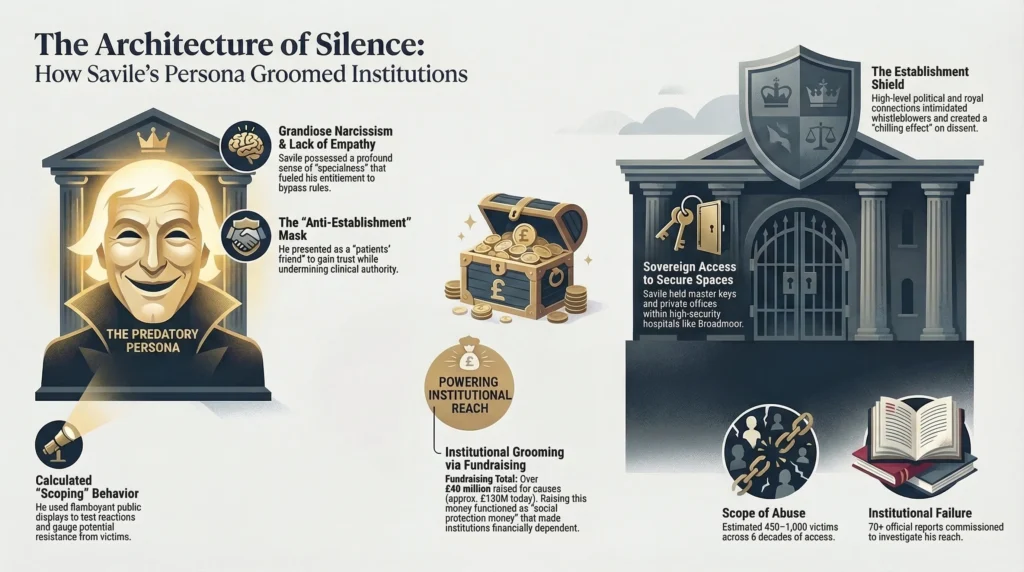
Thinking about Savile from a clinical perspective, the Broadmoor and Lampard reports describe a personality that was less about “eccentricity” and more about a highly functional, predatory psychopathology [2] [4]. For educators and psychologists, the profile that emerges is one of a “chameleon of authority”—a man possessing an extraordinary degree of egocentricity and a total lack of empathy or remorse.
Core Personality Traits: Savile was consistently described as grandiose, narcissistic, arrogant, and completely lacking in empathy. In a clinical setting, these are not merely negative traits; they were the primary drivers of his operational success.
- He was deeply self-centred and prone to “bizarre exaggeration,” often talking exclusively about himself, his achievements, and his connections to “people in high places.”
- While some found him to be charming, persuasive, and oddly charismatic, others perceived him as “bombastic,” “charmless,” and “psychopathic.”
- Clinical psychologist Dr Jackie Craissati observed that Savile likely had a major personality disorder rooted in narcissism, possessing a profound sense of “arrogance and specialness” that made him feel entitled [2] [30].
- Furthermore, staff who worked closely with him noted that he lacked human warmth, had no real friends, and never felt sorry for anyone.
- Interpersonal Functioning: Manipulation and Intimidation Savile was highly manipulative and expertly crafted an aura of power, invincibility, and untouchability.
- He leveraged his fame and claims of high-level political friendships to intimidate those around him. He successfully made hospital staff believe he had the power to have them fired, while simultaneously coercing vulnerable patients into believing that reporting his abuse would only worsen their treatment or lead to punishment.
- Savile also used bizarre and flamboyantly inappropriate public behaviour toward women—such as extravagant greetings and kissing up their arms to their lips—as a calculated method to “scope” their reactions and gauge the level of resistance he might face.
The Broadmoor investigation specifically identifies him as narcissistic and manipulative, traits that were not merely personality flaws but were the primary engines of his social functioning [4]. For psychiatrists, Savile represents a case study in how a personality disorder can be externalised into a set of social tools. His “specialness” was not just a delusion; it was an asset he used to convince hospital boards that he existed outside of standard safeguarding protocols.
The Defensive Utility of ‘Calculated Eccentricity’
The “wacky” persona was a form of calculated eccentricity. In psychological terms, this functioned as a defensive “smoke screen”. By appearing “weird” or “odd”, he created a social distance that discouraged standard professional scrutiny. Investigators noted that his performative weirdness acted as a boundary-testing mechanism; by seeing how much “calculated oddity” an institution would tolerate, he was able to gauge exactly how much he could violate more serious clinical and ethical boundaries without being challenged [4].
This “scoping” behaviour—mentioned in the Broadmoor report regarding his interactions with women—is a critical clinical finding. It suggests that his public persona was an active reconnaissance tool. If he could kiss a woman’s arm to her lips in a hospital corridor without being reprimanded, he knew the institution’s immune system was compromised. He was constantly probing for the point where “Jimmy being Jimmy” ended and “Sir Jimmy Savile” began.
Institutional Grooming and Symbolic Power
His functioning was defined by “institutional grooming”—a process where he applied the same predatory techniques used on individuals to entire organisations. He identified the specific needs of an institution (such as fundraising in the NHS or industrial mediation in Broadmoor) and fulfilled them to create a debt of gratitude. This “symbolic power” [34] then allowed him to operate in a clinical vacuum.
By fulfilling these critical needs, Savile made himself indispensable to the leadership. This created a “moral credit” that shielded him from suspicion [1]. When an educator or psychologist looks at this today, they see a man who did not just hide; he engineered an environment where his presence was a perceived benefit to the institution’s survival. He was not just a visitor; he was an apex predator who had successfully mimicked the protective features of the very systems he was infiltrating.
Deconstructing the ‘Fixer’: The Dual Persona of Jimmy Savile
The 2014 investigation into Broadmoor Hospital and the 2015 Lampard “Lessons Learnt” report provide a factual look at how Savile’s personality functioned as an administrative skeleton key [2] [4]. He successfully performed two contradictory roles simultaneously, creating a psychological “blind spot” for everyone involved.
The ‘Anti-Establishment’ Ally
In psychiatric and high-security settings like Broadmoor, Savile presented himself as a rebel. He was the “patients’ friend”, someone who sat on their side of the table during disputes with nursing staff or consultants. He intentionally adopted the language and grievances of the patients to build a deep, misplaced trust [4]. This was not kindness; it was a tactical positioning that allowed him to act as a gatekeeper for patient voices through the “Patients’ Council”. By appearing to be “one of them”, he ensured that if a patient did try to report his behaviour, it would look like a betrayal of their only high-profile ally—or would simply be dismissed by staff as “patient manipulation” [30].
The ‘Management’ Fixer
While he was playing the rebel on the wards, he was playing the executive in the boardroom. The Department of Health and hospital trusts saw him as a unique administrative asset—a man who could talk to anyone and “get things done” during periods of industrial unrest [4]. He was effectively a bridge between the clinical hierarchy and the unions, often brought in to smooth over disputes that professional managers could not handle. This made him indispensable to the leadership. When a man is helping you solve your biggest staffing crises and raising millions for your budget, you naturally develop a psychological incentive to overlook his “eccentricities” [34].
The ‘Keys to the Kingdom’: The Mechanics of Institutional Colonisation
Savile’s “functioning” was defined by a total disregard for the clinical and physical boundaries that govern medical life. At Stoke Mandeville, Leeds General Infirmary, and Broadmoor, he sought—and was frequently granted—unchecked physical access. This was often justified by his role as a “volunteer” or “fundraiser”, but in practice, it meant he occupied a tier of existence that bypassed all standard safeguarding [2].
Administrative Autonomy
He did not just have keys; he had the authority to move through hospitals at any hour of the day or night. The Lampard Report highlighted that he was often permitted to use hospital facilities, such as the staff canteen or private rooms, as if they were his own home [2]. In Broadmoor, he was even granted a suite of rooms in the female wing—a decision that clinical staff found bizarre and inappropriate, but which was sanctioned from the top down as part of his “task force” role [33]. This physical autonomy was the ultimate evidence of his symbolic power; he had “colonised” the hospital space to the point where he was no longer a guest, but a semi-permanent resident with more freedom of movement than many senior clinicians.
Simulation of Clinical Authority
Perhaps most disturbingly for medical professionals, Savile often simulated the appearance of clinical staff. He was known to wear white coats and assist in patient transfers, effectively “grooming” the institutional environment to accept him as a quasi-medical figure [30]. By performing these low-level clinical tasks, he lowered the natural wariness of patients and the suspicion of staff. To a patient, a man in a white coat with master keys is a figure of authority; Savile exploited this visual shorthand to create a “clinical shield” for his predatory behaviour [31].
Litigation as a Weapon: The Chilling Effect of Libel Laws
Savile was a master of using the UK’s stringent libel laws to suppress investigative journalism. Throughout the 1970s, 80s, and 90s, any journalist or publication that attempted to hint at his predatory behaviour was met with immediate and aggressive legal threats [6]. This created a “chilling effect” where editors were forced to spike stories they knew were true because they lacked the “bulletproof” evidence required to survive a courtroom battle with a wealthy, litigious celebrity [7].
Part II: The Enabling Machines (The Institutions)
The BBC and the “Talent” Culture: Star Power over Safeguarding
The BBC operated under a rigid hierarchical structure where “the talent” occupied a tier of existence far removed from ordinary staff. The Dame Janet Smith Review identified a “culture of fear”, where junior employees felt that raising concerns about a major star was a career-ending move [7]. Savile was a ratings giant; middle management was effectively paralysed by the prospect of challenging him.
This was compounded by a broader media failure to address the “open secret” of his behaviour [10]. Even when rumours reached senior levels, they were often handled with a lightness that bordered on complicity, focusing on protecting the brand rather than the safety of young people [11].
The NHS and the Volunteer Loophole: A Predator’s Playground
The investigations into Savile’s presence in the NHS uncovered a systemic failure to regulate “extra-statutory” figures. In hospitals like Stoke Mandeville and Leeds General Infirmary, Savile was more than a volunteer; he was an institution within the institution [12].
The Deification of the Fundraiser over Clinical Governance
By controlling the purse strings of charitable funds, Savile effectively bought the loyalty of hospital administrations [32]. Managers were reluctant to impose the same vetting on him that they would on any other person. This created a “god-like” status where his presence was viewed as a gift, making any criticism appear ungrateful.
Targeting the Non-Verbal and the Long-Stay
Medical professionals later noted Savile’s preference for patients who were unlikely to be believed or unable to communicate. In psychiatric settings and spinal units, he targeted individuals who were “long-stay”, away from the protective eyes of family [5]. He provided treats or attention that the overstretched NHS could not, creating a dependency he then exploited.
The Breakdown of the “Firm” System
Because he was not officially part of any one medical “firm”, no single consultant felt responsible for his actions [30]. He was everyone’s guest and no one’s responsibility. The Verita report into Leeds Teaching Hospitals noted that his “celebrity status” acted as a universal pass that overrode all standard clinical protocols [12].
The Political Shield: Relationships with the 1980s Establishment
Savile’s connections reached into the heart of the British state. He was a frequent guest at Chequers during Margaret Thatcher’s premiership and maintained close, advisory-style relationships with senior members of the Royal Family [13]. Letters revealed that Savile even acted as a PR strategist for the monarchy, providing advice on how the Royal Family should handle public relations crises [35]. These ties provided a level of political capital that made him virtually untouchable; it is difficult for a local police sergeant to imagine arresting a man who spent Christmas with the Prime Minister.
The Posthumous Technicality: Why the Knighthood Remained
In the United Kingdom, honours like knighthoods expire the moment the holder dies. Because the honours system technically “cancels” the title upon the death of the recipient, there was no active honour left for the Forfeiture Committee to rescind by the time the scandal broke in 2012 [14]. While his name was scrubbed from plaques and his headstone was eventually ground into rubble, he technically remains a man who died with his honours intact, a final layer of frustration for survivors.
The Police Sinks: The Failure to “Join the Dots” Across 43 Forces
The British policing model, fragmented across 43 independent regional forces, was perfectly suited for a nomadic predator. Allegations were made as early as the 1950s, but because they occurred in different jurisdictions, no single force ever saw the complete picture [15]. Intelligence was rarely shared between these “silos”, and there was a systemic reluctance to pursue “historic” allegations against a powerful public figure [16].
Part III: The Great Reckoning (Operation Yewtree)
The Exposure: The 2012 ITV Documentary and the End of Omertà
The catalyst was the ITV documentary The Other Side of Jimmy Savile, broadcast in October 2012 [8]. By featuring multiple women describing identical patterns of abuse, the documentary shattered the “isolated incident” defence. The fallout was immediate, exposing a burgeoning scandal within the BBC regarding its decision to spike a planned investigation just months earlier [11].
Operation Yewtree and the Mushrooming Effect
Operation Yewtree identified over 450 potential victims of Savile alone [15]. The investigation mushroomed because his integration into British life was so deep. To manage the complexity, the police created three distinct strands of investigation, moving away from the siloed approach of previous decades [16].
The Architecture of the 50 Inquiries
The scale of the national audit that followed was unprecedented. It eventually produced more than fifty formal investigations and reviews [2] [36]. The Department of Health alone commissioned 44 separate reports into NHS trusts. These were not mere administrative box-ticking exercises; they were forensic excavations of hospital logs spanning six decades. The sheer volume of paper produced—thousands of pages across reports for Leeds, Stoke Mandeville, Broadmoor, and dozens of others—serves as a map of how many different rooms Savile had successfully colonised.
The Second Wave: The Savile Legacy Unit (SLU)
In July 2014, the Department of Health established the NHS Savile Legacy Unit (SLU) to manage a “second wave” of allegations [36]. While 44 trusts had initially been investigated, a further 12 trusts were named by victims who only felt safe enough to speak out after seeing the first reports. This “long tail” of investigations proved that institutional denial was a moving target, requiring a dedicated unit to catch the names of additional hospitals that had been co-opted decades earlier.
The Domino Effect: Shifting the Police Paradigm
Yewtree triggered a “domino effect”, leading to the conviction of figures like Rolf Harris and Max Clifford [17]. The most significant legacy, however, was a shift in police methodology. The mantra “start by believing” became the new operational standard, correcting decades of dismissal [15]. This shift was not without controversy, as seen in subsequent reviews of police handling of non-recent allegations, which highlighted the need for a balanced approach to the presumption of innocence [19].
Part IV: The Systemic Deep-Dive (IICSA)
Clericalism and the Church: The Moral Authority Trap
The IICSA report on the Church of England described a culture where the reputation of the institution was always the priority [5]. Clericalism allowed leaders to use their moral authority to push back against allegations, essentially gaslighting survivors by suggesting that “men of God” could not do such things [20].
Westminster and Schools: The Failure of State Care
In residential schools and state-run homes, IICSA found that the testimony of children was treated as inherently unreliable compared to the word of staff or dignitaries [21]. The state essentially failed in its most basic duty of care, creating environments where predators did not have to hide because they knew they had the backing of a system that prioritised administrative quiet over the truth [5].
Institutional Grooming: How Organisations Were Co-opted
The concept of “institutional grooming” describes how an organisation can be manipulated. Predators like Savile targeted institutions, making themselves indispensable through fundraising or social connections [22]. Once an organisation becomes dependent on a person for money or status, it becomes blind to their faults. The BBC, the NHS, and the Church were all groomed into a state of collective denial [5].
Part V: The 2026 Landscape (The Legacy)
Mandatory Reporting and Obstructing a Report
As of March 2026, the Crime and Policing Bill introduced a statutory “Mandatory Reporting” duty for regulated professionals [23]. To address the institutional failures of the past, the bill includes a specific offence for “obstructing a report”, aimed at managers and executives who attempt to silence whistleblowers [24].
Legal Access and the Shift in Burden of Proof
The “three-year rule” has been effectively dismantled for child sexual abuse cases [25]. The burden of proof has shifted; it is now up to the defendant institution to prove that a delay makes a fair trial fundamentally impossible, rather than the survivor having to justify their silence [26].
The National Redress Scheme
Recognising the adversarial nature of courtrooms, the National Redress Scheme launched in late 2026 offers an alternative [27]. However, the scheme has faced scrutiny regarding the impact of its financial assessments on the Treasury and the long-term sustainability of multi-institutional funding [28]. It represents a move toward trauma-informed justice, prioritising apologies and acknowledgement over purely legal victories.
The CQC Framework and the Director of Nursing
Following the Lampard findings, the Care Quality Commission (CQC) has integrated safeguarding into its permanent inspection framework. Inspectors are now instructed to specifically interview the Director of Nursing about the governance of “celebrity volunteers” and other non-clinical groups [37]. This ensures that the responsibility for safeguarding sits at the executive level, making it a matter of clinical governance rather than a localised administrative detail.
Part VI: Conclusion: From Deference to Transparency
The Spell of Indispensability
Looking back, it is tempting to think Savile mesmerised the nation with some supernatural ability. But it was not magic; it was a trade. He built a persona as a vital organ of British life. We lived in a culture where visible moral credit could be used to bankroll almost any suspicion [1]. People did not stop seeing; they stopped processing what they saw because the cost of the truth was too high for the institutions involved.
The Infrastructure of Accountability
The work of 2026 is about ensuring that kind of national trance can never be cast again. The Crime and Policing Bill and the new Child Protection Authority are about breaking the social contract that Savile exploited [23] [29]. By removing the “three-year rule” and introducing mandatory reporting, we are finally admitting that no one is too important to be questioned and no amount of charitable work is an insurance policy against scrutiny [26].
The survivors who eventually broke the silence dismantled a decades-old culture of deference. The real test is whether we have actually moved past the era where we look for “National Treasures” to tell us what is true. Transparency is the only way to ensure we never again allow ourselves to be mesmerised by the shine of a tracksuit and a cigar while the most vulnerable are left to pay the price.
References
Not all references are in the public domain or findable via Google.
- Smith, J. (2016). The Revisited Report of the Jimmy Savile Trustees.
- Department of Health (2015). Lessons learnt: reviewing the NHS hospital investigations into Jimmy Savile. (Lampard Report).
- Grey-Thompson, T. (2014). Stoke Mandeville Hospital Savile Investigation Report.
- Department of Health (2014). Investigation into the association of Jimmy Savile with Broadmoor Hospital.
- Independent Inquiry into Child Sexual Abuse (2022). Final Report.
- Davies, N. (2014). Hack Attack: How the Truth Caught Up with Jimmy Savile.
- BBC (2016). The Dame Janet Smith Review Report.
- ITV (2012). The Other Side of Jimmy Savile (Documentary).
- Marzano, M. (2013). The Savile Phenomenon: Why We Didn’t See.
- Sanderson, T. (2014). Crisis Communication in an International Organization: An Investigation of the BBC’s Reputation in the Aftermath of the Savile Scandal.
- Pollard, N. (2012). The Pollard Review into the non-transmission of the Newsnight Savile report.
- Verita (2014). Independent investigation into the involvement of Jimmy Savile with Leeds Teaching Hospitals NHS Trust.
- Moore, C. (2019). Margaret Thatcher: The Authorized Biography.
- Cabinet Office (2012). Review of the Honours awarded to Jimmy Savile.
- Metropolitan Police (2013). Giving Victims a Voice: Joint report by the MPS and NSPCC.
- HMIC (2013). Mistakes Were Made: HMIC’s review into the police response to Jimmy Savile.
- BBC News (2014). Rolf Harris: The fall of a national treasure.
- O’Hagan, A. (2014). The Light Entertainment Elite: A Post-Savile Reckoning.
- Henriques, R. (2016). Independent Review of the Metropolitan Police Service’s handling of non-recent sexual offence investigations.
- IICSA (2020). The Anglican Church: Safeguarding Case Study (Peter Ball).
- IICSA (2021). Residential Schools Investigation Report.
- IICSA (2022). Final Report: Context and Challenges.
- Home Office (2025). Consultation on Mandatory Reporting of Child Sexual Abuse.
- UK Parliament (2026). Crime and Policing Bill.
- Ministry of Justice (2024). Reforming Limitation Periods for Historical Child Abuse.
- Law Society (2025). The End of the Three-Year Rule: A Practitioner’s Guide.
- Church of England (2026). National Redress Scheme Launch Briefing.
- Treasury (2025). Impact Assessment of the National Redress Scheme.
- Child Protection Authority (2026). The Single Unique Identifier: Operational Framework.
- Royal College of Psychiatrists (2025) – Stubely et al – The development of the RCPsych Position Statement on the impact of non-recent child sexual abuse and its application to our work.
- Council for Healthcare Regulatory Excellence (2013). Review of the medical response to Jimmy Savile.
- NHS England (2014). Investigation into the involvement of Jimmy Savile with NHS clinical settings.
- Department of Health (2014). Supplementary Evidence to the Broadmoor Savile Investigation.
- Dean, J. (2023). Charity and abuse: fundraising and symbolic power in the case of Jimmy Savile.
- The Herald (2022). Prince Charles wrote to Jimmy Savile for PR help, letters reveal.
- Savile Legacy Unit (2015). NHS Savile Legacy Unit Final Report.
- GOV.UK (2015). Update on the themes and lessons learnt from NHS investigations into matters relating to Jimmy Savile (Nov 2015).