


Estimated reading time at 200 wpm: 6 minutes
While Jimmy Savile and Jeffrey Epstein operated in different decades and across different social strata, their functional methods reveal a striking parallel in how predators can co-opt the machinery of power. If Savile was the ‘Chameleon of Authority’ within the British public sector, Epstein was the ‘Architect of Influence’ within the global private elite. Both men succeeded not merely through stealth, but through a form of aggressive visibility that made them feel like essential nodes in their respective social networks. Important reading for context is: The Savile Scandal: A Forensic Map of Institutional Failure.
Whether or not you agree our Fat Disclaimer applies
The Psychological Engine of Infiltration
The reach these men achieved wasn’t simply a result of institutional rot; it was driven by a specific set of personality features that functioned as a deliberate operational strategy. For educators and psychologists, the interest lies in how traits usually associated with dysfunction—narcissism, grandiosity, and a total lack of empathy—were industrialised into tools of social and political leverage.
Narcissism as a Shield of ‘Specialness’
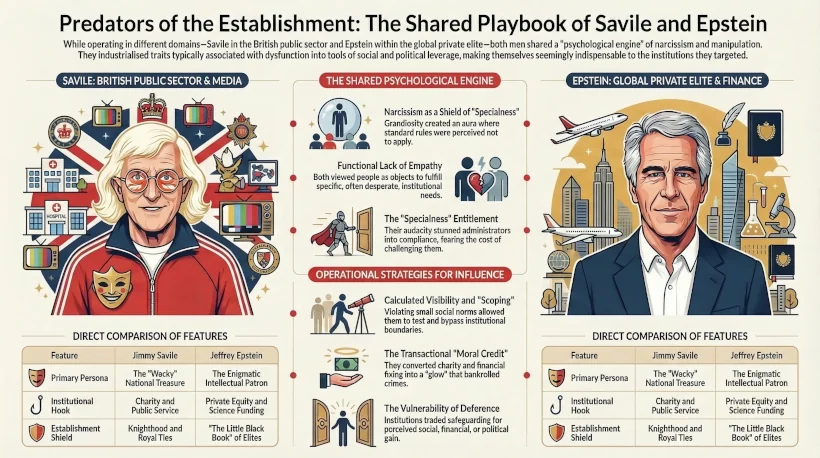
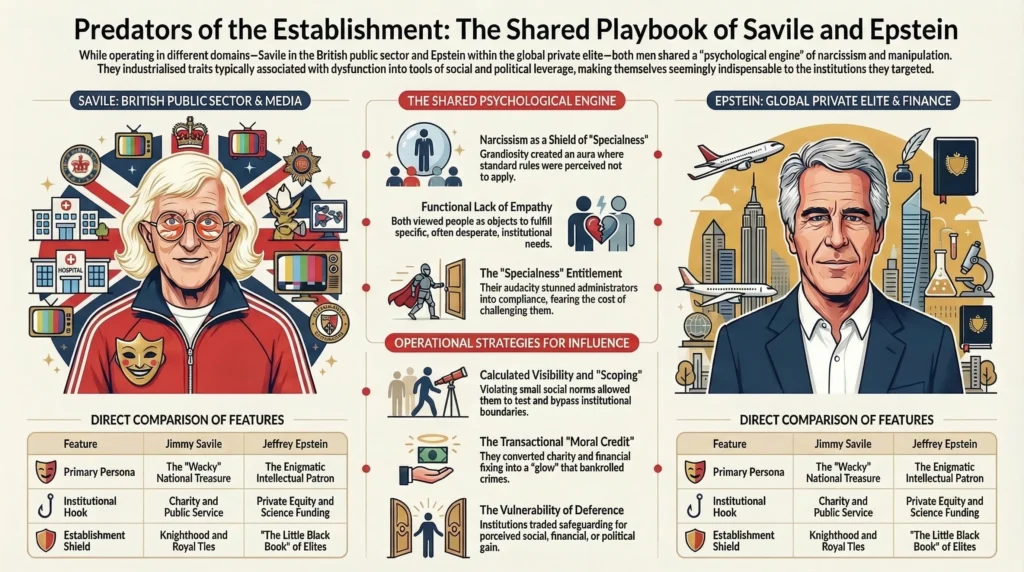
Both men possessed a profound sense of narcissistic entitlement. This didn’t just make them arrogant; it created an aura of “specialness” that institutional gatekeepers found difficult to challenge. Savile used his “National Treasure” status to signal that standard rules didn’t apply to him. Epstein used his financial and intellectual patronage to suggest he existed on a higher plane of global significance. In both cases, the audacity of their demands—whether it was Savile asking for master keys to a secure hospital or Epstein requiring a private island—often stunned administrators into compliance. They succeeded because they behaved as though their authority was a natural fact, and institutions, fearing the social or financial cost of challenging such a “special” figure, effectively deferred to their grandiosity.
The Transactional Utility of the Predator
Their total lack of empathy was a functional asset. Because they viewed people and institutions purely as objects to be manipulated, they were able to identify and fulfill the specific, often desperate, needs of the organisations they targeted. Savile identified the NHS’s need for funding and Broadmoor’s need for industrial peace. Epstein identified the elite’s need for discreet financial management and intellectual validation.
By becoming “fixers” for the establishment’s most difficult problems, they built a “moral credit” that bankrolled their crimes. The institution became psychologically dependent on the predator. To challenge Savile was to risk the hospital’s funding; to challenge Epstein was to risk the social and financial stability of a global network. Their personality traits allowed them to become the “bridge” that institutions felt they could not afford to burn.
Calculated Visibility and ‘Scoping’
Contrary to the image of a predator hiding in the shadows, both men used extreme visibility as a reconnaissance tool. Savile’s “calculated eccentricity”—the tracksuits, the cigars, the inappropriate touching—was a method to “scope” the environment. If he could violate small social norms without being reprimanded, he knew the institution’s boundaries were porous enough for more serious violations. Epstein used his “Little Black Book” and his high-profile social circle in a similar way; by being seen with the most powerful people in the world, he ensured that anyone lower down the social ladder would feel completely outmatched if they tried to report him. Their reach was built on the premise that no one dares to question what everyone else seems to accept.
The Transactional Nature of Infiltration
The similarity between Savile and Epstein is found in the way they treated relationships as a currency. In the original analysis, we noted Savile’s use of “symbolic power”—converting charitable donations into a form of moral credit. Epstein operated on a similar, albeit more financial, plane. He positioned himself as a financial “fixer” for billionaires and a patron of the sciences. In both cases, the abuse was bankrolled by a debt of gratitude. People did not look too closely at Savile because he was “fixing” hospitals; people did not look too closely at Epstein because he was “fixing” tax problems or funding research.
Lone Wolf vs. Architect of a Network
A key divergence lies in the structure of their functioning. Savile was largely a lone actor who groomed institutions to act as his shield. He used his status to intimidate individuals into silence, but he did not necessarily require a large team of co-conspirators to facilitate his crimes. His reach was horizontal, moving across dozens of regional NHS trusts and BBC studios.
Epstein, conversely, operated a vertical, hierarchical network. His functioning was that of a trafficker—creating a system of recruiters and co-conspirators that allowed him to scale his abuse. While Savile exploited the “loophole” of the volunteer or the celebrity guest, Epstein exploited the privacy of the ultra-wealthy. Savile’s crimes happened in the corridors of state-funded institutions; Epstein’s happened in the most private, guarded spaces of the global elite.
Comparative Template: Savile vs. Epstein
| Feature | Jimmy Savile | Jeffrey Epstein |
|---|---|---|
| Primary Persona | The ‘Wacky’ National Treasure / Benevolent Fixer | The Enigmatic Financier / Intellectual Patron |
| Institutional Hook | Charity, Public Service, and Media PR | Private Equity, High Finance, and Science Funding |
| Psychological Profile | Narcissistic Chameleon; Calculated Eccentricity | Grandiose Narcissist; Master of Social Leverage |
| Operational Strategy | Institutional Grooming (Colonising public space) | Network Grooming (Trafficking and social blackmail) |
| Environmental Control | Master keys; simulated clinical authority (white coats) | Private islands; “Lolita Express”; secured townhouses |
| Establishment Shield | Knighthood; ties to PMs and the Royal Family | Political and business elite; “The Little Black Book” |
| Victim Typology | Vulnerable, long-stay patients; young media fans | Underage girls; recruited through social coercion |
| Systemic Failure | Deference to celebrity and institutional silos | Deference to wealth and the privacy of the elite |
| Legacy of Reckoning | National audit of the state (BBC, NHS, IICSA) | Global audit of private power and trafficking networks |
Conclusion: The Vulnerability of Deference
The comparison suggests that the specific “flavour” of the predator is less important than the “blind spot” of the institution. Whether it is a state-funded hospital deferring to a knighted fundraiser or a billionaire deferring to a clever money manager, the vulnerability is always the same: a willingness to trade safeguarding for perceived social or financial gain.
In both cases, the “hypnosis” was broken only when the power of the mask was removed—Savile by death, and Epstein by the collapse of his financial and social protections. For educators and psychiatrists, these two figures serve as a template for how psychopathology can be industrialised when a society prioritises “indispensability” over accountability.