

Estimated reading time at 200 wpm: 9 minutes
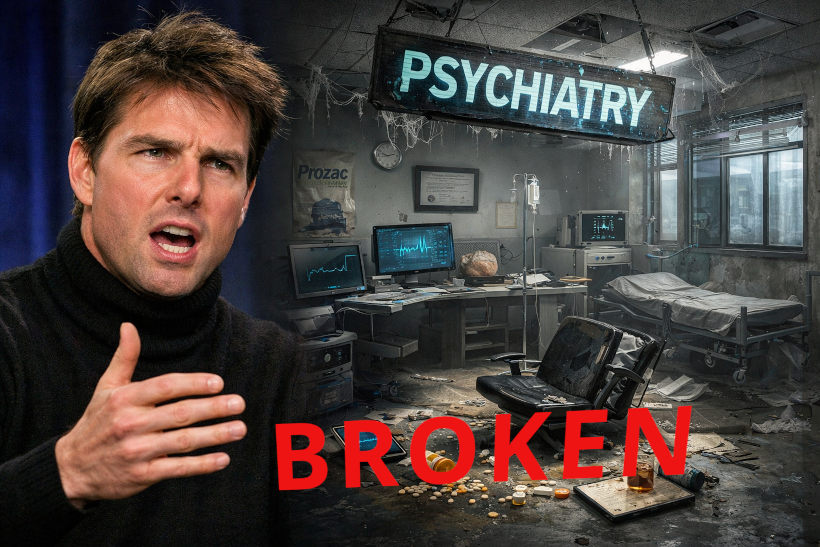
In June 2005, a movie star sat on a sofa and told the world that my profession was a “pseudoscience”. He called the anchor of the Today Show “glib” for defending the chemical imbalance theory. At the time, as a consultant forensic psychiatrist with the weight of the Royal College and the GMC behind me, I found it offensive. We had the manuals. We had the science. We had the authority.
Whether or not you agree our Fat Disclaimer applies
But that was twenty years ago.
Today, looking across a landscape of “divined” diagnoses and what Keith Rix (2025) has exposed [BJPsych Advances, 32, 44-56] as a systemic “misperception” of our own diagnostic tools, I am plagued by a disturbing question: What if the most aggressive critic of psychiatry in the last quarter-century was actually right—not about the specifics of his own solutions, but about the hollowed-out state of our practice?
We have spent two decades hiding behind the “persona” of our critics. It is time to look at the “glibness” of our own diagnostic habits.
The Serotonin Myth and the Early Warning
When Cruise attacked the “chemical imbalance”, he was dismissed because he was not a doctor. Yet, in 2022, the University College London (UCL) umbrella review essentially dismantled the serotonin hypothesis of depression. The “science” he called out as a marketing narrative finally met its match in the data. He was loud and he was aggressive, but he was also right about the fragility of the biological gospel we were selling on behalf of Big Pharma .
The Disappearing Substrate: Beyond EUPD
The issue is not just neurochemistry; it is the disappearance of diagnostic logic. In my previous writings, I have used Emotionally Unstable Personality Disorder (EUPD) as the primary example of this drift because it is the most conspicuous. For fifteen years, I have not seen the General Criteria for Personality Disorder (the “I” criteria) properly worked in a single clinical record. Not one.
But EUPD is just the tip of the iceberg. This systemic detachment from medical practice spans the entire diagnostic spectrum. Whether it is PTSD diagnosed without meeting the “gateway” criteria, or schizophrenia erased and replaced with EUPD without documented rationale, the result is the same: the diagnostic manuals—the ICD and the DSM—have become ghosts. They are cited to project authority but are absent from the actual work.
The Pseudoscience of the Unworked Criteria
If we define pseudoscience as a practice that claims to be scientific but lacks a substrate of evidence, then the modern psychiatric clinic is treading on dangerous ground. When we skip foundational criteria and jump to a sub-type based on a “vibe” or a twenty-minute crisis assessment, we are practising exactly what Cruise accused us of. We use the language of medicine to dress up a series of guesses shielded by institutional omerta. His posture was not an attack on science; it was an attack on the absence of it.
The Right Target, The Wrong Weapon
Cruise was right to target the over-medicalisation of human distress, but his weapon—a total rejection of biological intervention—was far too blunt. Suggesting postpartum depression could be solved with vitamins ignored the reality that acute biological distress sometimes requires an acute biological response. His error was not in noticing the cracks in the theory, nor in denying the reality of the distress—he was explicit that the struggle was “real”—but in his dogmatic conviction that because the psychiatric explanation was a fiction, the only valid remedy lay in vitamins and willpower.
Hacking the Brain: The Lustig and Taylor Warnings
The irony is that psychiatry has slowly come half-circle to meet its critics. We now acknowledge that antidepressants are significantly limited, offering clear value primarily in moderate to severe clinical depression when—and only when—properly diagnosed.
Robert Lustig, in The Hacking of the American Mind, argues that we have fundamentally confused pleasure (dopamine) with happiness (serotonin), and that our corporate-driven culture has “hacked” our biology to keep us in a state of substance-seeking rather than the pursuit of contentment.
Psychiatry has often functioned like the “pharmacological fixers” using this hack; prescribing pills to dampen the noise of a broken psychosocial environment. Even those at the very top of the profession are not immune. Professor David Taylor, a leading light in psychopharmacology and author of the Maudsley Prescribing Guidelines, has recently used his own harrowing experience with antidepressants to issue a stark warning to the whole of psychiatry. Having suffered debilitating withdrawal from the very drugs he spent a career advising on — symptoms the official literature long claimed were “rare” or “mild”—Taylor’s testimony in leading documentaries has shifted from personal reflection to a professional alarm bell.
He is cautioning the entire field that we have been operating on a profound misunderstanding of the biological toll these medications take. When the high priests of the manual find themselves broken by the ghost in the machine and issuing public warnings to their subjects, the “glibness” of the original 2005 Cruise exchange takes on a haunting quality.
This article if not saying that antidepressants are bad or dangerous. If you’re a patient seek individualised medical advice.
The Coercion of the Permanent Label
Cruise’s most valid, if unformed, point was regarding the stripping of personal agency. A diagnosis without substrate is a life sentence without a trial. In forensic psychiatry, I see the “liability time bomb” every day: labels inherited from crisis teams, passed down like family heirlooms, and used to justify detention or drugging without ever being subjected to diagnostic stress tests. He was misguided about the “spiritual” fix, but he was not wrong about the systemic danger of a label that had very little ground truth to support it.
The Insulation of Celebrity and the ‘Fuck You’ Truth
Why was it an actor, and not a consultant, who first shouted that the emperor had no clothes? Inside the profession, there is a structural silence enforced by careerism and peer-group validation. Cruise possesses the “fuck you” insulation of extreme wealth. He did not need the GMC’s approval or the authority of NICE. That independence allowed him to voice a fundamental scepticism that most psychiatrists—regardless of their private doubts—simply cannot afford to express.
The Structural Silence of the Peer Group
The “peer review” process in modern psychiatry has become performative. We audit the “wrapper” of care—the risk assessments, the signatures—but we never perform a “diagnostic stress test”. We have created a culture where challenging a colleague’s diagnostic logic is seen as a breach of professional courtesy rather than a requirement of medical ethics.
The Strategic Silencing of Dissent
To speak this truth is to invite a specific kind of professional marginalisation. The system protects its “divinations” by pathologising the dissenter. If you challenge the diagnostic vacuum too loudly, you risk being labelled an “anti-psychiatrist” or a “cloaked Scientologist”. It is a powerful form of social control: instead of engaging with the evidence—or the lack of it—the macroculture attacks the messenger’s loyalty. This fear of being cast out is what maintains the Institutional Omerta. It is the sound of a profession that has the power of a hard science but the accountability of a closed shop.
The Courtroom as the Final Arbitrator
The “liability time bomb” Keith Rix identifies is the moment where Cruise’s outsider scepticism meets legal reality. In the clinic, “divination” is business as usual. In the courtroom, under the scrutiny of Bolitho, an opinion must be logically defensible. When a diagnosis is exposed as having no substrate, the “pseudoscience” label starts to stick. The courts are beginning to do what the profession will not: hold us to the standard of being real doctors.
Conclusion: The Chimerical Truth
We find ourselves in a strange, chimerical reality where the frantic warnings of a Hollywood actor, the forensic evidence of a fifty-year veteran like Keith Rix, and the daily observations of my own thirty-five-year career have begun to coalesce into a single, devastating indictment. For decades, we hid behind our white coats and dismissed the outsider as “glib”, but we ignored the fact that our own diagnostic foundations were turning to dust.
The truth is that we have allowed a “Ghost Manual” to govern our clinics. We cite the ICD and DSM to project medical certainty to tribunals and courts, but in the quiet of the consultation room, we rely on “clinical intuition”—a polite euphemism for the vibe-based divination that has led to a national rash of unworked, substrate-free diagnoses. When Rix points out that cross-examination is doing the work that peer review refuses to do, he is describing a professional body that has effectively stopped policing its own logic.
This systemic failure is further complicated by the “pharmacological fix” we have applied to our cultural malaise. As Robert Lustig notes, we have confused the dopamine hit of pleasure with the serotonin-driven state of contentment, often using medication to “hack” a biology that is simply responding to a broken environment. When a figure as central to our prescribing culture as Professor David Taylor moves from advocate to victim, issuing a formal caution to the entire profession about the risks we have consistently downplayed, the “pseudoscience” label is no longer an insult; it is a clinical reality.
If a consultant forensic psychiatrist can work for fifteen years without seeing the foundational “I” criteria for a personality disorder worked in a single record, then we are medicating shadows and labelling ghosts. We are hiding behind an Institutional Omerta that protects our status at the expense of our patients’ agency. Cruise’s mistake was not thinking the suffering was a myth, but thinking that because the biological “ground truth” was missing, the medical sphere had no business being involved. Our mistake was thinking that the presence of our professional authority was a substitute for that ground truth.
The liability time bomb is already ticking. If the diagnosis is not in the work, it is not medicine. It is just an expensive, high-stakes performance of authority. And in the end, that is exactly as irresponsible as he said it was.