

Estimated reading time at 200 wpm: 31 minutes
What This Article Is Actually About
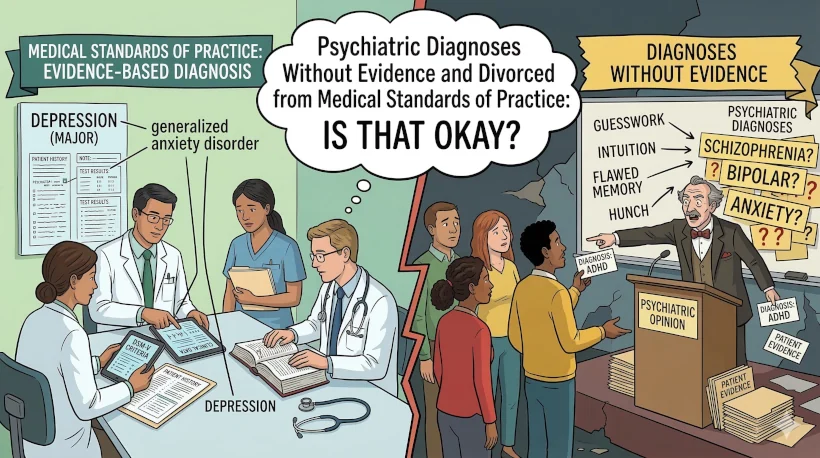
Prof Keith Rix, a forensic psychiatrist with fifty years’ experience, has collected the court judgments where these failures were exposed. His 2025 paper in BJPsych Advances shows what happens when diagnostic habits formed in clinics meet the scrutiny of a courtroom. The results are disturbing. And they affect everyone who has ever received a psychiatric diagnosis, instructed an expert, or sat on a tribunal. Consider the following: A man loses his compensation claim because an occupational physician listed “problems with employment” as if it were a mental disorder. A woman carries a diagnosis of EUPD for twenty years and treated with five psychotropic medications for most of that time, before anyone notices the diagnostic criteria were never applied i.e. botched diagnosis and botched unlicensed treatments. A prisoner or other in-patient in Medium Security supposedly diagnosed with PTSD is drugged up to the eye-balls with all sorts of potions, without clear diagnostics or appropriate treatment plan. A patient with robust documented diagnosis of treatment resistant schizophrenia suddenly has the diagnosis erased – without cogent documentation of rationale – and re-diagnosed with EUPD. None of the latter are ‘red herring’ cases chosen to sensationalise. They are unfortunately rather common. Out of sight – and out of mind – is that what we came into mental health services to deliver? Seriously?
Whether or not you agree our Fat Disclaimer applies
The above examples are not simply failures of bad doctors. They are failures of a system where diagnostic manuals—the ICD and DSM—are treated as ghosts: cited in reports, present on shelves, and absent from the actual work of diagnostics – and where there is virtually no scrutiny of diagnostics among trained psychiatrists. The mass and momentum of such failures over the last 30 years of UK psychiatry now approaches systemic corruption. See also: The Divination of Disorder: ‘Vibe-based’ Diagnosis of EUPD and Institutional Omerta in Modern Psychiatry
This is indeed a very long read. Unfortunately, those who most need to spend the time here won’t! Those types risk spending more time in court or at the sacrificial altar of the GMC. Their current sense of comfort won’t last. They have a rude awakenings coming. Soon!
Do not read this article if you have a dog to bathe, chickens to feed, garbage to put out or a hairdresser’s appointment approaching.
Why You Should Stay on This Page
This matters because the same habits that surface in court judgments are happening every day in clinics, wards, and consulting rooms across the UK. This is about the psychiatrist who diagnoses without applying ICD criteria; the psychologist who treats DSM as the final word on what counts as a disorder; the social worker who inherits a label and has no idea whether it was ever properly evidenced; the nurse who feels that they have no authority to challenge diagnoses; the patient who carries a diagnosis that would not survive five minutes of cross-examination.
Rix’s article is not an academic exercise. It is a mirror. If you work in mental health, you will recognise what you see in it. You may recognise yourself.
The cases cited by Rix span decades. The problems are not new. But Rix has done something no one else has: he has gathered the evidence, laid it out, and given us the language to describe what has been hiding in plain sight. Diagnostic manuals are being misused. Real people’s lives are affected. And until we name it, we cannot fix it.
The Author: Keith Rix
Keith Rix is not an academic critic writing from a safe distance. He qualified in medicine in 1975 and spent four decades as an NHS consultant forensic psychiatrist, working in Leeds, at HMP Leeds, and in psychiatric intensive care. He founded the Leeds Magistrates’ Court Mental Health Liaison and Diversion Scheme and held academic appointments at Manchester, Leeds, and now Chester and East Anglia. His doctoral research was supervised by Professor Sir David Goldberg. This is a man who has done the clinical work, run the services, and seen patients every day. When he writes about the gap between clinical habit and the requirements of medical practice, he knows both sides from the inside.
His expert witness career began in 1983 and spanned criminal, personal injury, family, and regulatory cases, including Harold Shipman, Ian Huntley, and Julian Assange. He led the Royal College of Psychiatrists’ report on expert evidence, developed the GMC-endorsed MAEP feedback system for experts, and in 2024 his submissions changed the Criminal Practice Direction. He holds honorary fellowships from the Faculty of Forensic and Legal Medicine and the Expert Witness Institute. He is not guessing. He is reporting what fifty years in the profession have shown him.
What Happens When Diagnosis Goes to Court or Tribunal
In clinic, a diagnosis guides treatment. In court, a diagnosis determines outcomes and sometimes treatment —whether someone is detained for more treatment, compensated, convicted, or believed. Rix shows that when the same diagnostic habits that pass unnoticed in the clinic enter the courtroom, they get exposed. Cross-examination does what peer review doesn’t: it asks for the evidence. And too often, the evidence isn’t there.
The Gap Between Clinic and Courtroom
Here’s the uncomfortable truth Rix documents: clinicians who never apply diagnostic criteria strictly in their daily practice will, when writing a medico-legal report, invoke those same criteria as if they’ve been rigorously applied all along. The manual sits on the shelf in both places. In clinic, it’s a ghost. In court, it’s suddenly treated as scripture. The gap between these two uses is where injustice takes root.
Meet the Manuals
DSM: The American Psychiatric Association’s Tool
The Diagnostic and Statistical Manual of Mental Disorders is now in its fifth edition, text revision. It’s a product of American psychiatry, designed primarily for US clinicians and researchers. Rix reminds us that it carries its own warning: when used for forensic purposes, there is a risk that diagnostic information will be misused or misunderstood. The manual itself knows it’s dangerous in court.
ICD: The World Health Organisation’s Classification
The International Classification of Diseases is the UK’s mandated diagnostic system. Currently in its eleventh edition, it serves global health statistics, epidemiology, and clinical communication. Rix notes that most UK psychiatrists use ICD in daily practice—but “use” here is loose. Using the code in a patient record isn’t the same as applying the diagnostic criteria.
What the Manuals Actually Say About Themselves
Both manuals contain preambles that clinicians rarely read and even more rarely quote in reports. ICD-11 calls its criteria “general guidelines” requiring clinical judgement. DSM-5 says it’s a “flexible guide” for organising information, not a rulebook. Rix quotes these passages because courts need to hear them. The authors of these manuals never intended them to be used as legal yardsticks.
What They Are (And More Importantly, What They Aren’t)
The manuals are not textbooks of psychiatry. They are not scientifically validated truth statements about where disorder ends and normality begins. They are not legally recognised schedules of conditions. They are not checklists. They are not substitutes for clinical formulation. Rix is painstaking in naming what they aren’t, because experts keep treating them as if they are all these things.
How Experts Misuse the Manuals
The Checklist Mentality Trap
Rix documents how experts treat DSM and ICD criteria like a shopping list: count the features, tick the boxes, announce the diagnosis. This ignores the manuals’ own instructions to use clinical judgement. Courts have noticed. In Vernon v Bosley (1996), a judge warned that psychiatric illness is “too complex and insufficiently concrete” for such rigid analysis. Yet experts keep doing it.
Turning Z Codes Into Fake Diagnoses
This is one of Rix’s most striking revelations. ICD-10 contains Z codes for “factors influencing health status”—things like unemployment, housing problems, or relationship difficulties. Rix shows cases where experts have presented these as medical diagnoses. In Michaelides (2019), an occupational physician listed “Problems with employment (Z56.0)” alongside depression, as if both were disorders. They are not. The court had to correct this.
When “Clinical Judgement” Becomes Guesswork
Both manuals explicitly require clinical judgement. Rix shows how this gets weaponised: experts invoke “clinical judgement” to justify diagnoses that have no documented basis in the criteria. The phrase becomes a shield against scrutiny. But as Rix notes, clinical judgement without evidence is not judgement—it’s assertion.
The “It’s Not in the Manual” Fallacy
Lawyers love this one. If a condition isn’t in DSM-5 or ICD-11, they argue it doesn’t exist. Rix demolishes this. Courts have accepted complex PTSD before it appeared in any manual. They have recognised psychiatric injury that falls outside classification altogether. The manuals are not exhaustive. They are not the final word on what constitutes a disorder.
Ignoring the General Criteria
Rix doesn’t explicitly name this, but his cases illustrate it: experts applying sub-type criteria for EUPD, PTSD, or personality disorders without first establishing that the general criteria for the broader category are met. ICD-10 requires this. Skipping it is not a shortcut—it’s a category error that renders the diagnosis invalid.
What Courts Have Noticed
The Imperfect Fit: Dowds Case Explained
R v Dowds (2012) is the jewel in Rix’s crown. The defendant argued that because ICD-10 lists “acute intoxication,” his voluntary drunkenness should count as a recognised medical condition for diminished responsibility. Lord Justice Hughes demolished this. He quoted DSM’s own warning about the “imperfect fit” between medical classification and legal questions. He listed other ICD entries—unhappiness, irritability, pyromania, paedophilia—to show that being in the manual doesn’t make something a legal defence. The judgment is a masterclass in understanding what diagnostic manuals are for.
When PTSD Diagnoses Go Wrong
Rix dedicates significant space to PTSD because it’s where classification problems become acute. The “gateway” criteria for trauma differ between ICD-11 and DSM-5. ICD-11 allows broader traumatic events but requires direct experience. DSM-5 has changed its definitions across editions. Experts pit one manual against the other. Courts are left to resolve disagreements that have more to do with manual choice than patient presentation.
The Research Courts Don’t See
Rix cites studies showing that many people experience PTSD symptoms in response to divorce, unemployment, or other events that don’t meet the manuals’ “gateway” criteria. He notes that ICD-11 diagnoses fewer people with PTSD than DSM-5, and they don’t identify the same groups. Experts rarely mention this research. They present manual-based diagnoses as if the manuals capture reality perfectly.
Drug-Induced Psychosis: Certainty Where None Exists
Experts frequently diagnose cannabis-induced or cocaine-induced psychosis based on clinical presentation matching manual criteria. Rix cites a 2021 review of 72 studies: there are no consistent psychopathological differences between substance-induced psychosis and primary psychotic illness. Chronology alone doesn’t prove causation. The manuals’ criteria don’t solve this. Yet experts testify with false certainty.
When the Disorder Isn’t in the Manual
London Borough of Haringey v FZO (2020) involved complex PTSD before it was formally in ICD-11. The council’s expert argued it couldn’t be diagnosed because it wasn’t in “standard diagnostic texts.” The court rejected this, accepting the diagnosis and noting that “real rigour” is required when accepting conditions not yet classified. Rix uses this to show that manuals are not the universe of disorders.
Controversial Diagnoses Exposed
In Kumar v General Medical Council (2012), an expert diagnosed Intermittent Explosive Disorder without explaining it was controversial and not in ICD. The GMC took an interest. Rix notes that using controversial diagnoses carries risks and requires explanation. The courtroom is not the place to discover that your diagnosis isn’t universally accepted.
The Manuals vs Real People
Why Patients Don’t Read the Manuals
Human distress does not arrange itself neatly into diagnostic boxes. Real people present with symptoms that overlap categories, shift over time, and resist tidy classification. Rix reminds us that most patients in ordinary clinical practice do not conform to textbook descriptions. They may satisfy some criteria from two or three different disorders. They may fall into the “not otherwise specified” categories that manuals include precisely because real people are messy.
The 20 Major Differences Between ICD and DSM
Rix cites First et al (2021): of 103 disorders appearing in both ICD-11 and DSM-5, twenty have major differences. This means the same patient can receive different diagnoses depending entirely on which manual the clinician favours. These are not trivial disagreements about wording. They are fundamental differences in what counts as a disorder and what thresholds must be met. A patient who is disordered by one manual may be normal by the other.
When Diagnoses Exist in One Manual But Not the Other
Seven DSM-5 categories do not appear in ICD-11. Nineteen ICD-11 categories do not appear in DSM-5. Rix warns that this creates opportunities for “weaponisation” in adversarial proceedings. A lawyer can attack a diagnosis simply because it lacks cross-manual recognition. The assumption that both manuals cover the same territory is false, and experts who don’t know this leave themselves exposed.
The Problem of Subthreshold Conditions
Many patients have genuine suffering that falls below the manuals’ diagnostic thresholds. Rix notes that experts sometimes use terms like “subthreshold PTSD”—technically correct if they mean the gateway criterion isn’t met, but potentially misleading. Courts may hear “subthreshold” and assume the condition is milder or less real. The patient’s experience of distress doesn’t diminish just because they don’t tick enough boxes.
When the Best Diagnosis Isn’t in Any Manual
Rix traces this through cases spanning nearly two decades. In C v D (2006), an expert diagnosed “mental abnormality as distinct from emotional distress” even though it wasn’t a classified disorder. In Lawson v Glaves-Smith (2006), the court concluded that whether the label PTSD was right mattered less than assessing the symptoms the claimant actually suffered. In D v The Bishop’s Conference of Scotland (2022), the court drew on these cases to accept psychiatric injury that fell outside DSM-5 entirely.
Hoarding Disorder: A Case Study in Manual Problems
Dudley Metropolitan Borough Council v Mailley (2022) illustrates the absurdity. Both experts agreed Mrs Mailley had severe hoarding behaviour. Both refused to diagnose hoarding disorder—one because DSM-5 requires it not be due to another mental disorder (and she was depressed), the other because it wasn’t in ICD-10 (he was wrong; it had been added). The court was unimpressed with both rationales. The manuals became an obstacle to describing what was plainly in front of everyone.
What Judges Want You to Know
“Ticks in Boxes” Are Not Enough
Lord Justice Thorpe in Vernon v Bosley (1996) said it directly: psychiatric illness is too complex for rigid analysis based on “sufficient ticks within boxes.” This is not an ancient judgment courts have forgotten. Rix shows it remains relevant. Judges want to understand the patient, not just count symptoms. An expert who presents a checklist without clinical formulation has missed the point of giving evidence.
The Clinical Picture Matters More Than the Label
This theme runs through decades of case law. Duthie v MacFish Ltd (2000): “It is the practical effect on him, rather than the appropriate diagnostic label, that matters.” Hynd v David Reekie & Sons Ltd (2013): “I am not persuaded that the difference in their diagnosis… makes a lot of difference.” LKM v NPM (2023): “I do not think that focusing on labels is of much assistance.” Judges are telling us, repeatedly, that what counts is the person’s condition, not what we call it.
Courts Can Reject Illogical Expert Opinions
The Bolitho principle (1997) matters here. A responsible body of medical opinion is not enough if that opinion is not logically defensible. Rix shows courts applying this to diagnostic evidence. In Hibbert v Ministry of Defence (2008), a judge preferred an expert who used clinical judgement over one who ticked boxes but disregarded severity. In Calvert v William Hill (2008), the court acknowledged that a DSM-IV “probable pathological gambler” score might be explained by other factors. Judges will look behind the diagnosis.
The Manuals Are Tools, Not Oracles
R v Wilcocks (2016): “As some of the manuals themselves make clear, care is needed before the classifications are used in a forensic context.” Judges read the prefaces. They know about the warnings. An expert who presents DSM or ICD as unquestionable authority risks looking either ignorant or dishonest when cross-examination reveals the manuals’ own cautions.
What Judges Actually Want From Experts
Rix doesn’t list this explicitly, but his case summaries reveal it. Judges want: an expert who has examined the whole evidence, not just the patient’s self-report. An expert who acknowledges uncertainty and the range of reasonable opinion. An expert who can explain why a diagnosis matters for the legal question, not just assert that it does. An expert who treats the manuals as aids to judgement, not replacements for it.
The Difference Between Description and Legal Determination
Lord Justice Hughes in Dowds made this distinction crystal clear. Medical classification serves description, communication, and statistics. Legal questions involve policy considerations that medicine doesn’t address. A condition can be perfectly sensibly included in a medical guide without answering any legal question. Judges know this. Experts who don’t are dangerous.
When Experts Disagree About Manuals, Judges Lose Patience
Rix shows cases where experts argued about which manual to use or whether a disorder appeared in one but not the other. In DL-H v Devon Partnership NHS Trust (2010), the tribunal was troubled by “over-prescriptive criteria” and the use of different manuals. In Noble v Owens (2008), the court said the precise characterisation didn’t signify—what mattered were the symptoms and prognosis. Experts who fight about manuals while the patient’s condition goes undescribed are not helping.
Practical Guidance for Professionals
Psychiatrists: What to Actually Put in Your Reports
Your report is not your clinic note. It is evidence. Rix’s analysis suggests several concrete practices. First, decide whether you need to mention the manuals at all. If a conventional diagnosis communicated in plain language serves the purpose, the manuals may add nothing but vulnerability. Second, if you do use them, explain their status, nature, purpose, and limitations. Tell the court they are guidelines requiring clinical judgement. Quote their preambles if necessary. Third, document your application of the criteria conspicuously. Do not assume—show. Fourth, acknowledge the range of reasonable opinion. If another expert might reasonably make a different diagnosis using a different manual, say so. Fifth, remember that your diagnosis is only part of the assessment. The court needs your formulation, your reasoning, your consideration of the whole evidence.
Psychologists: DSM Isn’t Your Only Bible
Rix notes a peculiar habit emerging in some cases: psychologists use DSM, psychiatrists use ICD, and both treat this as natural. It is not. DSM is an American psychiatric manual, not a psychological one. In UK courts, ICD is the government-mandated classification. If you use DSM, explain why. If you diagnose something not in ICD, or use DSM criteria to identify a condition that ICD codes differently, be explicit about this. The court may not know that DSM-5 and ICD-11 diverge on twenty major disorders. You need to tell them.
Social Workers: What These Labels Really Mean
You may not diagnose, but you read reports that do. Rix’s analysis should change how you read them. When a report says “EUPD” or “PTSD” or “depressive episode,” ask yourself: where is the evidence that the diagnostic criteria were applied? Is there a documented formulation? Has the writer considered alternative explanations? Has anyone established the general criteria for personality disorder before applying a sub-type? These are not academic questions. They affect care plans, funding, tribunal outcomes, and the person’s life. You are entitled to ask for the evidence behind the label.
Lawyers: How to Read a Psychiatric Report
Rix’s article is a gift to cross-examiners. It tells you where the weaknesses hide. Look for experts who treat manuals as checklists rather than guides. Look for Z codes or V codes presented as diagnoses. Look for controversial diagnoses presented without explanation or acknowledgment of disagreement. Look for experts who assert substance-induced psychosis without citing the research showing no consistent psychopathological differences. Look for reliance on one manual without explanation of why the other was not used. Look for the absence of clinical judgement—the purely mechanical application of criteria. And read the prefaces yourself. DSM-5’s forensic warning is devastating in the right hands.
Judges: What You Already Know But Experts Forget
Rix quotes several judgments that show judges understanding the manuals better than some experts. You know that labels matter less than clinical pictures. You know that “ticks in boxes” are insufficient. You know that medical classification does not answer legal questions. You know that Bolitho allows you to reject illogical expert opinions even if they come from a responsible body. What Rix adds is the specific evidence of how experts go wrong. Use it. When an expert treats DSM as scripture, ask if they’ve read the disclaimer. When an expert relies on ICD-10’s Z codes, ask what chapter they came from. When an expert insists a condition must be in the manual to exist, ask about CPTSD in 2009.
Trainees: What You’re Not Being Taught
Rix’s article exposes a hidden curriculum. You are taught diagnostic criteria. You are probably not taught their limitations, their forensic dangers, or the research showing how rarely they are strictly applied in clinical practice. You are not taught that the manuals contain their own cautions against forensic misuse. You are not taught that twenty disorders differ significantly between ICD-11 and DSM-5. You are not taught that Z codes are not diagnoses. If you plan to do medico-legal work, you need to learn this yourself. Your training may not cover it.
Service Leaders: What Your Audits Miss
Your Trust audits probably check whether a diagnosis is recorded. They almost certainly do not check whether that diagnosis is justified by documented evidence. Rix’s cases show what happens when this gap reaches court. Your services are producing records that may not survive scrutiny. The psychiatrist who diagnoses EUPD without applying ICD criteria, without documenting the general criteria, without longitudinal evidence, is creating a liability. Not just for themselves—for the trust, for the patient, for the next clinician who inherits the label. Consider what a diagnostic audit would actually find if it looked at content, not just presence.
For Ordinary Folk
If You’re Given a Diagnosis, Ask These Questions
You have a right to understand what is being said about you. Rix’s article suggests some questions you might ask. What criteria from ICD or DSM have been used to reach this diagnosis? Can I see where those criteria are documented in my records? Has the doctor considered other explanations for my difficulties? Is this diagnosis accepted by both major classification systems, or is it controversial? What does this diagnosis mean for my treatment, my insurance, my employment, my future? A doctor who cannot answer these questions may not have done the work the diagnosis requires.
What Your Medical Records Should Actually Contain
If you have a diagnosis of EUPD, PTSD, depression, or any mental disorder, your records should contain more than just the label. There should be evidence that the diagnostic criteria were considered and applied. There should be a formulation that connects your history to your presentation. There should be documentation of differential diagnoses considered and ruled out. There should be some indication that the general criteria for a category (like personality disorder) were satisfied before a sub-type was applied. If your records contain only the label, the diagnosis may be what Rix’s article exposes: a diagnosis without substrate.
When a Diagnosis Might Not Survive Scrutiny
Some diagnoses are more vulnerable than others. Rix’s cases show particular problems with EUPD, PTSD, substance-induced psychosis, and controversial conditions like Intermittent Explosive Disorder. If your diagnosis falls into these categories, or if it relies on a condition that appears in only one manual, or if it uses Z codes or V codes as if they were disorders, it may not withstand independent review. This matters if your diagnosis is used in a tribunal, a benefits claim, an insurance application, or legal proceedings. You are entitled to seek a second opinion that applies the criteria properly.
Your Rights When a Label Changes Your Life
A psychiatric diagnosis is not just a medical opinion. It affects your liberty if you are detained. It affects your compensation if you are in litigation. It affects your access to services, your insurance premiums, your employability, your relationships, your sense of yourself. Rix’s article shows that these life-changing labels are sometimes applied without the rigour the manuals themselves require. You have a right to challenge them. You have a right to ask for the evidence. You have a right to a second opinion that takes the diagnostic criteria seriously. The diagnosis is not the final truth about you. It is a clinical judgement, and like all judgements, it can be wrong.
What to Do If You Suspect Your Diagnosis Was “Divined”
This article uses the word “divination” for a reason. If you suspect your diagnosis was reached without proper application of the criteria, without documented evidence, without consideration of alternatives, you have options. You can request your records and see what they contain. Ask your clinician to explain the diagnostic process. Seek a second opinion from a psychiatrist who takes diagnostic rigour seriously. If the diagnosis affects legal proceedings, instruct your solicitor to read Rix’s article and ask the right questions. The culture of institutional omerta you describe depends on patients not knowing what they’re entitled to. Know it.
Why This Matters Even If You’re Not in Court
Most people with psychiatric diagnoses never see a courtroom. But the diagnosis still affects them. It shapes how clinicians treat them. It influences what services they can access. It becomes part of their identity. If that diagnosis was reached without rigour, if it misrepresents their difficulties, if it pathologises their life circumstances (the Z code problem), then they are being failed by the system designed to help them. Rix’s article is about medico-legal reporting, but its implications reach into every clinic where diagnoses are made without the work the manuals require.
The Bigger Picture
Institutional Habits That Protect Poor Practice
Rix documents individual errors, but this article names the deeper problem: habits embedded in institutions. These habits survive because they are shared. A psychiatrist who diagnoses EUPD without applying ICD criteria is not deviating from local norms—they are conforming to them. The habit is invisible because everyone does it. The institution does not see poor practice; it sees business as usual. Rix’s cases only become visible when they reach court because the courtroom is the only place where these habits are exposed to light.
Why Peer Review Doesn’t Catch These Errors
Peer review in mental health services rarely examines diagnostic logic. Cases are presented, formulations offered, heads nod. No one asks why the general criteria for personality disorder were not documented. No one notes the absence of longitudinal evidence. No one challenges a colleague’s diagnosis because doing so would invite the same scrutiny in return. As this article puts it, the silence is not conspiratorial—it is structural. Peer review has become performative. It audits the wrapper, not the contents.
The Malpractice Vacuum Inside the NHS
This article uses the phrase “malpractice vacuum” to describe what happens when there is no mechanism for holding diagnostic practice to account. Rix’s article provides the evidence that this vacuum exists. Cases reach court only when something else has gone wrong—a detention, a compensation claim, a criminal proceeding. The thousands of diagnoses made every day in NHS clinics never face any equivalent scrutiny. There is no equivalent of cross-examination in the corridor. There is no judge asking for the evidence behind the label. The vacuum is not empty. It is full of unexamined practice.
What Regulatory Bodies Actually Audit
The Care Quality Commission inspects staffing levels, waiting times, and safety incidents. Trust audits check whether diagnosis fields are completed. The Royal College’s Quality Networks examine service delivery, patient involvement, and administrative compliance. None of these mechanisms perform what this article calls “diagnostic stress tests.” No one reads a sample of EUPD diagnoses and asks: where is the documented evidence that the ICD criteria were applied? The regulators audit what is measurable. Diagnostic rigour is not measured, so it is not managed.
How One Diagnosis Haunts the Patient Forever
Once a diagnosis enters the electronic record, it becomes inertial fact. Subsequent clinicians inherit it as the starting point rather than a hypothesis to be tested. The patient who was diagnosed with EUPD after a twenty-minute crisis assessment carries that label for decades. It shapes every future encounter with services. It becomes part of their identity. It affects their insurance, their employment, their relationships. Rix’s cases show that some of these diagnoses would not survive five minutes of cross-examination. But they never face cross-examination. They just persist.
The Liability Time Bomb for Clinicians
Rix’s article should worry every psychiatrist doing medico-legal work. The diagnostic habits that pass unnoticed in the clinic become exposed in court. The expert who has never applied ICD criteria strictly in NHS practice must suddenly produce a report that implies they have. The gap between clinical habit and forensic requirement becomes visible under cross-examination. The expert’s credibility depends on the court not knowing what happens in ordinary practice. But as Rix shows, courts are learning. The manuals’ warnings are being read. The judgments are accumulating. The liability is not hypothetical—it is already materialising in cases like Kumar v GMC.
Why Good Clinicians Should Welcome Scrutiny
The defensiveness that protects poor practice also protects good practice from being seen. A psychiatrist who does apply diagnostic criteria rigorously, who documents the evidence, who considers alternatives, who formulates carefully, has nothing to fear from audit or cross-examination. But they currently work in a system where their rigour is invisible because no one looks. Proper scrutiny would reveal not only the poor practice but also the good. It would separate the clinicians who diagnose from those who divine. The omerta protects everyone, but it serves no one.
Where Next?
Questions Rix Leaves Unanswered
Rix’s article is descriptive, not prescriptive. He shows what goes wrong but does not tell us how to fix it. He does not address whether the manuals themselves should be reformed or abandoned. He does not consider what training might prevent these errors. He does not examine whether regulatory bodies should change their audit methods. He does not ask whether the adversarial system is the right place to test diagnostic validity. These questions are not criticisms of his work—they are the natural next steps after reading it. He has given us the diagnosis. The treatment is still to be determined.
What Individual Clinicians Can Do Now
You do not need to wait for system change. You can change your own practice. Read the prefaces to the manuals you use. Know what they say about themselves. Apply diagnostic criteria conspicuously and document that application. If you diagnose EUPD, show the general criteria were met before applying the sub-type. If you use Z codes, know they are not diagnoses. If you diagnose something controversial, explain its status and the range of opinion. If you write medico-legal reports, explain the manuals’ limitations up front. The guidance in Box 8 of Rix’s article is a practical starting point. Use it.
What Service Leaders Should Be Asking
If you lead a service, you have responsibility for the diagnoses made within it. You could ask questions that no one is currently asking. What proportion of EUPD diagnoses in our service have documented evidence that the general criteria for personality disorder were applied? How many clinicians in our service have read the prefaces to ICD-11 or DSM-5? Do our audit processes examine diagnostic logic or just diagnostic presence? Are our peer review meetings equipped to challenge diagnostic practice? These questions would be uncomfortable. They might also be the beginning of real accountability.
What Trainers Should Be Teaching
Rix’s article should be required reading for every psychiatry trainee, every forensic psychology student, every lawyer who instructs expert witnesses. But reading it is not enough. Trainees need to learn that diagnostic criteria are tools, not truths. They need to understand that the manuals contain their own cautions. They need to know that twenty disorders differ significantly between ICD-11 and DSM-5. They need to be taught how to write reports that explain these complexities rather than hide them. They need supervised experience of having their diagnostic reasoning scrutinised. If we do not teach this, we are sending them into court unarmed.
What Researchers Could Investigate
The research Rix cites shows the gap between clinical and research diagnoses. But we need more. We need studies examining how often EUPD diagnoses in NHS records are supported by documented evidence of ICD criteria. We need research on whether patients diagnosed without rigorous application have different outcomes from those diagnosed properly. We need to understand why clinicians who would never skip a physical examination step feel entitled to skip diagnostic steps in psychiatry. We need to know whether the “vibe-based” diagnosis this article describes is as prevalent as we suspect, or whether it is a minority practice that happens to generate most of the litigation.
What Regulatory Bodies Could Do Differently
The General Medical Council could ask different questions when concerns arise. The Care Quality Commission could sample diagnostic records for evidence of rigour. The Royal College could develop guidance on what constitutes an adequate diagnostic assessment and audit against it. These bodies currently focus on the measurable. They could start measuring what matters. It would require resources, expertise, and the willingness to find what they might find. But the alternative is to continue regulating the wrapper while the contents remain unexamined.
What Patients and Families Should Know
This article is written for patients as much as professionals. Rix’s article is not, but its implications for patients are profound. Patients need to know that a diagnosis is not a final truth. They need to know they can ask for the evidence behind it. They need to know that some diagnoses are more contested than others. They need to know that Z codes describe life circumstances, not disorders. They need to know that if their diagnosis affects legal proceedings, they have rights to challenge it. Knowledge is not a guarantee of better practice, but it is a necessary condition for demanding it.
What the Courts Might Do With This
Rix’s article is published in a journal read by psychiatrists, not judges. But his companion article for the judiciary exists. As more judges read it, as more experts are cross-examined using its insights, as more judgments cite its cases, the courts will become increasingly sophisticated about diagnostic practice. The gap between clinical habit and forensic requirement will become harder to hide. Experts who rely on the manuals without understanding their limitations will find themselves exposed. This is not a threat to good practice—it is a threat only to practice that cannot withstand scrutiny.
A Call for Diagnostic Honesty
Rix’s article provides the evidence that makes an urgent call for diagnostic honesty. This means acknowledging what the manuals are and are not. It means applying criteria conspicuously or not claiming their authority. It means admitting uncertainty where research shows it exists. It means telling courts when a diagnosis is controversial, when it appears in only one manual, when it rests on contested grounds. It means treating patients as people whose lives are affected by our labels, not as opportunities to demonstrate our clinical intuition. The call is simple: do the work, show the work, or do not claim the diagnosis. Everything else is just words.
Footnotes and references
[being updated]
- London Borough of Haringey v FZO [2020] EWCA [TBC] (QB) – note: “Davies LJ referred specifically to the medical evidence and found that the judge had erred in law because she had not given any or any adequate weight to the clinical assessments of the claimant from his breakdown in late 2011 up to 2014. In none of those assessments had the claimant been diagnosed with PTSD, Complex or otherwise. In fact, no treating clinician had diagnosed Complex PTSD until after Dr O’Neill had done so for the purposes of this claim. The fact that the advanced diagnosis was not even part of WHO international classification placed even greater importance on the 2011-14 assessments. Davies LJ decided that this error was not sufficiently material to result in dismissal of the appeal; whatever the diagnosis, the claimant had suffered a breakdown in 2011 as a result of the abuse and his disability and losses flowed from that.” – Yes, the case was not lost but it provides evidence of one strand of practice emerging at this high level. That strand continues unchecked.