

Estimated reading time at 200 wpm: 3 minutes
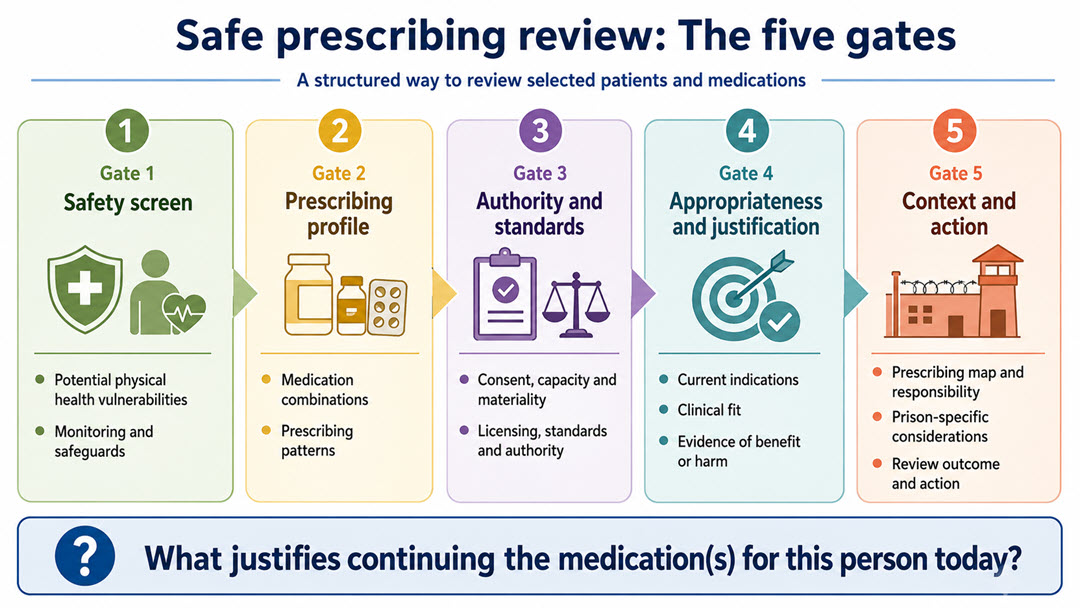
This work contains a downloadable PDF document below. It is a working instrument, not a policy paper; a single-page crib sheet with explanatory guidance, for structured individual or team review of prescribing. Every gate serves one closing question — what justifies continuing the medication(s) for this person today?
Whether or not you agree our Fat Disclaimer applies

That question is the point of the whole exercise. In everyday practice, continuation is the default. Optimising, changing or stopping medications is what requires sound clinical and legal justification. Study of Good practice in proposing, prescribing, providing and managing medicines and devices – GMC is a good idea for both medical and non-medical prescribers. Inherited prescribing is not treated as self-justifying, says the GMC. But a prescription, once written, acquires a kind of squatter’s rights.
Everyday, millions of prescriptions are re-written by doctors, oblivious to Para 97 of the GMC’s standards.The logic is not spoken but it is something along the lines of ‘Saving the NHS is a higher priority than protecting patients’ lives and well-being.‘ Actions speak louder than words. Repeats are now called ‘Scripts’ in many services – especially in Prison Healthcare. How it works: usually it is a tired and overworked doctor sitting in a chair (hopefully), re-writing by hand or navigating some electronic system that does the ‘repeats’ – while stuffing their face hurriedly with some food or drink. Umpteen scripts are done in quick time – everybody is happy! Documentation? That’ll be “Meds repeated. No concerns. Patient stable” or something telegraphic like that.How do I know? I’ve seen them in action and seen records hundreds of times.
Those who have been hauled before the Coroner and grilled for 2 or more hours on some medication issue, have a rude awakening. The Five Gates strategy places burdens where it is due. Many will not ‘like it’. No one likes more burden. What people in general want is an easy life and an easy take home packet of pay.
Five Gates serves a second purpose. In Why the Oliver McGowan Case Still Matters I described the ‘neck of the funnel‘: the failures at the interface of medicine and law that can endanger every patient regardless of personal characteristics. I also observed that no body in the regulatory landscape routinely audits individual medical prescribers’ practice. The standards exist; the checking does not. The Five Gates crib sheet is one practical attempt at narrowing the neck. It requires no legislation, no funding and no permission from any regulator. Individuals and teams can begin using it now (subject to local policies).
Version 1 is presented and may be updated without notice.
No liabilities accepted. DO NOT use this unless you know you have sufficient justification or authority to use it.
This methodology is not about criticising individuals. It is designed to improved standards and accountability which should have positive effects for patient safety.
It is for individuals and teams to use their professional judgement as to what actions, if any, need to be taken on such reviews – and with what speed.
Clear documentation of the substance of reviews is recommended. Think about you and the Coroner, and your regulator (or not).