

Estimated reading time at 200 wpm: 26 minutes
On 11 November 2016, Thomas Oliver McGowan, an 18-year-old man with epilepsy, mild autism, a mild learning disability, and cerebral palsy, died at Southmead Hospital in Bristol. He had been admitted on 22 October 2016 with uncontrolled seizures. During that admission, he was sedated, intubated, and given olanzapine, an atypical antipsychotic, despite explicit warnings from his family and documented evidence of prior adverse reactions to antipsychotic medication. He developed neuroleptic malignant syndrome (NMS), suffered a catastrophic brain injury, and died.
Whether or not you agree our Fat Disclaimer applies
The case has since become the foundation for a statutory mandatory training programme for all health and social care staff in England. The Oliver McGowan Mandatory Training on Learning Disability and Autism is now enshrined in law. Its stated purpose is to ensure that staff have the skills to provide safe care to autistic people and people with a learning disability. The official narrative– accepted without serious challenge by the NHS, the regulators, and the legislature–is that Oliver died because clinicians lacked understanding of autism and learning disability.
This paper will argue that this narrative is incomplete and misleading. The failures that killed Oliver were not primarily failures of autism awareness. They were basic failures of clinical competence and legal process. The failures encompassed breaches of national guidance on prescribing medications, prescribing standards expected by the General Medical Council, other failures to meet GMC expectations on Capacity/Consent, communication, documentation, diagnostics, and engaging with relatives. There were failures of vigilance and recognition about NMS that average higher trainees in psychiatry would be expected to demonstrate. The collective failures would have been fatal to any patient, regardless of disability.
The Patient: his conditions and his death
Oliver McGowan was 18 years old at the time of his death. He had mild autism, a mild learning disability, cerebral palsy, and epilepsy resulting from a hypoplastic right cerebral hemisphere following neonatal meningitis. He was not previously known to suffer a mental disorder. Three psychiatrists had assessed him and confirmed that he had no psychotic disorder. There were previous documented prior adverse reactions to antipsychotic medication, including an oculogyric crisis in April 2016 that required reversal with procyclidine after a six-hour delay.
On 22 October 2016, he was admitted to Southmead Hospital with a cluster of focal partial seizures. His mother provided his hospital passport, which contained explicit warnings about his intolerance to antipsychotics, written in bold red on his drug charts and care sheets. A nurse placed the passport in a drawer, unopened.
When his seizures could not be controlled, he was sedated and intubated. On 25 October, while Oliver was unconscious, Dr Monica Mohan, a consultant neuropsychiatrist, prescribed olanzapine to manage “ictal psychosis” when he became awake. As it was known that Oliver was not conscious it is reasonable to infer that olanzapine was administered via nasogastric tube or parenteral route. His parents were not consulted before the prescription. They were informed afterwards.
About 3.5 days after the first dose, Oliver deteriorated seriously. His temperature rose to 43°C. His brain swelled catastrophically, to the point of bulging from the base of his skull. The clinical team did not recognise NMS. Life support was withdrawn on 7 November 2016. He died on 11 November 2016.
Purposes of this article
This paper has three aims.
- to set out the specific clinical and legal failures that caused Oliver’s death; demonstrating that these were universal failures of competence and process, not failures specific to autism or learning disability.
- to examine the official response: the coroner’s legally questionable conclusion, the mismanaged LeDeR review, the GMC investigation with no public outcome, the police inquiry still unresolved, and the mandatory training programme now enshrined in law.
- to introduce the concept of institutional overshadowing: the process by which a healthcare system attributes an adverse outcome to a patient’s protected characteristic rather than to the universal failures that caused it, thereby protecting itself from accountability. The Oliver McGowan case is an unusual example of institutional overshadowing.
The paper will conclude that the mandatory training, while useful is an inadequate response to the failures identified. The need for enhanced national training is a palatable version of the problem–leaving the underlying collective failures unaddressed. A truthful reckoning is required.
The clinical failures that contributed to death
The following failures are drawn from the public record of the inquest, the LeDeR review, Hansard, and contemporary reporting. Each failure is presented as a discrete clinical or legal dysfunction. The cumulative effect of these account for Oliver’s death.
Diagnostic failures: no confirmed psychosis
Oliver was diagnosed with ‘ictal psychosis’ – a presumption made on questionable evidence and process, in an unconscious patient.
Ictal psychosis, if present, required observable symptoms such as evidence of a pattern of delusions, hallucinations, disorganised behaviour, or thought disorder. Oliver was unconscious, sedated, and intubated when the diagnosis was made and when olanzapine was prescribed. He could not display any of these symptoms. The evidence was weak for such patterns at a time previous to him being medically anaesthetised – based on source materials in the public domain.
Prior to this admission, three psychiatrists had assessed Oliver and confirmed he had no mental disorder. A letter from Bristol Children’s Hospital explicitly stated that he was not psychotic. His parents repeatedly told the clinical team that his behaviour – including repetitive talk about a video game blogger – was an autistic special interest, not a delusion.
What is Ictal Psychosis
“Ictal psychosis of epilepsy (IP) is a non-convulsive epileptic state in the form of psychotic symptoms that occur primarily in the temporal lobe and rarely outside the temporal lobe (i.e., the frontal lobe). Psychomotor states of temporal lobe origin may be characterized by thoughts of persecution, anxiety/fear, negativity, irritability, or aggression. Hallucinatory symptoms, depersonalization, or derealization that occur during seizures are almost always associated with other symptoms (automaticity, altered consciousness) of seizures that occur in the temporal or frontal lobes. Therefore, for any sudden onset of mental abnormalities, an EEG examination is very necessary.” [Qiu Z, Guo J, Chen B, Fang J. Psychosis of Epilepsy: An Update on Clinical Classification and Mechanism. Biomolecules. 2025 Jan 3;15(1):56. doi: 10.3390/biom15010056. PMID: 39858450; PMCID: PMC11762389.]
This is not an attempt to re-diagnose or de-diagnose Oliver. The issue is whether diagnostic efforts were documented about the decision-making on diagnosis, and whether diagnostics came under regulatory or other scrutiny. It that happened it is not available in the public domain.
Prescribing failures: unlicenced olanzapine without consent
Olanzapine is licensed for schizophrenia and bipolar disorder. It was prescribed for “ictal psychosis”, which is not a licensed indication according to the olanazpine SMPC (available on line). This was unlicenced prescribing according the GMC.
The General Medical Council’s guidance on prescribing (in force at the time) required that unlicenced use is justified by a sufficient evidence base, documented with a clear rationale, and accompanied by informed consent from the patient. Where the patient lacks capacity, those authorised to make decisions on their behalf according to law and other National guidance. All that had been underpinned for many years by similar guidance from the Royal College of Psychiatrists and The Medicines and Healthcare products Regulatory Agency.
The public record discloses no documentation of consideration of such guidance. It is possible that documentation was made but not reported to the public.
Oliver and his parents had explicitly objected to antipsychotic medication. Those objections were documented in the hospital passport and communicated to the clinical team. Despite this, the drug was administered.
Capacity and consent failures: no MCA assessment, parents ignored
The Mental Capacity Act 2005 establishes a presumption of capacity for adults. Oliver was an adult at the material time. Section 1(2) requires that a person is assumed to have capacity unless it is established that they lack capacity. Section 2(1) requires that any assessment of incapacity is decision-specific: a person lacks capacity “in relation to a matter” if at the material time they cannot understand, retain, use or weigh, or communicate the relevant information.
No decision-specific capacity assessment was disclosed as conducted before olanzapine was prescribed. Dr Mohan told the inquest that she believed Oliver was incapacitated because he was sedated and intubated, and she characterised the situation as an “emergency”. In law, a presumption of incapacity may arise where a person is unconscious and the decision is urgent. Dr Mohan sought to rely on this.
However, having invoked incapacity based on an emergency, she said her decision was in his best interests. To do that she was required to make a “best interests” decision under section 4 of the Mental Capacity Act 2005. Section 4(7) requires that anyone making a best interests decision must consult, so far as is practicable, “anyone engaged in caring for the person or interested in his welfare”.
It is not disclosed in the public domain that Dr Mohan consulted Oliver’s parents before prescribing. She informed them after the drug had been administered. The parents were the primary source of information about Oliver’s known intolerance to antipsychotics. They had provided written warnings. They had explicitly objected to the drug. The failure to consult them before the decision was made means that, from the evidence available in the public domain, the prescription could not have arisen from a lawful best interests decision.
Dr Mohan told the inquest she would prescribe olanzapine again in the same circumstances.
As reported in the Bristol Live:
“I take responsibility because I wanted the best for Oliver. I prescribed it in the best interest and followed all the rules including consulting with the neurologist, Dr Campbell (ICU doctor) and the family. I took their concerns about Olanzapine, but I would choose it again because it’s one of the medications we use in an acute setting.”
The BBC reported: “I take responsibility. I prescribed Olanzapine but I don’t know that I’m responsible for anything else that happened.”
The Daily Mail / PA Media reported: “I had to do the best for Oliver at that given time because he was incapacitated and I wanted him to have a good outcome.”
From the same source: “I had to do that as a clinician. All the evidence I had heard pointed towards doing something reasonable, less restrictive, less detrimental, so he could have a better quality of life.”
Chopsy Bristol reported: “Dr Monica Mohan who prescribed the fatal dose said during the inquest ‘I would do it again’, even though she had said that the family were ‘right all along’.”
Monitoring failures: NMS not recognised, early signs missed
Neuroleptic malignant syndrome is a medical emergency. It is taught to every psychiatric trainee. The cardinal early signs include fever, altered mental status, rigidity, and autonomic disturbance. Mortality has fallen substantially over the past thirty years, not because the condition has become less dangerous, but because earlier recognition and prompt intervention have improved.
Oliver McGowan developed a fever. He developed increased seizure activity, noticed by his parents as “alarmingly different” from his usual seizures. He had recently been started on olanzapine, an antipsychotic known to carry a risk of NMS. He had multiple known risk factors for NMS: organic brain problems, cerebral palsy, epilepsy, and documented prior adverse reactions to antipsychotics.
At the point when fever and increased seizure activity were first observed, any clinician alert to the possibility of NMS should have considered the diagnosis. Early recognition requires only that the possibility enters the clinician’s mind. The diagnostic criteria are not obscure. The threshold for suspicion is low once a patient on an antipsychotic develops fever and neurological change.
There is no evidence in the public record that NMS was considered at this stage. The clinical team did not stop olanzapine when fever and increased seizure activity emerged. The drug continued to be administered until 28 October, by which time catastrophic brain injury had already occurred.
The failure was not a failure to diagnose a rare condition in its late stages. It was a failure to maintain basic clinical vigilance and responsivity in a patient with clear risk factors. Fever and increased seizure activity in a patient of his biological characteristics, newly started on an antipsychotic are not subtle signs. They are alarm bells that required a robust and timely clinical response.
It is not reported in the public domain whether creatinine kinase and iron serum iron levels were tested. Those could have indicated (but not diagnosed) the probability of NMS. It is unusual that if such tests were done, they did not feature in media reporting.
The later findings – a temperature of 43°C, brain swelling visible on CT scan, the brain “bulging out of the base of the skull” – are not evidence that NMS was unpredictable. They are evidence that the opportunity for early recognition was missed. The condition progressed to its most severe form because it was not identified and treated at the point when intervention could have altered the outcome.
These failures were fundamental. They do not require understanding of autism or learning disability to avoid. They require basic clinical competence, adherence to the Mental Capacity Act 2005, and proper medical monitoring. Oliver could have been any patient. The same errors would have been equally fatal.
The inquiries and their findings
The inquest was heard before Assistant Coroner Dr Peter Harrowing. It concluded on 20 April 2018. The coroner recorded a narrative conclusion.
The coroner found that Oliver died of “the combined effects of pneumonia and hypoxic brain injury the latter caused by seizures and neuroleptic malignant syndrome (NMS)”. He further found that “the NMS being a very rare adverse effect of olanzapine which was properly indicated and prescribed” and that “the olanzapine was not contra-indicated and the occurrence of NMS could not have been predicted”.
The coroner accepted that Oliver suffered from “psychosis related to his seizures, or ictal psychosis”. He noted that Oliver did not have an “enduring mental illness”. He concluded that Dr Mohan “throughout acted in accordance with Oliver’s best interests”.
The coroner also noted that Dr Mohan did not discuss the risk of NMS with Oliver’s parents before the drug was prescribed, on the basis that it was “not a common side-effect”. He recorded that the parents had provided a hospital passport, that Oliver had been given the drug despite the family’s objections, and that the drug was administered while Oliver was sedated and intubated.
The statutory limits on a coroner’s function
The Coroners and Justice Act 2009 defines the purpose of a coroner’s investigation. Section 5(1) provides that the purpose is to ascertain (a) who the deceased was, (b) how, when and where the deceased came by his or her death, and (c) the particulars required for registration.
Section 5(3) provides that a coroner “may not express any opinion on any matter other than” those statutory questions.
Section 10(1) requires the coroner to make a determination as to the questions in section 5(1)(a) and (b). Section 10(2) provides:
“A determination under subsection (1)(a) may not be framed in such a way as to appear to determine any question of—(a) criminal liability on the part of a named person, or (b) civil liability.”
Applying the statute to the coroner’s words
The coroner’s finding that olanzapine was “properly indicated and prescribed” is not a finding about who Oliver was, or how, when, and where he died. It is an opinion about the clinical standard of care provided by Dr Mohan and the clinical team. It addresses whether the prescription was clinically appropriate.
The finding that NMS “could not have been predicted” similarly addresses the standard of care. It speaks to foreseeability of harm, a core question in any clinical negligence claim.
Both findings appear to determine, or at least to give the appearance of determining, or ruling out a question of civil liability. They state, in effect, that no fault was found. That sits uneasily with the prohibition in section 10(2).
The same finding is also hard to place within section 5(3), which confines the coroner to the statutory questions. The propriety of a clinical prescription is not among them.
The consequence for accountability
Section 10(2) exists to preserve the distinction between a coroner’s inquisitorial function and the adjudicative functions of civil courts and professional regulators. A coroner who oversteps that boundary risks distorting subsequent proceedings. The GMC, considering a complaint about Dr Mohan, would have to contend with a formal coronial finding that the prescription was proper. A civil court considering a negligence claim would face the same difficulty.
The coroner was not required to make any finding about the propriety of the prescription. The statutory questions were: who Oliver was, and how, when, and where he died. The coroner could have recorded that olanzapine was administered and that NMS followed. He did not need to add that it was “properly indicated and prescribed”. Those words may have had the effect of appearing to determine that ‘no fault’.
On a plain reading of section 10(2), these words appear to stray beyond the boundary the section sets.
The LeDeR review’s potentially avoidable finding
The Learning Disability Mortality Review (LeDeR) programme reviewed Oliver’s death. The review concluded that his death was “potentially avoidable”. It found that if Oliver had been assessed correctly on admission and staff had read his hospital passport, he might never have needed to be intubated and sedated.
The LeDeR review also found a “general lack of understanding and acknowledgement of Oliver’s autism” and that there was “no substantial evidence” that alternatives to antipsychotic medication had been considered.
The local clinical commissioning group (CCG) was responsible for managing the LeDeR process. The HSJ reported in 2020 that the CCG had “mismanaged” the review. The lead reviewer told investigators that she felt “bullied” into changing the “potentially avoidable” finding. The original draft report had ticked “Yes” to the question “Was the death, on balance, potentially avoidable?”. The published version unticked the box and removed passages critical of the decision-making.
NHS England subsequently conducted an independent review of the LeDeR process. That review concluded that the process had been “mismanaged, poorly monitored and allowed to progress without due rigour”. The Chief Executive of the local CCG, Julia Ross, apologised to the family and admitted that the process had been flawed.
The GMC investigation without public outcome
In June 2021, the General Medical Council opened an investigation into Dr Monica Mohan. The HSJ obtained a letter from the GMC to the McGowan family confirming the investigation.
The GMC does not disclose the outcomes of individual investigations except in specific circumstances. If a case is resolved without a tribunal hearing – by no further action, a warning, or undertakings (agreed restrictions on practice) – the outcome is not made public. Only referrals to the Medical Practitioners Tribunal Service result in public hearings and published outcomes.
No public outcome has been disclosed in Dr Mohan’s case. As of the latest public information, Dr Mohan remains registered with the GMC with a licence to practise. It is not possible from the public record to determine on what foundations the investigation came to conclusions.
The police inquiry still unresolved
Avon and Somerset Police launched a criminal inquiry into the circumstances of Oliver’s death. The inquiry was opened in 2020. No charges have been filed against any individual. The current status of the investigation is not publicly confirmed.
The National Response to the Death of Oliver McGowan
The tragic death of 18-year-old Oliver McGowan in November 2016, following the administration of the antipsychotic drug Olanzapine against his and his parents’ explicit instructions, sparked a nationwide campaign led by his family. The campaign highlighted that his death, triggered by Neuroleptic Malignant Syndrome (NMS), was a result of clinicians failing to understand how to make reasonable adjustments and effectively communicate with an autistic patient who had a mild learning disability. In response, a series of national measures were implemented to transform the culture and practices of the health and social care system.
The Response of the Law
The national response was fundamentally underpinned by new legislation. Section 181 of the Health and Care Act 2022 amended the Health and Social Care Act 2008 to introduce a strict legal requirement for staff training. As of 1 July 2022, all service providers registered with the Care Quality Commission (CQC) across England are legally mandated to ensure that their staff receive training on learning disability and autism that is appropriate to their role.
The Response of the Code of Practice
The Oliver McGowan Code of Practice on Statutory Learning Disability and Autism Training was published by the Department of Health & Social Care to guide providers in meeting their legal requirements. The Code establishes four core standards that training must meet, detailing both content and delivery methods.
Crucially, the Code mandates that training covers essential capabilities to prevent the specific circumstances that led to Oliver’s death. These include:
- Avoiding “diagnostic overshadowing”, to ensure physical illnesses are not wrongly attributed to a patient’s autism or learning disability.
- Adhering to existing laws, specifically the Mental Capacity Act 2005, the Human Rights Act 1998, the Autism Act 2009, and the Equality Act 2010.
- Applying reasonable adjustments, including the use of and respect for hospital passports.
- Implementing STOMP and STAMP principles (Stopping over-medication of people with a learning disability, autism, or both), which challenge the inappropriate use of psychotropic medicines and chemical restraints.
The Response of Training
To meet the new legal requirement, the government funded and developed The Oliver McGowan Mandatory Training on Learning Disability and Autism. The training is specifically designed to be co-produced and co-delivered by people with a learning disability and autistic people, ensuring that their lived experiences are central to the education of medical staff.
The training is divided into two packages tailored to the responsibilities of the staff:
- Tier 1: Designed for staff requiring a general awareness of learning disabilities and autism. It consists of a 90-minute e-learning module and a one-hour online interactive session co-delivered by individuals with lived experience.
- Tier 2: Designed for health and social care staff with responsibility for providing direct treatment, care, or support. It consists of the 90-minute e-learning module followed by a full-day face-to-face training session, again co-delivered by an autistic person and a person with a learning disability.
Content of the training is described at NHS England.
What the national responses do not address
While the law, training, and the Code of Practice represent a significant overhaul in autism and learning disability awareness, independent critical analysis argues that these national responses fail to address the core medical and pharmacological incompetence that occurred during Oliver’s care.
The official narrative adopted by the NHS frames Oliver’s death as a failure to understand autism. By attributing Oliver’s death mainly to autism awareness issues, the system avoids confronting concerns about clinical failures by ordinary medical standards that have nothing to do with autism. Specifically, the national responses do not address:
- Basic Pharmacology irregularities: Oliver was given an antipsychotic medication known to lower the seizure threshold, despite having epilepsy and being admitted to the hospital specifically for uncontrolled seizures. Autism training would not except by a stretch of imagination, have prevented that course of events.
- Failures in Basic Attention to Information: The clinical team failed to read Oliver’s hospital passport or heed the explicit red-ink warnings on his ICU charts detailing his severe allergies to antipsychotic medications. No amount of autism training would have addressed that apparent lack of attention.
- Unrecognised Medical Emergencies: Following the administration of olanzapine, clinicians appeared to have difficulty contextualising Oliver’s rising temperature, Neuroleptic Malignant Syndrome (NMS). NMS is a known, foreseeable risk of antipsychotics and a medical emergency taught to every psychiatric trainee.
- Off-label Prescribing Without Evidence: The medical decisions bypassed standard diagnostic rigour by prescribing an antipsychotic for difficult to diagnose ‘ictal psychosis’ without considering alternative treatments for an unconscious patient.
- Materiality: Following Montgomery 2015 (UKSC) every UK health practitioner is required to consider risks that would be relevant to patients from their perspective. Normally that would be part of a consent dialogue where a patient is of capacity to decide on treatment or close to such capacity. As Oliver was not of capacity for such a decision due to being unconscious and either deemed an emergency or lacking capacity, the effect of Montgomery is still present. It would seem unusual for Montgomery to create a duty to consider materiality only for capacitate patients. It is not known whether materiality was considered in prescribing for Oliver. Autism training would not and still does not address such matters.
Ultimately, the analysis suggests that while the national response will improve the broader culture around neurodiversity, it allows the medical system to bypass confronting the uncomfortable truth that basic clinical, diagnostic, and legal failures were apparent. The effect, on the public record, was that the clinical decisions drew neither coronial criticism nor any disclosed GMC discontent.
Institutional Overshadowing
Defining the concept
Institutional overshadowing occurs when a healthcare system attributes an adverse outcome to a patient’s protected characteristic (such as learning disability or autism) rather than to the failures of clinical competence and legal process that contributed to harm. The characteristic becomes the explanation for the outcome, obscuring the fact that the same errors would have been fatal to any patient regardless of mental or physical disability.
Unlike diagnostic overshadowing, where a clinician misattributes physical symptoms to a patient’s disability, institutional overshadowing operates at systemic and multi-system levels. It serves a protective function: it stands to mask or overshadow incompetence, offers a palatable solution (awareness training) instead of an unpalatable one, and allows the system to avoid confronting uncomfortable truths about clinical standards.
The official narrative, now codified in statutory guidance, is that Oliver died because clinicians lacked understanding of learning disability and autism. The evidence set out in this paper suggests otherwise.
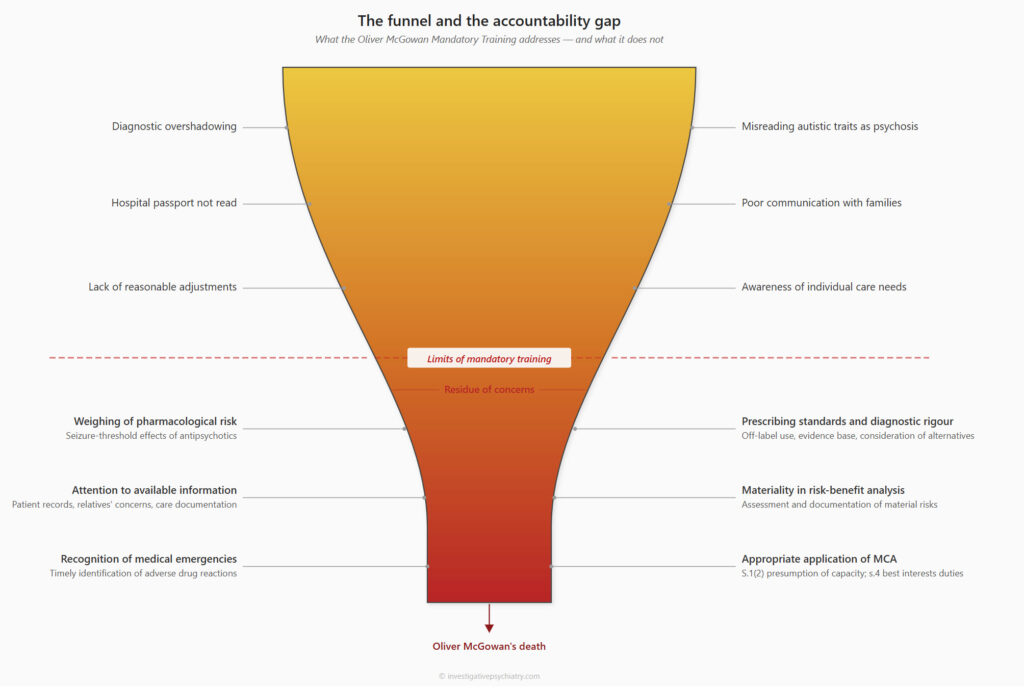
The funnel, the killer, and the cover
It helps to separate three things that the official narrative runs together.
The first is what opened the door. Oliver’s repetitive talk about a video-game blogger, an autistic special interest, was read as a symptom of psychosis. That misreading is diagnostic overshadowing, and it supplied the pretext for reaching for an antipsychotic. But diagnostic overshadowing happens to large numbers of autistic and learning-disabled patients every day, and they do not die of it. It opens the door to risk. On its own, it does not kill.
The second is what did the killing. An antipsychotic known to lower the seizure threshold was given to a patient admitted in seizures, with a documented intolerance to antipsychotics, against his own recorded objection, without consent, and by a route nobody appeared to know or questioned. None of that is specific to autism or learning disability. The same sequence would have been fatal to any patient placed on the same drug in the same way. The diagnostic label that opened the door was, in this sense, interchangeable: any erroneous indication would have served.
The third is what happened afterwards. The death was attributed back to the first step, a failure of autism awareness, so that the second step never had to be examined. That reattribution is institutional overshadowing. It is the move that converts a question of clinical and legal competence into a question of training.
This ordering matters, because the reflex to reach for diagnostic overshadowing as the cause is itself the error this paper describes. To say that Oliver died because his clinicians did not understand autism is to mistake the funnel for the killer, and to perform, in miniature, the very reattribution that has protected everyone involved.
How the system reframed incompetence as ignorance
The clinical failures that killed Oliver were not failures of autism awareness. They were failures to read a hospital passport, to consult parents before a best interests decision (contrary to section 4 of the Mental Capacity Act 2005), to recognise the early signs of neuroleptic malignant syndrome, to prescribe only with a confirmed diagnosis, and to follow the GMC’s requirements for off-label prescribing. A clinician who lacks understanding of autism could still perform all of these tasks correctly. A clinician who understands autism perfectly could still fail at all of them.
The cost of institutional overshadowing
The cost of institutional overshadowing is that the true causes of Oliver’s death remain unaddressed. The mandatory training on learning disability and autism does not teach clinicians how to recognise NMS. Even where the training touches on capacity considerations under MCA 2005, that is not to say that clinicians at the frontlines are coming new to such training; it has been standard training for many years. It does not teach the GMC expectations about appropriate prescribing. A clinician who completes the training will be better informed about autism and learning disability, but will be no better equipped to prevent the key failures that led to Oliver’s demise.
Institutional overshadowing explains why that choice has gone unchallenged. The narrative that Oliver died because clinicians lacked autism awareness is not false. It is incomplete. But incompleteness, in this context, serves the system. It allows the system to claim that it has responded, while leaving the underlying failures of competence, regulation, and coronial oversight intact.
Oliver McGowan did not die because his clinicians failed to understand autism. He died because they failed to read his records, to consult his family, to recognise a medical emergency, and to follow the law. Institutional overshadowing has hidden that fact. This paper has tried to uncover it.
Conclusion
The national rollout of mandatory learning disability and autism training, underpinned by the new Code of Practice, represents a vital and long-overdue cultural shift in health and social care. By embedding the lived experiences of autistic people and their families into the curriculum, the system is actively working to dismantle the dangerous practice of diagnostic overshadowing and improve patient communication. However, if this cultural transformation is to be truly effective, it must operate in tandem with rigorous clinical accountability. The new training frameworks will undoubtedly empower clinicians to better understand and respect neurodiversity, but they must not be used by the medical establishment as a convenient shield to obscure basic incompetence in pharmacology, emergency medicine, or legal consent.
Ultimately, the way forward demands a health system that is radically honest about where its failures truly lie. While improving autism awareness will help mitigate broader systemic risks, protecting patients at the acute, sharp end of care requires an unwavering adherence to foundational medical standards. Clinicians must be given the time and confidence to listen to families, respect established care passports, and treat patients as individuals, while simultaneously being held strictly accountable to the fundamental principles of diagnostics and patient safety. Only by marrying this newfound neurodivergent awareness with uncompromising, ordinary medical competence can the system ensure that no other family has to endure such an avoidable tragedy.