


Estimated reading time at 200 wpm: 10 minutes
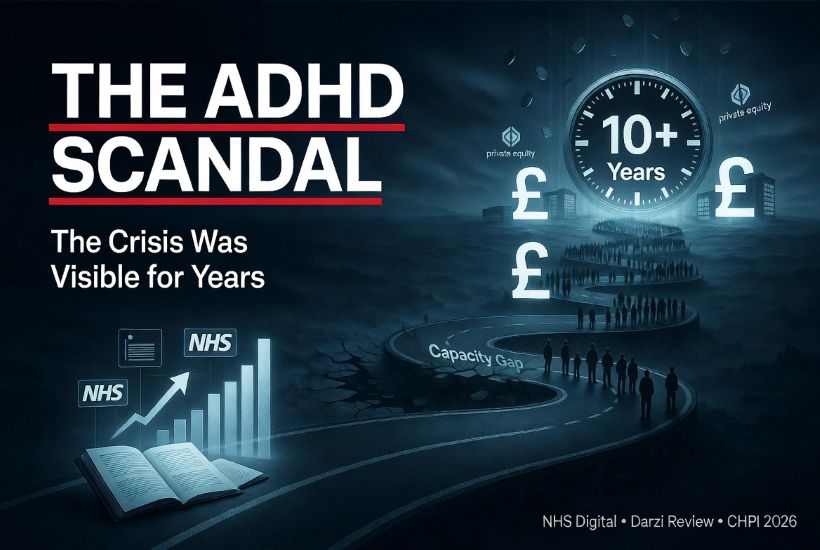
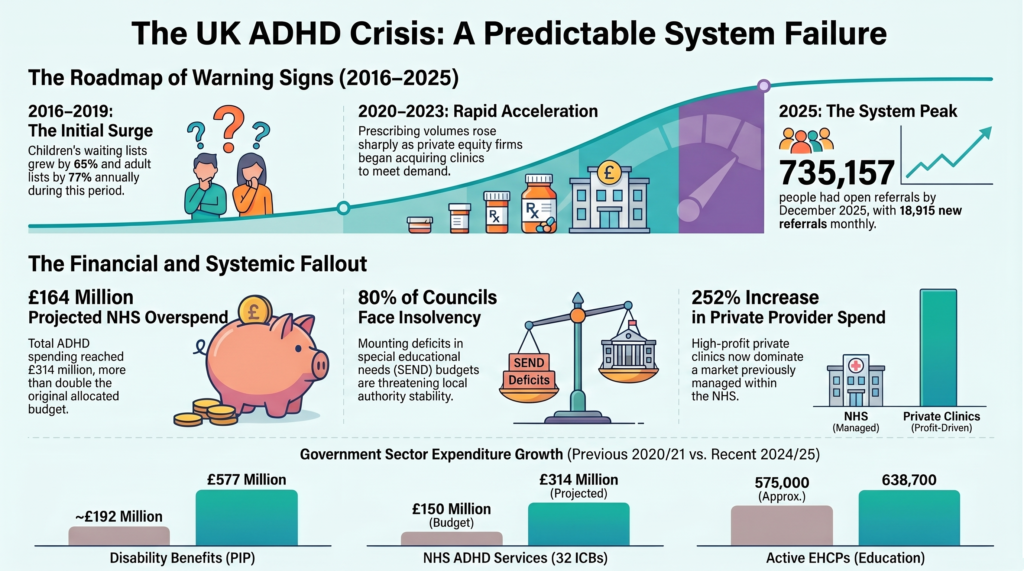
A staggering 18,915 new referrals for ADHD assessments arrived in mental health services in December 2025 alone — up 17.3% on the previous year. As of that month, up to 735,157 people in England had open referrals that may relate to ADHD, with more than 562,000 recorded in core mental health datasets. NHS spending on ADHD services is projected to hit £314 million in 2025/26 for just 32 integrated care boards — more than double the original £150 million budget and triggering an estimated £164 million overspend. In some parts of the country, patients face waiting times for assessment stretching to a decade. Real-terms disability benefits spending linked primarily to ADHD tripled between 2020/21 and 2024/25, reaching £577 million.
Whether or not you agree our Fat Disclaimer applies
These are not abstract figures. They represent a system under extreme strain, with private equity-backed clinics scaling rapidly, local authorities warning of insolvency over special educational needs budgets, and genuine patients left waiting years for support. Yet the most striking fact is this: none of this was a surprise. Public datasets from the NHS, Department for Work and Pensions (DWP), and Department for Education (DfE) had been flashing clear warning signs of sustained and accelerating demand since the late 2010s. The 2024 Darzi review did not uncover a hidden crisis — it simply documented in one place a trajectory that multiple government departments could have tracked for years in routine administrative data.
This article traces that roadmap: what the official numbers showed, when they showed it, the structural drivers that amplified the trend, the commercial response that followed, and the consequences now visible across health, education, and welfare budgets. The data trail is public. The question is why the system responded as it did.
Visibility of the Trend: What the Data Showed Year by Year
Official statistics across multiple departments painted a consistent picture of rising ADHD-related demand long before it became headline news. The growth was not a post-pandemic anomaly but a sustained upward trajectory identifiable from the late 2010s onward.
Late 2010s Baseline (2016–2019)
NHS Digital’s Mental Health Services Dataset (MHSDS) and early prescribing data began recording year-on-year increases in ADHD referrals and stimulant medication use. Lord Darzi’s 2024 independent investigation explicitly noted that children’s waiting lists for autism assessments were already growing at around 65% per year and adults’ at 77% per year from 2016 levels. [Adult stats included show the scale of overall burden on services]. ADHD is unpackaged from Autism as there is significant co-morbidity and overlap. Over the same period, DfE special educational needs statistics showed autism, ADHD, and social, emotional and mental health (SEMH) needs forming a growing share of Education, Health and Care Plans (EHCPs), with pressures on local authority SEND budgets becoming evident by 2019. The point is that demand for ADHD assessments cannot be dealt with in isolation. The overall burden of services is of extreme importance. Many of the professionals who were coping with demands for autism assessments and treatment were also burdened with ADHD related matters.
2020–2021: Early Acceleration
The pandemic amplified existing trends. DWP Personal Independence Payment (PIP) statistics recorded a marked rise in claims citing “hyperkinetic disorders” (the clinical category for ADHD). Local authorities reported escalating demands on high-needs budgets, while NHS Digital data continued to show referral growth. Private equity firms began acquiring ADHD clinics from 2021, signalling investor confidence in long-term demand based on the same public indicators.
2022–2023: Sharp Rise
By this period the acceleration was unmistakable in routine publications. NHS Digital’s ADHD Management Information (MI-ADHD) series documented surging open referrals and waiting lists. Prescribing volumes rose sharply, with some analyses showing post-pandemic annual increases approaching 18%. DfE data confirmed continued rapid growth in EHCPs linked to neurodevelopmental conditions. BBC Panorama’s 2023 investigation into private clinic practices added public scrutiny, but the underlying volume trends were already visible in NHS quarterly statistics.
2024 Onward: Darzi Formalises the Known Crisis
The September 2024 Darzi review quantified what the datasets had been showing: exponential growth in demand, backlogs that would take decades to clear at current capacity, and medication prescribing that had risen roughly 10% annually for nearly two decades. By late 2025 the trajectory remained steep. NHS Digital’s February 2026 release (covering December 2025) reported up to 735,157 open ADHD-related referrals and 18,915 new referrals in a single month. DWP figures showed PIP claims for hyperkinetic disorders jumping 20% in the year to October 2025 (from 75,722 to 91,211). DfE statistics for January 2025 recorded 638,700 active EHCPs — an 11% increase on the prior year — with ADHD and autism continuing to drive much of the growth in special educational needs spending.
These were not obscure internal reports. They were published quarterly or annually on gov.uk and NHS Digital platforms, available to analysts, commissioners, and policymakers in real time. The roadmap was there for anyone who chose to read it.
Drivers of System Expansion: Why Demand Outstripped Supply
The expansion of ADHD services—both within the NHS and in the private sector—was shaped by three interlocking structural factors that were visible in public policy documents and administrative data for years. These drivers created a self-reinforcing loop between rising demand and limited public capacity.
1. Reduced NHS Capacity
Longstanding workforce shortages in psychiatry, combined with post-pandemic surges in mental health referrals, created a persistent gap between assessed need and available provision. The 2024 Darzi review explicitly documented how these shortages forced NHS commissioners to outsource assessments and treatment to independent providers in order to meet statutory waiting-time obligations and patient demand.
2. Policy and Funding Incentives
NHS waiting-time standards and the Right to Choose scheme (which gives patients in England the legal right to select any qualified mental health provider) actively encouraged referrals to independent clinics. At the same time, disability benefits (PIP) and special educational needs (SEND) frameworks explicitly tied financial entitlements and school support to a formal diagnosis, creating a strong incentive for assessments. Commissioning rules made outsourcing administratively simpler and faster than rebuilding in-house psychiatric capacity .
3. Cultural and Social Acceleration
Increased public awareness, social-media discourse (including celebrity disclosures) and widespread self-identification contributed to a sharp rise in requests for assessment. This cultural shift was measurable in the same NHS Digital and DfE datasets that tracked referral growth from the late 2010s onward.
The Commercial Response: Rise of Private Clinics and Private Equity
Private providers and investors responded rapidly and predictably to the demand signals that were already clear in public statistics.
NHS expenditure on independent ADHD providers rose 252% over three years, with spending on private services for 32 Integrated Care Boards reaching an estimated £128 million+ and contributing to a projected £164 million overspend in 2025/26. The Centre for Health and Public Interest (CHPI) “Market Failure” report (January 2026) documented heavy dependence on private equity-backed firms, high profit margins (one provider reported 33%), and limited contractual oversight.
Key examples of commercial scaling include:
- ADHD360, one of the largest providers, was sold in May 2025 to Keys Group after years of rapid growth .
- Psicon Ltd was acquired in October 2023 by OneBright (backed by private equity firm EMK Capital), delivering a significant payout to its founders .
Quality and Oversight Concerns That Emerged
As private provision expanded, concerns about assessment quality became public. The BBC Panorama investigation (May 2023) used undercover reporting to highlight short appointments, high diagnosis rates, and prescribing practices at several private clinics. The CHPI report further noted that some providers operated without full CQC registration or robust NHS contracts, raising questions about variation in diagnostic standards and value for public money.
These commercial developments were not hidden; they were direct, measurable responses to the demand trajectory visible in NHS Digital, DWP and DfE data for years.
Consequences: Where the Roadmap Has Taken Us
By the time the Darzi review was published in September 2024, the system was already experiencing the predictable consequences of years of visible demand growth, capacity constraints, and policy incentives. Those pressures have intensified since.
Financial strain is now acute across multiple departments. NHS spending on ADHD services for 32 integrated care boards is projected to reach £314 million in 2025/26 — more than double the original £150 million budget — resulting in an estimated £164 million overspend. Real-terms disability benefits spending linked primarily to ADHD tripled to £577 million between 2020/21 and 2024/25.
In education, the surge in autism and ADHD diagnoses has driven special educational needs and disabilities (SEND) spending to record levels. As of January 2025 there were 638,700 active Education, Health and Care Plans. The Local Government Association survey (February 2026) found that eight in ten councils warn they face insolvency due to mounting high-needs deficits.
Operationally, waiting lists remain extreme. Some patients face waits of up to a decade, with private clinics offering “buy now, pay later” payment plans for assessments and treatment. Variation in diagnostic practice between providers has been repeatedly highlighted, and genuine cases with severe needs are competing for limited capacity.
The human cost is clearest for those most in need: unsupported ADHD carries well-documented risks across education, employment, crime, substance misuse and mental health. Yet the same system that expanded rapidly in response to demand is now rationing medication and struggling to provide consistent, high-quality care. The roadmap led exactly where the data had been pointing for years.
Conclusion: Lessons from a Predictable Crisis
The data trail was public and consistent from the late 2010s onward. NHS Digital quarterly statistics, DWP PIP claims, DfE SEND returns, and the accelerating signals in prescribing and private-sector investment all told the same story. The 2024 Darzi review and the subsequent NHS England Independent ADHD Taskforce reports (Parts 1 and 2, 2025) did not reveal a sudden crisis — they formalised a trajectory that multiple departments could have read in real time.
The central lesson is straightforward: when demand signals are visible in routine administrative data, policy, commissioning and capacity planning must respond earlier. Incentives that tie benefits, school support and waiting-time targets to formal diagnosis, combined with chronic under-supply of NHS psychiatric capacity, created the conditions for rapid commercial expansion and the current multi-billion-pound strain.
Calls for reform — including tighter oversight of private providers, profit caps on NHS-contracted services, and a more balanced whole-system approach — are now on the table. Whether the ongoing ADHD Taskforce recommendations and government responses will break the cycle or simply manage its symptoms remains to be seen.
What is beyond dispute is the human cost: thousands of people still waiting years for assessment and support while budgets buckle and diagnostic variation persists. The roadmap was there. The question now is whether the system will finally follow it.
Key Official Sources Used
- NHS Digital ADHD Management Information – February 2026
- 18,915 new referrals
- 17.3% on the previous year
- up to 735,157 people in England had open referrals
- £314 million in 2025/26
- £150 million budget
- £164 million overspend
- £577 million
- 2024 Darzi review
- 2024 independent investigation
- Right to Choose scheme
- DfE Special Educational Needs statistics January 2025
- 638,700 active EHCPs
- 11% increase on the prior year
- 20% in the year to October 2025
- DWP Personal Independence Payment Official Statistics (to October 2025)
- Centre for Health and Public Interest (CHPI) “Market Failure” report (January 2026)
- 252% over three years
- £164 million overspend in 2025/26
- DWF legal announcement
- OneBright announcement
- BBC Panorama investigation (May 2023)
- Local Government Association survey (February 2026)
- eight in ten councils warn they face insolvency
- NHS England Independent ADHD Taskforce – Part 1 (April 2025)
- NHS England Independent ADHD Taskforce – Part 2 (November 2025)