


Estimated reading time at 200 wpm: 21 minutes
The study of psychiatry’s role in the Nazi extermination policies is not merely a retrospective moral exercise; it is a critical and uncomfortable inquiry into the contemporary foundations of professional ethics. While the atrocities of the Second World War are often viewed as a singular historical aberration, the specific complicity of psychiatrists in the planning and execution of programmes like Aktion T4 exposes a more insidious and enduring danger: the potential for a profession dedicated to care and healing to become an instrument of state-sanctioned violence.
Whether or not you agree our Fat Disclaimer applies
This investigation is of profound importance today for several reasons. Firstly, it challenges the comforting myth that only a handful of “mad” or “evil” individuals were responsible. On the contrary, it reveals how a broad professional culture, driven by pre-existing eugenic ideologies and administrative conformity, could rationalise the systematic murder of vulnerable patients as a therapeutic or economic necessity. This historical precedent serves as a stark warning about the dangers of institutional groupthink and the erosion of ethical boundaries under authoritarian regimes.
Secondly, the long silence of the post-war German psychiatric community, a silence only publicly broken in 2010, is an object lesson in accountability. The failure to confront this history for over six decades allowed perpetrators to resume their careers and ethical lapses to remain unexamined. Understanding this post-war reckoning is essential for grasping the significance of institutional memory and the enduring responsibility of professions to confront their past.
Finally, this research offers crucial insights for contemporary psychiatric ethics. It raises vital questions about the limits of professional autonomy, the responsibilities of mental health professionals in a context of state violence, and the vigilance required to resist the dehumanisation of patients. By examining how a profession could so completely lose its ethical bearings, this historical inquiry becomes a guide for fostering moral courage and professional integrity in an increasingly complex world. It ensures that the lessons of the past are not simply remembered, but are actively integrated into the ethical training of future generations of psychiatrists.
For the dimmest of persons out there, this is not an assault on present-day psychiatry
Executive Summary
The widespread and systemic involvement of psychiatrists in the Nazi extermination programmes, particularly Aktion T4, was not an isolated aberration or a result of simple coercion. This report demonstrates that the complicity of the German psychiatric community was the culmination of decades of intellectual and professional trends that had already laid the ideological groundwork for such atrocities. The perversion of professional ethics was deeply intertwined with the prevailing theories of eugenics and “racial hygiene,” which reframed the physician’s duty from caring for the individual patient to preserving the health of the collective German “Volk.”
The analysis reveals how this ideological foundation was bolstered by a powerful economic narrative that portrayed the mentally ill as “useless eaters” and a financial burden. This convergence of pseudoscientific rationalisations and utilitarian arguments created the ethical conditions for mass murder. The Aktion T4 programme, formally initiated in 1939, functioned as a bureaucratic and logistical blueprint for the Holocaust, employing methods and personnel that were later transferred to the extermination camps. Psychiatrists played a central role at every stage, from patient selection to operating the gas chambers and falsifying death certificates.
In the post-war era, the legal accountability for these crimes was profoundly limited, and the profession engaged in a decades-long period of collective denial, which can be described as a “second crime” against the victims. This report concludes by synthesising these historical findings into critical lessons for modern healthcare. It asserts that understanding the history of Nazi medicine is a moral and ethical imperative for all health professionals, serving as a guide to ethical vigilance against the dangers of dehumanisation, competing loyalties, and the erosion of professional integrity.
1. The Intellectual and Professional Context: Seeds of Atrocity
The atrocities committed by German psychiatrists during the Nazi era were not born in a vacuum. The groundwork for the professional complicity in Aktion T4 was laid over several decades through the widespread adoption of eugenic theories and the reorientation of professional ethics towards the interests of the state.
1.1. The Rise of Eugenics and “Racial Hygiene” in German Psychiatry
The science of eugenics, which aimed to reduce rates of physical and mental illness and “morally deviant behaviours” by controlling human reproduction, emerged in the late Victorian era and was actively promoted across industrialised nations.1 In Germany, this movement was formalised under the term Rassenhygiene, or “racial hygiene“.3 This was not a Nazi invention but a pre-existing medical and academic discipline. The term was coined in 1895 by the physician Alfred Ploetz, who, along with Ernst Rüdin, co-founded the German Society for Racial Hygiene in 1905.4
The prominence of this movement within German medical and scientific circles is significant. The German Racial Hygiene Society had a larger number of biologists and medical specialists than its British counterpart, which speaks to its deep institutionalisation in Germany.4 The ideology was framed as a legitimate, scientifically based solution to social problems.4 This professionalisation of eugenic thought fundamentally altered the concept of medical responsibility, shifting the focus from the individual patient to the “biological body of the German people” (Volkskörper).7 The Bavarian psychiatrist Wilhelm Schallmayer articulated this shift, stating that a physician’s primary responsibility was to society, not the individual.4 This intellectual reorientation, which predated the Nazi regime’s rise to power, set the stage for the perversion of medical ethics, where the health of the individual was seen as secondary to that of the collective.
Furthermore, German psychiatrists were not coerced into this new paradigm; many “collaborated eagerly with the Nazis from the very beginning“.2 The 1933 “Law for the Prevention of Hereditarily Diseased Offspring,” which prescribed compulsory sterilisation for individuals with conditions such as schizophrenia, epilepsy, and “imbecility,” was made possible by “much preparatory work during the Weimar Republic, initiated not least by the medical profession“.7 This legislation, which led to the forced sterilisation of over 400,000 people, most of whom were labelled “mentally ill,” was enforced through special “Hereditary Health Courts” (Erbgesundheitsgerichte).2 The enthusiastic participation of the medical community, coupled with the swift purging of Jewish and communist doctors from the profession, created a self-reinforcing system that was ideologically aligned with the Nazi regime from the outset.8
1.2. The Economic and Societal Underpinnings
The intellectual embrace of eugenics was complemented by powerful economic and societal pressures. The post-World War I Weimar Republic saw a significant rise in patients with psychosis and schizophrenia, leading to overcrowded psychiatric hospitals.9 This coincided with an economy crippled by war reparations and the Great Depression, a context ripe for Nazi propaganda. The regime leveraged this situation to portray the mentally ill as a financial burden on the state, using dehumanising terms such as “useless eaters” and “burdensome lives“.12
This economic rationalisation was a crucial tool for making the ideological justifications for murder more palatable to both the public and the medical profession. The head of a state hospital near Munich, Hermann Pfannmüller, encapsulated this chilling convergence of ideas in his 1939 quote: “It is unbearable to me that the flower of our youth must lose their lives at the front, while that feeble-minded and asocial element can have a secure existence in the asylum“.14 This sentiment, which combined a utilitarian view of human worth with a powerful sense of wartime sacrifice, established a direct link between a person’s perceived economic productivity and their right to live.13 The criteria for inclusion in the Aktion T4 programme were thus not exclusively genetic but also explicitly economic, a pragmatic extension of the eugenic ideology.
2. The Initiation and Mechanism of Aktion T4
The Aktion T4 programme was a highly organised and systematic campaign of mass murder, the operational details of which reveal the central and active role of the psychiatric profession at every turn.
2.1. The Programme’s Covert Origins and Authorisation
The idea for the programme was not a sudden wartime impulse. Hitler had expressed his favour for the killing of the incurably ill as early as 1933, but he recognised that public opinion would not accept it in peacetime.8 In 1935, he told the Leader of Reich Doctors that “such a problem could be more smoothly and easily carried out in war,” a clear articulation of the plan’s premeditated nature.8
The programme formally began with a “trial” case in late 1938, when Hitler instructed his personal physician, Karl Brandt, to evaluate a petition for the “mercy killing” of a disabled child.8 This child, Gerhard Kretschmar, was killed in July 1939, and Hitler authorised Brandt to proceed in a similar manner in all like cases.8 The official authorisation, a “euthanasia note,” was signed by Hitler in October 1939 but was deliberately backdated to 1 September 1939, the day the invasion of Poland began.8 This backdating served a dual purpose: it linked the programme to wartime measures, making it a perceived necessity, and provided a layer of legal immunity for all participants.9 It is noteworthy that Hitler did not order psychiatrists to carry out the murders; rather, he “permitted it” and “empowered” them to do so, delegating the authority to act on their own volition within the new ethical framework.16
2.2. The Bureaucracy of Murder: The Patient Selection Process
To implement the programme, a new bureaucracy was established in Berlin at Tiergartenstraße 4, which gave the campaign its name, Aktion T4.1 This new department, headed by physicians, was granted the authority to kill anyone deemed to have a “life unworthy of living” (Lebensunwertes Leben).13 The patient selection process was designed to be bureaucratically efficient and to distance the perpetrators from their victims. Psychiatrists and medical experts reviewed questionnaires sent from institutions throughout Germany, which provided information on patient health and their capacity to work.12 The decision to kill was made based on these forms, with the doctors “most often never [seeing] the patient” or their full medical records.12
This process of reducing human lives to data on a form was an essential step in the programme’s success. It served to dehumanise the patients, allowing psychiatrists to make life-or-death decisions without confronting the human consequences of their actions. The use of euphemistic terms like “mercy death” (Gnadentod) and “euthanasia” further masked the reality of the killings as a medical procedure rather than an act of mass murder.8 The entire system was structured to diffuse and compartmentalise responsibility, so that each person’s role—from filling out a form to giving an opinion or providing guidelines—seemed minor in isolation.17
2.3. The Killing Centres and Methods of Extermination
The Aktion T4 programme established six primary killing centres in Germany and Austria by converting existing psychiatric facilities and a former prison into extermination sites. These centres were: Grafeneck, Bernburg, Hadamar, Hartheim, Pirna-Sonnenstein, and Brandenburg.13
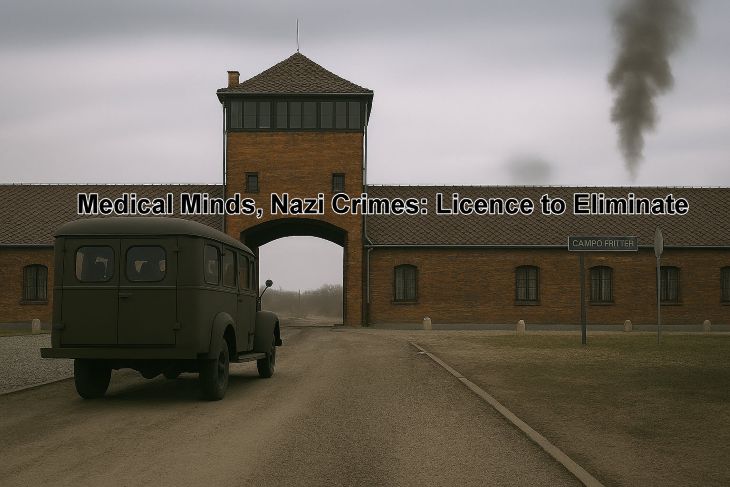
The methodology of murder was systematic and medically supervised. Patients were transported to these centres in buses with painted windows to conceal the human cargo.19 Upon arrival, they were led to gas chambers disguised as shower rooms.13 Physicians, dressed in white coats to maintain the charade of a medical procedure, were responsible for operating the gas taps, releasing carbon monoxide gas to asphyxiate the patients.13 The use of gas chambers and crematoria at these facilities, along with the development of lethal injections and starvation as methods of killing, served as a prototype for the extermination camps of the Holocaust.11
The scale of the operation was immense. By 1941, Aktion T4 had eliminated over 70,000 psychiatric patients.11 Despite its official cessation in August 1941 due to public outcry, the killings continued covertly until the end of the war, bringing the total number of victims to an estimated 200,000 to 350,000.8
Table 2: Aktion T4 Killing Centres and Victim Counts
| Killing Centre | Location | Type of Facility | Estimated Victims (until Aug 1941) |
|---|---|---|---|
| Brandenburg | Brandenburg, Germany | Former Prison | 9,772 21 |
| Grafeneck | Grafeneck, Germany | Psychiatric Facility | 10,654 20 |
| Hartheim | Hartheim, Austria | Psychiatric Facility | N/A |
| Sonnenstein | Pirna, Germany | Psychiatric Facility | N/A |
| Bernburg | Bernburg, Germany | Psychiatric Facility | 8,601 21 |
| Hadamar | Hadamar, Germany | Psychiatric Facility | 10,000 19 |
The transfer of the knowledge, technology, and personnel from Aktion T4 was a direct precursor to the Holocaust. The programme provided the logistical blueprint and the trained killers necessary for the later, larger-scale genocide of Jews and other groups.12
3. The Psychiatrist as a Perpetrator: Widespread Professional Complicity
The involvement of German psychiatrists in the Aktion T4 programme was not a passive compliance but an active, central, and willing participation in the mass murder of their own patients. The evidence shows that psychiatrists were instrumental in the success of the programme, demonstrating a profound commitment to the atrocities.
3.1. The Central and Pivotal Role of Psychiatrists
Psychiatrists were “among the worst transgressors” during the Nazi era.16 They were “instrumental in instituting a system of identifying, notifying, transporting, and killing hundreds of thousands” of individuals.16 This role was far from passive. Psychiatrists were responsible for reporting their patients to the authorities, coordinating their transfers, overseeing the gassings, and signing falsified death certificates to send to the victims’ next of kin.13
The professional identity of the psychiatrist was profoundly perverted to serve the state’s racial hygiene policy. Instead of a healer, the psychiatrist became a gatekeeper and an arbiter of life and death, tasked with “cleansing” the German people of “racial enemies“.8 Medical ethics education during this period was altered to include teachings on the “unequal worth of human beings” and the priority of the state’s health (Volk) over the care of the individual patient.22 This demonstrates that ethical codes were not merely abandoned but were explicitly “manipulated to serve the regime’s agenda“.24 The fact that many doctors and researchers enthusiastically participated suggests that they had already lost their “moral, professional, and ethical inhibitions“.13
3.2. Case Studies of Key Perpetrators: Werner Heyde and Irmfried Eberl
The abstract concept of professional complicity is given chilling substance through the careers of key individual psychiatrists. Werner Heyde, a German psychiatrist, was one of the “main organisers” of the Aktion T4 programme.25 He established systems of psychiatric and eugenic examinations in concentration camps, served as a psychiatric consultant for the Gestapo, and was responsible for the patient selection process.25 His actions demonstrate the direct link between institutional psychiatry and the broader machinery of the Nazi state.
Irmfried Eberl, an Austrian psychiatrist and Nazi Party member, served as the medical director for the Brandenburg and Bernburg killing facilities.21 His direct experience in the medicalised mass murder of psychiatric patients was a key factor in his later role. In 1942, Eberl was transferred to Treblinka, becoming the first commandant of the extermination camp and the only physician to hold such a command.21 His transfer from
Aktion T4 to Treblinka is a powerful symbol of the programme’s role as a training ground for genocide. A particularly horrifying detail of Eberl’s command at Treblinka is that he was dismissed for “inefficiency in disposing of the thousands of bodies he succeeded in accumulating“.26 This reveals a transition from a medicalised killing programme to a pure industrial process, where success was measured by throughput and efficiency, and failure was defined by the public health risks and the stench of decomposing bodies.26
Table 1: Key Figures and Their Roles
| Name | Professional Role and Affiliations | Role in Aktion T4 and Related Crimes | Post-War Fate |
|---|---|---|---|
| Karl Brandt | Physician to Adolf Hitler; Reichsleiter; General in the SS | Co-leader of Aktion T4; authorised the first killing 8 | Sentenced to death at the Doctors’ Trial; executed 1948 27 |
| Philipp Bouhler | Chief of Hitler’s Chancellery; SS officer | Co-leader of Aktion T4; responsible for the programme’s operations 12 | Arrested in 1945; committed suicide 12 |
| Werner Heyde | Psychiatrist; SS medical officer; Professor of Psychiatry at University of Würzburg | Main organiser of Aktion T4; responsible for patient selection and examinations in concentration camps 25 | Escaped after the war and practiced under an alias; arrested and committed suicide in prison in 1964 25 |
| Irmfried Eberl | Psychiatrist; Nazi Party and SS member; medical student | Medical director of Brandenburg and Bernburg killing centres; first commandant of Treblinka extermination camp 21 | Arrested and committed suicide in prison in 1948 26 |
| Adolf Wahlmann | Psychiatrist at Hadamar killing centre | Charged with determining lethal drug dosages 29 | Sentenced to life imprisonment at the Hadamar Trial; released in 1952 29 |
4. The Link to the Holocaust: A Prototype for Annihilation
The Aktion T4 programme was not merely a parallel atrocity; it was a foundational element and direct precursor to the industrialised mass murder of the Holocaust. The programme served as a prototype for future extermination campaigns.11
The evidence reveals a clear transfer of personnel, technology, and methodology from the psychiatric killings to the extermination camps. The gas chambers used for mass murder were first developed and refined in psychiatric hospitals.21 The knowledge and expertise gained from these medicalised killings were directly applied to the larger-scale annihilation of Jews, Roma, and other groups.11 Key personnel from Aktion T4, such as Irmfried Eberl, were transferred to the extermination camps to apply their expertise.11 The organised transportation of victims to killing centres also foreshadowed the mass deportations of the Holocaust.13 The Aktion T4 programme thus created a cadre of trained killers who had already shed their “moral, professional, and ethical inhibitions,” making the transition to the death camps seamless.13 This continuity of methods and personnel demonstrates that the psychiatric killings were a direct and indispensable step in the evolution of the Nazi genocidal machine.
5. The Post-War Reckoning: Trials, Denial, and Decades of Silence
The post-war period was marked by a limited and incomplete reckoning for the medical crimes committed, followed by decades of institutional denial by the German psychiatric profession.
5.1. The Hadamar and Doctors’ Trials: Limited Justice
The legal accountability for the medical murders was profoundly inadequate. The Hadamar Trial in 1945 was one of the earliest war crimes cases to be tried by a US military commission.29 However, this trial focused on the killing of non-German nationals—specifically, 476 Russian and Polish citizens—as acts of murder against German citizens were not considered a violation of international law by the prosecution.19 This legal distinction meant that a vast number of victims of the programme went unprosecuted.
The Doctors’ Trial, part of the Subsequent Nuremberg Proceedings in 1946-1947, prosecuted 23 German physicians and administrators for their involvement in Aktion T4 and human experimentation.27 While several were found guilty and sentenced to death, the prosecution was unable to classify the forced sterilisations as war crimes because similar laws had been implemented in countries like the USA.2 The focus on human experimentation, rather than the broader scope of the Aktion T4 programme, meant that many perpetrators escaped a full reckoning.32 Furthermore, many key individuals, such as Werner Heyde, evaded justice entirely by escaping and living under assumed names.25
Table 3: The Post-War Reckoning
| Trial | Defendant(s) | Charges | Outcome |
|---|---|---|---|
| Hadamar Trial (1945) | Alfons Klein et al. (7 defendants, incl. Adolf Wahlmann) | Killing of 476 Russian and Polish nationals at the Hadamar institution 29 | All defendants convicted. Klein, Ruoff, and Willig sentenced to death; Wahlmann sentenced to life imprisonment; others received prison terms 29 |
| Doctors’ Trial (1946-1947) | Karl Brandt et al. (23 defendants, incl. 20 physicians) | Involvement in Aktion T4 and Nazi human experimentation 27 | 16 doctors found guilty; 7 were sentenced to death, including Karl Brandt 27 |
5.2. Personal and Institutional Denial in Post-War West Germany
Following the war, a “collective denial” descended upon German psychiatry.21 The profession was afraid that public acknowledgement of the crimes would “prevent efforts to rebuild the profession“.21 Many implicated psychiatrists continued their careers and even served as court-appointed medical experts under assumed names, as in the case of Werner Heyde.21 The silence of the profession also affected the legal and political landscape. The 1965 revised Federal Indemnification Law excluded those who had been forcibly sterilised from compensation, with the argument that they had not been persecuted for reasons of race.21 The psychiatric community was implicated in this decision and in the denial of guilt and complicity that characterised the decades following the war.33
This period of institutional silence, denial, and a failure to acknowledge guilt has been referred to as a “second crime” against the victims.33 It compounded the pain and injustice endured by those who were sterilised, murdered, or forced to emigrate.34
6. The Modern Legacy: Lessons for Contemporary Medicine
The history of psychiatric involvement in Nazi policies offers vital and enduring lessons for modern medical ethics and professional responsibility. It serves as a powerful cautionary tale against the dangers of a profession unmoored from its core ethical principles.
6.1. The Dangers of Dehumanisation and Dual Loyalties
The historical record of the Aktion T4 programme, where patients were dehumanised by being reduced to data points on a form and labelled as “useless eaters,” remains profoundly relevant.12 The programme’s rationalisations—that the killings would save money and remove a “burden” from the state—are a stark example of how economic and political considerations can override a doctor’s fundamental obligation to the individual patient.13 The history exposes the perilous nature of “competing loyalties,” where a professional’s duty to a system, an ideology, or an economic model can corrupt their primary responsibility to care for the human being before them.17 This is not a lesson unique to a totalitarian regime; it is a warning for modern healthcare systems that face similar pressures to prioritise efficiency and cost-saving over compassionate, individualised care.17
6.2. The Imperative of Historical Education for All Medical Professionals
The pervasive complicity of the medical profession in the Nazi atrocities, driven not by coercion but by a deeply held, albeit flawed, belief that what they were doing was “the right thing to do,” makes it an essential subject for modern medical education.22 This history should be part of the “repertoire of knowledge” for all health professionals, serving as a guide for “ethical vigilance” and helping to “foster empathy and prevent dehumanisation“.22
Learning this history requires confronting uncomfortable truths, such as the fact that “evil was mainstream” and that internationally revered academics and physicians willingly participated in mass extermination.32 It dispels the myth that the perpetrators were “simply evil monsters” and forces students to reflect on their own potential for complicity and to develop a “moral compass” to navigate the ethical dilemmas they will face.22
A pivotal step in this process of historical reckoning was the 2010 apology by the German Association for Psychiatry and Psychotherapy (DGPPN).34 In a landmark event, Professor Frank Schneider, the DGPPN president, formally asked for forgiveness for the “pain and injustice” the victims endured, breaking the “decades of silence, denial and looking away” that had followed the war.33 This moment, and the DGPPN’s subsequent travelling exhibition “Registered, Persecuted, Annihilated,” demonstrates that the professional bodies themselves have a moral obligation to confront historical wrongdoing and to ensure such a “dark chapter” is never forgotten.33 The fact that victims of forced sterilisation are still not explicitly recognised for state compensation highlights that the process of reckoning is still ongoing and incomplete.33 The history of Nazi medicine is, therefore, not just a historical study but a critical component of professional and ethical development, a constant reminder of the fragility of medical ethics and the importance of centreing care on the dignity of the individual patient.33
References
- Eugenics, Nazi and Soviet psychiatry – Cambridge University Press & Assessment
- Psychiatry and the dark side: eugenics, Nazi and Soviet psychiatry | Advances in Psychiatric Treatment | Cambridge Core
- Racial hygiene – Wikipedia
- Conceptualising Eugenics and Racial Hygiene as Public
- Alfred Ploetz founds the periodical, Archiv für Rassen – und Gesellschaftsbiologie hygiene und… • Timeline –
- Alfred Ploetz – Wikipedia
- Commentary: The Third Reich—German physicians between resistance and participation
- Aktion T4 – Wikipedia
- Nazi eugenics – Wikipedia
- Medical Care, Nazism, and the Holocaust – Experiencing History
- Revisiting psychiatric support for the National Socialist Agenda in Germany: Implications for medical and residency training – The Southwest Journal of Medicine
- Nazi Euthanasia: Aktion T4 | Kenyon College
- T4 Program | Definition and History – Britannica
- Symposium of Student Scholars: Forgotten Victims: The Euthanasia of the Disabled Under the Third Reich – Digital Commons@Kennesaw State
- Euthanasia Program and Aktion T4 | Holocaust Encyclopedia
- Psychiatry during the Nazi era: ethical lessons for the modern professional – PMC
- The Silence of the Doctors: Fifty Years After Nuremberg – PMC
- The national socialist»euthanasia« killings – The … – T4 Denkmal
- The Hadamar Trial | Holocaust Encyclopedia
- Grafeneck | Holocaust Encyclopedia
- Irmfried Eberl: psychiatry and the Third Reich | The British Journal of psychiatry
- Why we must teach medical students about the role of physicians during the Holocaust (AAMC)
- Action T4 | EBSCO Research Starters
- Practicing Law Authoritarian Style | 3 Geeks and a Law Blog
- Werner Heyde – Wikipedia – https://en.wikipedia.org/wiki/Werner_Heyde
- Irmfried Eberl – Wikipedia – https://en.wikipedia.org/wiki/Irmfried_Eberl
- Doctors’ Trial – Wikipedia – https://en.wikipedia.org/wiki/Doctors%27_Trial
- 17 Werner Heyde Stock Photos, High-Res Pictures, and Images
- NATIONAL ARCHIVES TRUST FUND BOARD
- Juristische Auseinandersetzung (1945 – 1947) – Gedenkstätte Hadamar
- The Doctors Trial: The Medical Case of the Subsequent Nuremberg Proceedings
- Teaching Hard Truths About Medicine and the Holocaust
- F. Schneider (ed): Psychiatry under National Socialism
- Brochure – »Psychiatry under National Socialism« – Stiftung
- The Sick and Disabled under National Socialism – NS-Dokumentationszentrum München
- Registered, persecuted, annihilated – nsdoku münchen