


Estimated reading time at 200 wpm: 11 minutes
I have been thinking about documentation of capacity assessments in overview spanning the last 5 years – and how that connects to prescribing of medications. There can absolutely be no debate that capacity and consent are the bedrock of therapeutic relationships and prescribing practices. This exploration excludes considerations that fall under the Mental Health Act 1983 (to become the MHA 2025). But some of the basic issues will become relevant when prescribing under the MHA 1983. I focus almost exclusively on the vast majority of situations where the MCA 2005 will apply.
Whether or not you agree our Fat Disclaimer applies
The MCA 2005 has been law for over twenty years. Its Code of Practice has been around for nearly the same. Yet proper documentation—the diagnostic test, the functional test, and clear documented assessments—remains the exception, not the rule. What I see, routinely, is something like: “Medication explained. Patient understood he was depressed and anxious. Accepted the side-effects. Prescribed oral citalopram on a trial basis.”
The above is not a capacity assessment. It is not consent. It is a shorthand that has become normalised to the point where challenging it feels uncomfortable because ‘everyone’ else seems to think it is sufficient in some sort of cultural norm. I have found myself apprehensive about pointing out the inadequacy, even though I know what proper application of the law is about. Going against the grain of cultures even with the law in hand, is dangerous. You don’t have to believe me. Danger? It’s about ‘adjectives’ and marginalisation. Don’t be fooled by “We welcome people who stand up for legal and ethical standards.” Actions speak louder than words.
The Presumption of Capacity as Shortcut
The first layer of the problem is the misuse of the presumption of capacity. Section 1(2) was designed as a shield. It was meant to say, ‘do not assume incapacity based on age, diagnosis, or a decision you disagree with.’ But in practice, it has become a sword cutting the other way—a carte blanche to assume capacity without any assessment.
The functional test is simply omitted. Understanding, retention, weighing, communication—my experience is that these are not addressed in a conspicuous evidence-based way. The diagnostic test is ignored. The presumption was meant to be a starting point. But for many clinicians, it has become both the beginning and the end of the inquiry.
Section 4 and the OMG Reaction
The second layer is the disincentive created by Section 4. When I first read the best interests provisions, I had an OMG reaction. The consultation requirements, the consideration of past wishes, the proportionality principle—it seemed overwhelming. I suspect most clinicians never move past that initial reaction. They avoid triggering the process altogether by finding capacity where it may not exist, or by never formally determining capacity at all. No one will admit to that sort of thing. They can’t.
But when I sat with the statute—tabulated it, read it carefully—I discovered something important. Section 4 is not as brutal as it appears. Parliament built in allowances: practicable, appropriate, reasonably ascertainable. For many patients, in many situations, the process is proportionate. But the folklore that circulates among clinicians—the mythology of the impossible best interests meeting—is far more punitive than the law itself. And that folklore drives avoidance.
The Debt We Inherit
The third layer revealed itself when I considered what happens when a patient moves through the system. I inherit patients on multiple medications—five, sometimes more, often with unlicensed indications. The original prescribing purposes are not documented. Capacity assessments, if they ever existed, are absent. Consent is not recorded. The latter is 100% of the time. But what if it was only 25% of the time? Is that fine? Did the law say you can break or bend this law 25% of the time? What is the impact of that for say the 25%? Is it okay if 25% of patients suffer and are served poor care? Is the greater good the unwritten ‘operating principle’?
The GMC prescribing standards (para 97 to 101) require me to ensure that existing medications are “safe and appropriate.” Appropriate includes capacity and consent. Safe means reasonably safe bearing in mind unlicenced uses, contraindications, and material risks [as per Montgomery 2015]. But I cannot ascertain what I cannot find. I cannot reconstruct what was never documented. It is not for me to conjure up diagnoses and indications at point of contact with the patient, so as to justify the ‘chemical basket’ – and the say ‘Yeah it’s fine’. To do so would be grossly dishonest – a striking off offence at the GMC.
So I am left with a choice. I can spend hours per patient—which would upset the ‘masters of my treadmill’—scouring records, consulting pharmacy, reconstructing histories, and assessing capacity for each medication. Or I can triage, prioritise, and accept that some aspects of my reviews will be less thorough. This is not necessarily negligence. This is resource allocation when one is caught between a rock and a hard place. It is the only way to function when directed by force of circumstances. But it means I am carrying the accumulated debt of every clinician who came before me—and I have no way to pay it in full. Let me not forget the poor patient – who often does not know what’s what – and is told to take the ‘chemical basket’ without any real idea if it is effective for their mental health or how harmful it may be.
The Asymmetry of Accountability
Here is the injustice that sits at the heart of this.
The system creates or allows the conditions: fragmented records, inadequate documentation, grossly inadequate time allocated for proper medication review, no infrastructure to support capacity assessment. Trust executives are rarely held accountable for these conditions. Previous prescribers are rarely called to account for their shortcuts. Their failures are buried in the past, scattered across services, rendered invisible by the passage of time.
But I am visible. I am the one whose name is on the record as the last point of specialist contact. If something goes wrong—if that one-in-a-million terrible event occurs—the scrutiny will fall on me. The GMC, the coroner, the solicitor will ask: Why did you not thoroughly review that medication? Why did you not assess capacity? Why did you not identify that material risk and inform the patient?
The systemic failures that made thorough review impossible will not be on trial. I will be. If you think ‘scapegoating is paranoid’ then you need to read Bawa-Garba
Rounding the Corners
I used the phrase “rounding the corners” to describe what I do. I prioritise high-risk medications, complex combinations, patients with identified vulnerabilities. I am forced to make professional judgments about where to focus the limited time afforded to patients. I do what I can.
But the language of “corner-cutting” implies culpability. It suggests I am choosing a shortcut that a perfect clinician would not take. That framing is false. I am not choosing between thorough and careless. I am choosing between focusing my attention where it is most needed and attempting the impossible—which would lead to burnout, fatigue, and its own forms of error.
The system depends on clinicians like me making these judgments. If every clinician religiously decided to do a full Montgomery-MCA-Section 3 & 4 review for every medication on every patient, the system would collapse. So the system relies on us to absorb the burden, to make the impossible workload manageable through our own professional judgment, and to carry the personal risk that comes with that.
The Defensive Statement

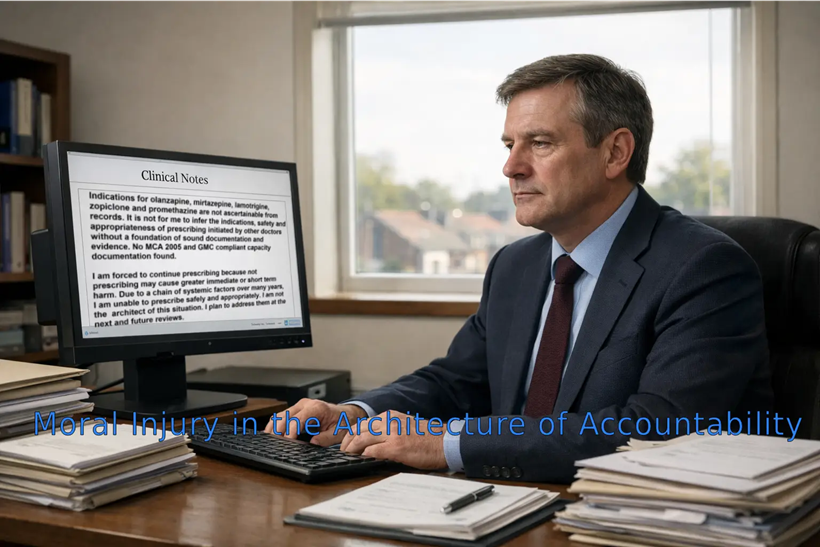
The only thing I can add to this cycle is the defensive statement. I must document the gaps I cannot fill e.g. “Indications for olanzapine, mirtazepine, lamotrigine, zopiclone and promethazine are not ascertainable from records. It is not for me to infer the indications, safety and appropriateness of prescribing initiated by other doctors without a foundation of sound documentation and evidence. No MCA 2005 and GMC compliant capacity documentation found. I am forced to continue prescribing because not prescribing may cause greater immediate or short term harm. Due to a chain of systemic factors over many years, I am unable to prescribe safely and appropriately. I am not the architect of this situation. I plan to address them at the next and future reviews, within the resources available to me.“
This does not fix the problem. It does not restore what was lost. It does not give the patient back the autonomy they should have had when those medications were first prescribed. It simply creates a trail—evidence that I saw, that I cared, that I did what I could.
The defensive statement is not a solution. It is a symptom. It is the trace left behind when a clinician recognises a problem but cannot remedy it, and needs to protect against the retrospective scrutiny that will come if something goes wrong.
The Cycle
So here is the bitter conclusion: I am repeating the very patterns that landed me with this patient on five psychotropic medications in the first place. The only difference is that I would be adding defensive statements to my records.
The next clinician will inherit the same patient, the same medications, the same missing documentation—plus my notes. And they will do the same. The cycle perpetuates itself because the system is structured to reward throughput and penalise thoroughness. The clinician who takes the time to properly review a complex medication regimen will see fewer patients, meet fewer targets, and attract attention—not for being thorough, but for being slow or perceived as inefficient.
The Moral Injury
This has been a tough realisation. I entered forensic psychiatry with a commitment to doing things properly. To respecting patient autonomy and the ethics of the medical profession – to applying the law as Parliament intended. But the system has structured itself such that doing things properly for every patient is impossible.
I am forced to either burn out by attempting the impossible, collude by adopting the same shortcuts as everyone else, or do what I am doing now: work conscientiously within the constraints, document defensively, and carry the quiet knowledge that I am participating in a cycle I did not create and cannot stop.
None of these are acceptable. None of them are what I trained for. This is moral injury.
What Remains
I do not have a solution. I do not think there is one that any individual clinician can implement. The problems are structural: fragmented records, inadequate documentation, time poverty, asymmetry of accountability. They did not arrive overnight, and they will not be solved by better templates or more training.
What I have is clarity. I see the gap between what the law requires and what the system enables. I see the asymmetry of accountability. I see the cycle. And I see that my defensive statements are not a solution but a survival mechanism—a way of practising with integrity within a system that makes integrity costly.
I will continue to document as clearly as I can. I will continue to triage, to prioritise, to do what I can with what I have. I will carry the risk that should not be mine alone to carry. And I will write—because making this visible, naming it, is itself an act of professional integrity.
Perhaps that is all that can be asked of any of us.
Closing Reflection
What began as a question about capacity documentation became something larger: an examination of how the system operates, how it distributes risk and accountability, and how conscientious clinicians are positioned within it. The thread led to uncomfortable places, but I did not flinch from it.
The conversation that drew this out was remarkable for its clarity and its refusal to accept easy answers. It gave language to things I had felt but not fully articulated. I am not alone in seeing these problems; it’s just that a silent majority are – well, silent of course.
Now the task is to hold onto this clarity. To let it inform my practice without hardening into cynicism. To continue to do what I can for my patients, within the constraints that I cannot change. The ‘masters of my treadmill’ sleep well at night – comfortable that they could not do more – limited by their spreadsheets.
So this is where I land. Not with answers, but with clearer questions—and the resolve to keep asking them in the face of fear.