


Estimated reading time at 200 wpm: 20 minutes
Why clinicians should care about this case? Many clinicians know that consent is important. Fewer appear to know how much the law of consent changed after Montgomery v Lanarkshire Health Board [2015] UKSC 11, or how the Supreme Court later refined that position in McCulloch v Forth Valley Health Board [2023] UKSC 26.
Whether or not you agree our Fat Disclaimer applies
That matters because consent is not just about obtaining agreement. It is about ensuring that the patient is given information that allows a real decision to be made. In clinical work, that requires more than saying what the doctor recommends. It also involves discussion of material risks and reasonable alternative treatments.

If you hate anything legal and don’t have time to give a monkeys, you should stop and leave this article now. Do not return.
McCulloch is important because it explains where that duty begins and where it ends. It does not undo Montgomery. It does not restore the old paternalistic model of consent. But it does place a boundary around what clinicians must discuss. That boundary is clinically important, legally important, and easy to misunderstand.
The clinical facts behind the legal argument
The case arose after the death of Mr Neil McCulloch, a 39-year-old man who had been treated at Forth Valley Royal Hospital in Scotland. He had symptoms and investigations raising concern about pericarditis and pericardial effusion. He was reviewed by a consultant cardiologist, Dr Labinjoh, who did not prescribe a non-steroidal anti-inflammatory drug, such as ibuprofen.
After discharge, Mr McCulloch suffered a cardiac arrest and died. His family argued that Dr Labinjoh should have discussed NSAID treatment with him as an available option. Their case was that, had the option been discussed, he would have taken it and would not have died.
The issue was not simply whether NSAIDs existed as a possible treatment for pericarditis. They plainly did. The more precise question was whether NSAID treatment was a reasonable alternative treatment in Mr McCulloch’s actual clinical circumstances, such that it had to be discussed with him under the principles in Montgomery.
The legal question: possible treatment or reasonable alternative?
The legal argument turned on a deceptively simple distinction. Is a doctor required to tell a patient about every possible treatment known to the doctor, or only about treatments that are reasonable alternatives in the patient’s circumstances?
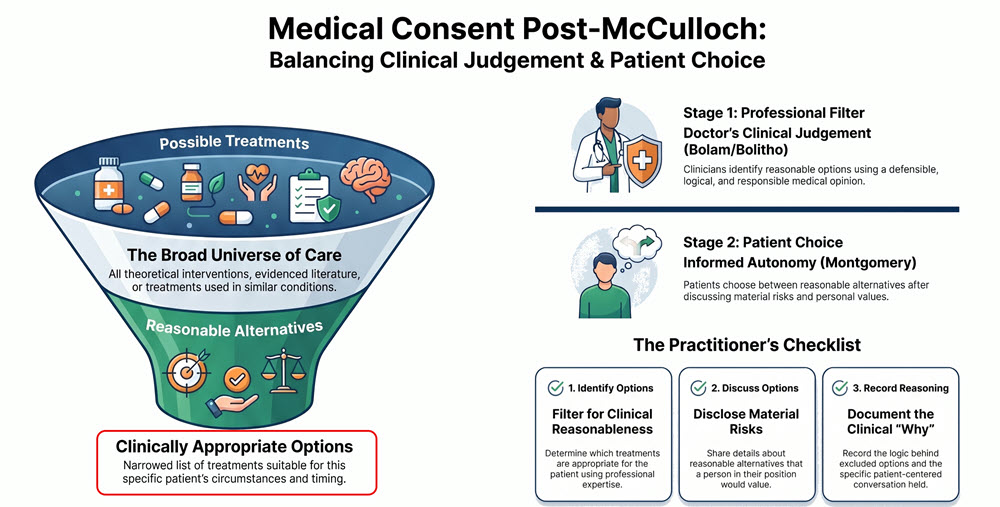
That distinction matters. A possible treatment is any treatment that could be imagined or used in some circumstances. A reasonable alternative is narrower. It is a treatment that is clinically appropriate for the particular patient, at the particular time, in the particular clinical context.
The Supreme Court held that the identification of reasonable alternative treatments remains a matter of professional judgement. In other words, the clinician must first decide which options are clinically reasonable. That judgement is assessed by the professional practice test associated with Bolam, refined by Bolitho. Once reasonable alternatives have been identified, the patient-centred duty in Montgomery applies: the patient must be told about those reasonable alternatives and the material risks that matter to the decision.
That is why McCulloch deserves close attention. It sits at the meeting point between professional judgement and patient autonomy.
The legal background McCulloch had to deal with
Bolam: when professional judgement sets the standard
The older starting point is Bolam v Friern Hospital Management Committee [1957] 1 WLR 582. In that case, the court was concerned with alleged medical negligence in the delivery of electroconvulsive therapy. The central question was whether the doctor had fallen below the standard expected of a responsible medical practitioner.
The famous principle from Bolam is that a doctor is not negligent if acting in accordance with a practice accepted as proper by a responsible body of medical opinion. Put more simply, the law did not ask whether another doctor might have done something different. It asked whether the doctor’s conduct was supported by a responsible body of relevant professional opinion.
This became the professional practice test. In Scotland, the equivalent starting point was Hunter v Hanley 1955 SC 200. In McCulloch, the Supreme Court treated the two approaches as consistent. The point was that diagnosis and treatment often involve professional judgement, and courts should be cautious before substituting their own view for that of competent clinicians.
But Bolam also created a risk. If misunderstood, it can sound as though clinical practice is lawful simply because some doctors support it. That is too broad. The question is not whether a few peers agree. The question is whether the opinion relied upon is responsible, relevant and properly directed to the clinical issue.
Bolitho: when professional opinion can still fail
Bolitho v City and Hackney Health Authority [1998] AC 232 added an important control. It confirmed that professional opinion is not immune from scrutiny. A court is not bound to accept expert medical opinion simply because it exists.
The court may reject a body of professional opinion if it is not capable of withstanding logical analysis. That does not mean judges can simply choose whichever expert they prefer. The threshold is higher than that. But it does mean that professional opinion must have a defensible basis. It must engage with the risks, benefits and clinical reasoning in a way that can properly support the conclusion reached.
This matters because Bolitho prevents Bolam from becoming a rubber stamp. It preserves the court’s role in deciding the legal standard of care, while still recognising that clinical judgement often requires expert professional assessment.
In McCulloch, this meant that the cardiologist’s view about NSAID treatment was not automatically protected merely because it was a medical view. It had to be a view supported by a responsible body of professional opinion and capable of logical analysis.
Montgomery: the patient-centred turn in consent law
Montgomery v Lanarkshire Health Board [2015] UKSC 11 changed the law of consent in a major way. It rejected the idea that disclosure of risk was simply a matter for medical judgement under Bolam.
The Supreme Court held that a doctor must take reasonable care to ensure that the patient is aware of material risks involved in recommended treatment, and of reasonable alternative or variant treatments. A risk is material if a reasonable person in the patient’s position would be likely to attach significance to it, or if the doctor is or should reasonably be aware that the particular patient would be likely to attach significance to it.
That was a clear patient-centred shift. The law recognised that the patient, not the doctor, is the person who must live with the consequences of treatment. The doctor’s role is not merely to recommend and obtain agreement. It is to support a properly informed decision.
But Montgomery left an important question open. It referred to reasonable alternative treatments. It did not fully explain how those reasonable alternatives were to be identified in the first place. That gap became central in McCulloch.
Duce: separating clinical knowledge from disclosure duties
Duce v Worcestershire Acute Hospitals NHS Trust [2018] EWCA Civ 1307 helped clarify the structure of the post-Montgomery duty. The case concerned risks, rather than alternative treatments, but its reasoning became important in McCulloch.
The Court of Appeal in Duce distinguished between two stages. First, what risks were known, or ought to have been known, to the doctor? That is a matter involving professional knowledge and expertise. Secondly, should the patient have been told about those risks? That is judged by the Montgomery test of materiality.
That distinction is useful. It prevents two different questions from being collapsed into one. Clinical expertise is needed to identify the medical facts. But once those facts are known, the legal duty to inform the patient is not governed simply by what doctors customarily disclose.
In McCulloch, the Supreme Court used that structure by analogy. It treated the identification of reasonable alternative treatments as the first-stage clinical question. Once the reasonable alternatives have been identified, the second-stage Montgomery duty applies: the patient must be told about them, so that the choice is genuinely informed.
What McCulloch clarified
Drawing the boundary around Montgomery
McCulloch did not reverse Montgomery. That is important. The Supreme Court did not return consent law to a purely doctor-centred model. Patients remain entitled to be told about material risks and reasonable alternative treatments.
What McCulloch did was clarify the stage at which professional judgement still matters. The Court drew a boundary between two questions. First, what treatment options are clinically reasonable in this patient’s circumstances? Secondly, once those options have been identified, what must the patient be told so that they can make an informed decision?
The first question belongs substantially to professional judgement. The second belongs to the patient-centred approach in Montgomery. That distinction is the heart of McCulloch.
Without that boundary, Montgomery could be read as requiring doctors to discuss every treatment that was theoretically possible, even where the doctor did not regard it as clinically appropriate. The Supreme Court rejected that interpretation. The duty is not to list every possible intervention. The duty is to discuss reasonable alternatives.
The word “any”: powerful, but not unlimited
Montgomery said that patients should be told about “any reasonable alternative or variant treatments” [para 87, Montgomery]. The word “any” is powerful. It suggests that, once a treatment falls within the class of reasonable alternatives, the doctor cannot simply choose which one to mention and which one to leave out.
McCulloch confirms that point. If there are several reasonable treatment options, the doctor should not discuss only the one they prefer. The patient should be told about the reasonable alternatives so that the patient can make the decision.
But “any” does not mean every possible treatment known to the doctor. The word is limited by the phrase that follows it: “reasonable alternative or variant treatments”. The duty is not to discuss ‘any’ treatment at all. It is to discuss any reasonable alternative treatment.
That may sound like a narrow grammatical point, but clinically it matters. It prevents consent from becoming a defensive recital of theoretical options. It also prevents the doctor from withholding discussion of a reasonable option merely because it is not the doctor’s preferred option.
So the word “any” remains important. It expands the duty once the field of reasonable alternatives has been identified. It does not decide what enters that field in the first place.
The difference between possible, reasonable and clinically appropriate
The key distinction in McCulloch is between a possible treatment and a reasonable alternative treatment.
A possible treatment is broad. It may be a treatment that exists in medical practice, appears in the literature, or may be used in some patients with a similar condition. But that does not mean it is clinically appropriate for the patient actually being treated.
A reasonable alternative is narrower. It is a treatment that is clinically appropriate in the patient’s particular circumstances. That includes the patient’s presentation, diagnosis, differential diagnosis, risks, likely benefits, contraindications, timing, and the clinical purpose of the intervention.
The Supreme Court treated “reasonable alternative treatment” as meaning a treatment that is clinically appropriate or clinically suitable. This is where the professional practice test [Bolam] comes back in. If a doctor decides that a possible treatment is not clinically reasonable, that judgement is assessed by reference to whether it is supported by a responsible body of medical opinion and whether it can withstand logical analysis.
In McCulloch, NSAIDs were plainly a possible treatment for pericarditis. The issue was whether they were a reasonable alternative treatment for Mr McCulloch at the time Dr Labinjoh saw him. On the findings made below, the view that NSAIDs were not appropriate was supported by responsible medical opinion and was not illogical. For that reason, the Supreme Court held that Dr Labinjoh was not under a Montgomery duty to discuss NSAID treatment with him.
Where professional judgement ends and patient choice begins
The practical effect of McCulloch is that clinical judgement and patient choice operate at different stages.
Professional judgement identifies the clinically reasonable options. That judgement is not beyond challenge. It must be supported by responsible medical opinion and must be capable of logical analysis. If the professional judgement is unsound, Bolam will not protect it.
But once the reasonable options have been identified, the decision is not the doctor’s alone. The patient must be given the information needed to decide between those options. That includes material risks and reasonable alternatives. It also includes attention to what matters to the particular patient, not only what matters to doctors in general.
This is the point clinicians may miss. McCulloch protects clinical judgement, but it does not protect a poor consent conversation. It says doctors do not have to discuss unreasonable or clinically unsuitable options. It does not say that doctors can decide, without discussion, which reasonable option the patient should accept.
The better reading is therefore balanced. Montgomery moved consent law towards patient autonomy. McCulloch explains that patient autonomy operates within a clinically reasonable range of options. The doctor identifies that range. The patient decides within it.
Why McCulloch matters in psychiatric practice
Capacity does not replace the Montgomery conversation
Psychiatric practice has its own legal and ethical complexities. Capacity, compulsion, risk, safeguarding and public protection may all be present in the same clinical encounter. That can make consent feel different from consent in other areas of medicine.
But the basic point should not be lost. Where a patient has capacity to make the relevant decision, the duty to support informed choice remains. The fact that the patient has a psychiatric diagnosis does not reduce the importance of the conversation. Nor does it allow the clinician to treat consent as a formality.
Capacity is decision-specific. A patient may lack capacity for one decision but retain it for another. A patient may also make a decision that clinicians consider unwise without necessarily lacking capacity. That distinction is familiar in mental health practice, but it is not always carried through into consent discussions.
This is where Montgomery remains important after McCulloch. If a patient has capacity, the clinician must think not only about what the profession would usually recommend, but about what information this particular patient needs in order to decide. That includes material risks. It may also include reasonable alternatives.
McCulloch does not weaken that obligation. It clarifies that the alternatives to be discussed are those that are clinically reasonable. But once options are within that clinically reasonable range, the patient’s values, priorities and concerns become central.
Risk, treatment options and patient values
Psychiatry often involves difficult judgements about treatment benefit and treatment burden. Medication may reduce relapse risk, distress, aggression, self-neglect or risk to others. But it may also bring sedation, weight gain, sexual dysfunction, emotional blunting, cognitive dulling, extrapyramidal symptoms, metabolic risk, cardiac risk or other adverse effects that matter greatly to the patient.
A clinician may see one option as plainly preferable. The patient may see the same option differently. That difference does not necessarily mean the patient lacks insight or capacity. It may simply mean that the patient gives different weight to the risks and benefits.
This is the patient-centred lesson from Montgomery. Materiality is not just about statistical frequency. A low-frequency risk may matter deeply to a particular patient. A common side effect may matter more to one patient than another because of work, relationships, identity, previous experience, physical health, trauma history, or fear of coercion.
McCulloch adds an important boundary. The clinician is not required to discuss every theoretical treatment, every unevidenced possibility, or every option that would be clinically unsuitable. Professional judgement still has a filtering role. The clinician must identify what is clinically reasonable in the circumstances.
But that filtering role should not be stretched too far. It should not become a way of avoiding difficult conversations. In psychiatric practice, a reasonable alternative might include a different medication, a different dose, a slower titration, psychological therapy, social intervention, watchful waiting, physical health monitoring, or no immediate treatment, depending on the clinical context.
The practical question is not simply, “What do I think is best?” It is also, “What reasonable options exist, and what would this patient need to understand in order to choose between them?”
Recording the reasoning, not just the outcome
The documentation point is simple but often neglected. It is not enough to record that the patient “consented”, “agreed”, or “declined”. Those words may record the outcome, but they do not show the quality of the decision-making process.
A better record shows the reasoning. What was the clinical problem? What options were considered? Which options were regarded as clinically reasonable? Which options were rejected as unsuitable, and why? What material risks were discussed? What mattered to the patient? What did the patient decide?
That level of recording does not require pages of defensive prose. It requires a clear account of the conversation. The record should show that the clinician used professional judgement to identify the reasonable options, and then supported the patient to make an informed choice within that range.
This is especially important in psychiatry because later review often occurs in a different context. A patient may relapse. Medication may be changed. A tribunal, hospital managers’ hearing, complaint investigator, second opinion appointed doctor, coroner, regulator or court may later examine the notes. The question may then become not only what was decided, but how the decision was reached.
McCulloch therefore has a practical message for psychiatric records. Do not merely record the conclusion. Record the clinical judgement that shaped the available options, and the consent conversation that followed.
The practical lessons for clinicians
What should change in everyday practice?
The first practical lesson is that clinicians should stop treating consent as a narrow event at the end of assessment. Consent is part of clinical reasoning. It begins when the clinician identifies the problem, considers the available options, and decides which options are clinically reasonable.
The second lesson is that professional judgement still matters, but it must be used carefully. McCulloch confirms that clinicians are not required to discuss every possible intervention. They are required to identify the reasonable alternatives. That judgement should be clinically grounded, not merely habitual or convenient.
The third lesson is that once reasonable alternatives exist, the conversation belongs much more to the patient. The clinician may recommend, advise and explain. But the patient must be given enough information to decide. That includes material risks, likely benefits, reasonable alternatives, and the option of no treatment where that is clinically reasonable.
The fourth lesson is that clinicians should be cautious about assuming what matters to a patient. A risk that seems small to the clinician may be significant to the patient. A side effect that appears tolerable in professional terms may be unacceptable in the patient’s life. Good consent practice requires curiosity about the patient’s values, not just clarity about the doctor’s recommendation.
The fifth lesson is that documentation should show both stages of the process. It should record the professional judgement about which options were clinically reasonable, and it should record the patient-centred conversation that followed. A note that simply says “risks discussed” or “patient consented” may not be enough to show that the legal and ethical work was actually done.
In practical terms, clinicians might ask themselves a small number of questions before concluding a consent discussion. What are the clinically reasonable options? Why have other possible options been excluded? What material risks should this patient know about? What does this particular patient seem to care about? Does the record show the reasoning and the conversation?
Case vignette: reviewing consent after stability has been achieved
A patient with a long history of relapsing psychosis has been stable for several years on an established a depot antipsychotic medication. Previous relapses were severe and associated with marked distress, self-neglect and repeated admissions. The current medication is not perfect. The patient has gained weight and reports some emotional blunting, but also says that life has become more predictable and that admission has been avoided.
At review, the clinician does not need to restart the consent conversation as though no treatment history exists. McCulloch helps explain why. The question is not whether every possible antipsychotic, psychological intervention, dose change, depot preparation or non-treatment option must be rehearsed at each appointment. The first question is whether there is a clinically reasonable reason to reopen those alternatives now.
If the patient remains well, understands the purpose of treatment, understands the important risks and burdens, and wishes to continue, the clinical focus may properly be narrower. The reasonable options may be to continue, adjust the dose, review side effects, address physical health risks, or plan a future medication review. Other alternatives might become reasonable if the patient raises concerns, side effects worsen, physical health changes, relapse occurs, or the balance of benefit and burden shifts.
The documentation should not merely say “patient consents”. It should show that the patient understands the purpose of continuing treatment, the material risks and burdens, the reason for not reopening every alternative treatment at that point, and the plan for review if circumstances change.
Medical and non-medical managers should note the time impacts involved for proper documentation.
Case vignette: proposing clozapine after failed antipsychotic trials
A patient with schizophrenia continues to experience persistent psychotic symptoms despite two adequate trials of conventional antipsychotic medication. The trials were of sufficient dose and duration, adherence was reasonably established, and other relevant factors were considered. The treating team now considers clozapine to be clinically appropriate.
This is a different kind of consent conversation. Clozapine is not simply one possible medication among many. In this scenario, it may be a reasonable alternative because the patient has not responded adequately to other antipsychotic treatment. The clinician’s professional judgement identifies clozapine as falling within the range of clinically reasonable options.
Once that point is reached, Montgomery becomes central. The patient should be helped to understand why clozapine is being proposed, what benefits are hoped for, what important risks and burdens attach to it, and what reasonable alternatives remain. Those alternatives might include further non-clozapine medication strategies if clinically supportable, augmentation approaches, psychological and social interventions, or declining the proposed treatment, depending on the circumstances.
The consent conversation should not be reduced to “clozapine is indicated”. Nor should it become a mechanical recital of every remote possibility. The important task is to identify and discuss the matters that would be material to this patient’s decision. These may include blood monitoring, potentially serious adverse effects, sedation, hypersalivation, weight gain, constipation, metabolic risks, the practical burden of attendance, and the patient’s own previous experience of medication.
The record should show the clinical reasoning that made clozapine a reasonable option, the alternatives considered, the material risks discussed, the patient’s questions and concerns, and the decision reached. In a case like this, McCulloch does not narrow the conversation. It helps structure it: professional judgement identifies clozapine as a reasonable option, and patient-centred consent then requires a meaningful discussion before the patient decides.
Medical and non-medical managers should note the time impacts involved for proper documentation.
Final thought: consent after McCulloch
The importance of McCulloch is that it gives shape to the space between clinical judgement and patient choice. It does not make consent less patient-centred. It explains that patient choice operates within a range of clinically reasonable options.
That should reassure clinicians, but not make them complacent. The decision protects doctors from having to recite every theoretical possibility. It does not protect poor communication, thin documentation, or a failure to engage with what matters to the patient.
The best practical reading is therefore straightforward. Use professional judgement to identify the reasonable options. Use the consent conversation to help the patient choose between them. Then record both the judgement and the conversation clearly.
That is where McCulloch leaves modern consent law: not with the doctor alone, and not with the patient choosing from an unfiltered list of possibilities, but with a structured conversation in which clinical expertise and patient autonomy each have their proper place.