


Estimated reading time at 200 wpm: 30 minutes
The Quantitative Landscape of Patient Homicide in the United Kingdom
Over the past decade, homicides by individuals in contact with mental health services have posed a persistent challenge for the NHS and the criminal justice system. Data from the National Confidential Inquiry into Suicide and Safety (NCISH) and various independent investigations show a troubling pattern. Patient homicides represent a minority – 11% – of total homicides in the UK. However, they constitute a significant group of incidents where timely service intervention might have changed the outcome.[1, 2]
Whether or not you agree our Fat Disclaimer applies
Between 2012 and 2022, the United Kingdom recorded approximately 658 victims of patient homicide. This translates to an average of 60 incidents per year.[1] Patients—defined as individuals in contact with mental health services within 12 months of the offence—account for approximately 11% of all people convicted of homicide across the UK.[1, 3, 4]
However, this 11% figure is almost certainly an underestimate. NCISH data relies on convictions to classify a killing as a patient homicide. This means homicide-suicides—where the perpetrator dies and no conviction occurs—are excluded from the count entirely. These cases often represent some of the most acute clinical failures, yet they remain invisible in the official statistics.
This percentage has remained relatively stable over the last ten years, though regional variations exist. The proportion of homicide convictions involving mental health patients is notably higher in Scotland (17%) and Wales (14%). This correlates with higher overall homicide rates in the general populations of these countries.[1, 5]Homicide Metric (UK National Data 2012-2022) Annual Average Total for Period Patient Homicide Convictions 58 637 Victims of Patient Homicide 60 658 Percentage of Total UK Homicide Convictions 11% N/A Convictions Aged Under 25 13 127 Convictions Aged Under 18 3 29
The temporal trends within this data are complex. Homicide convictions fell after 2013 and remained steady until 2019. However, estimated figures for 2021 and 2022 show an apparent increase. Analysts largely attribute this to the clearing of court backlogs and prosecution delays caused by the COVID-19 pandemic rather than a fundamental surge in incidence.[1]
The demographic profile of perpetrators consistently highlights young men as the primary group involved in these acts. Nearly one in five patient-perpetrators are under the age of 25.[1, 5]
The relationship between perpetrator and victim reveals a disturbing pattern. Data from 162 inquiries indicates that 71% of victims were family members, friends, or partners. Only 15% were strangers. This underscores the domestic and relational context of many mental health tragedies, compared to the 44% domestic victim rate in the general population.[3, 6]
Extracting the Clinical and Relational Root Causes
Independent inquiries and thematic reviews have identified multiple factors contributing to these tragedies. These go far beyond simple clinical error. The causes are better understood as failures at the intersection of clinical practice, service capacity, and patient pathology.[6, 7]
The Stratification Trap and Risk Assessment Deficits
One of the most profound root causes identified in the last decade of inquiries is the systemic failure of risk assessment methodologies. Despite national guidance from the National Institute for Health and Care Excellence (NICE) advocating for holistic, biopsychosocial assessments, many NHS trusts in England have remained tethered to outdated risk stratification tools that label patients as “high, medium, or low” risk.[8] Inquiries repeatedly demonstrate that these labels are often meaningless in a predictive sense, as the majority of patient homicides occur when the risk is assessed as “low” or when there is no obvious warning.[5, 8]
The specific clinical failings associated with risk assessment include the minimisation of historical violence, a failure to document the escalation of symptoms in a narrative format, and a lack of dynamic assessment that accounts for recent life stressors such as bereavement or financial instability.[9, 10, 11] For instance, recent reviews into the Nottingham tragedies highlighted that risk assessments for Valdo Calocane omitted critical details regarding the seriousness of his psychosis and the immediate threat he posed to the public when non-compliant with treatment.[11, 12] The reliance on “tick-box” exercises over therapeutic engagement has been described as a “defensive practice” born from a fear of blame, which ironically increases the risk of oversight.[8, 13]
Medication Compliance and the Management of Psychosis
A second recurring root cause involves the management of pharmacological interventions, particularly for patients with schizophrenia or other forms of severe psychosis. Approximately 52% of perpetrators in a national study of inquiries had a diagnosis of schizophrenia, and a concomitant 52% had a history of non-adherence to medication and follow-up care.[6] Inquiries frequently identify a “passive” approach to medication management, where clinicians accept a patient’s preference for oral medication despite a clear history of non-compliance in the community.[14]
The failure to utilise more robust legal and clinical frameworks, such as Section 3 of the Mental Health Act (MHA) and Community Treatment Orders (CTOs), has been cited as a missed opportunity in several high-profile homicides.[11, 14] In cases where a patient’s psychosis is known to escalate into violence, the decision to maintain a patient on a voluntary status rather than a supervised community framework is often viewed in retrospect as a failure to balance patient autonomy with public safety.[12, 14]Clinical Root Cause Theme Frequency/Impact Common Investigative Finding Diagnosis of Schizophrenia 52% of perpetrators [6] Core underlying clinical factor in many cases. Medication Non-Adherence 52% of perpetrators [6] History of non-compliance often ignored. Substance Misuse (Dual Diagnosis) 88% – 100% of cases [2, 5] Primary driver of risk across UK countries. Family/Carer Involvement Frequently cited as poor [11] Families’ concerns often ignored or not sought. History of Self-Harm Present in 62-64% of cases [10, 15] Indicates general severity of distress and risk.
The Dual Diagnosis Imperative
The role of substance misuse as a root cause cannot be overstated. Inquiry data shows that it is exceptionally rare for a mental health patient to commit a homicide in the absence of alcohol or drug misuse.[2, 5] In England, 88% of patients convicted of homicide had a history of substance misuse, while in Northern Ireland, this figure reached 100%.[2] Despite this clear causal link, “dual diagnosis” services—those designed to treat both mental illness and addiction simultaneously—are frequently described as fragmented or under-resourced. Scotland’s high homicide rates among patients are particularly driven by this cohort, yet policy responses often fail to integrate substance misuse treatment into core mental health care.[5]
Socio-Clinical Factors: Bereavement, Isolation, and Financial Stress
While the focus of homicide inquiries is often on psychosis and violence, the broader “background noise” of social adversity is increasingly recognised as a catalyst for crisis. Data from patient suicide reports—which often involve the same vulnerable cohort—highlights that isolation and social adversity are pervasive.
| Social Adversity Factor | Frequency in High-Risk Patients |
|---|---|
| Living Alone | 47% – 48% [10, 15] |
| History of Self-Harm | 62% – 64% [10, 15] |
| Financial Problems | 17% [10] |
| Recent Bereavement (<3 months) | 8% (Increasing trend) [9, 10] |
| Domestic Violence Experience | 9% [15] |
Inquiries into homicides frequently find that perpetrators were living in isolation and had recently experienced significant life stressors that were not fully appreciated by their care teams.[9, 11] For instance, a patient who is non-compliant with medication and is also recently bereaved or facing eviction is at a significantly higher risk of a catastrophic “breakdown” than a patient who is socially stable.[9, 10] The “siloed” nature of care often means that social workers and clinical teams do not communicate these “non-clinical” risk factors effectively.[8, 12]
Systemic and Strategic Failures: The National Context
While clinical failures are often the focus of inquiry recommendations, there is a growing consensus that these are symptoms of broader systemic pathologies within England’s mental health infrastructure.
The Decommissioning of Assertive Outreach
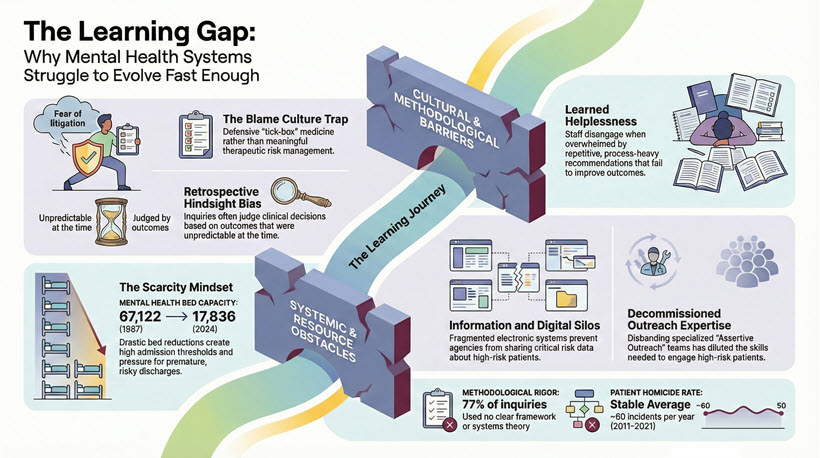
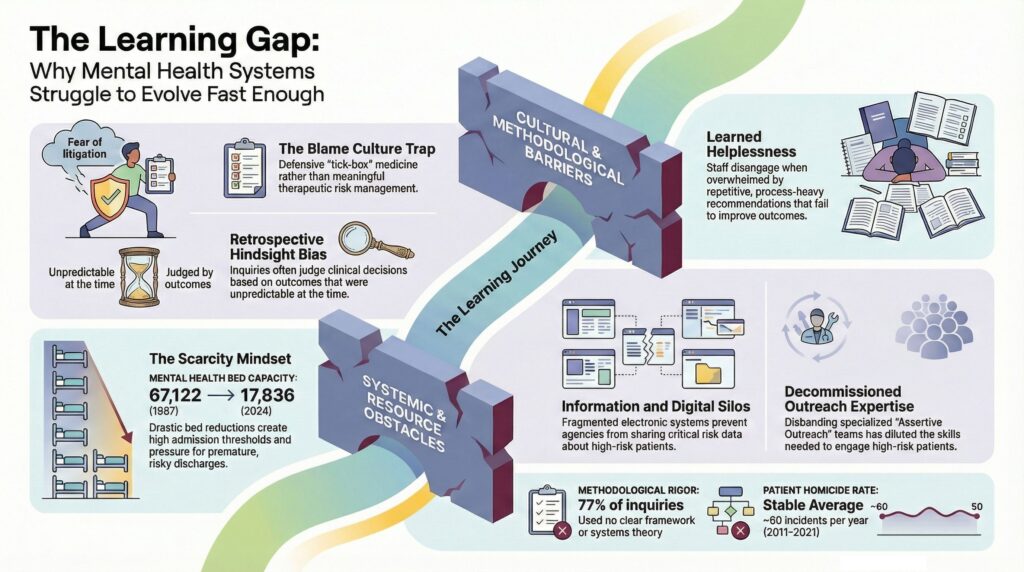
A critical strategic root cause identified over the last decade is the disbanding of “Assertive Outreach” teams. These specialised services were originally designed to proactively engage with patients who are difficult to reach or who frequently miss appointments—the very group most at risk of committing violent acts when untreated.[16] The transition away from these intensive community models to more generalist community mental health teams (CMHTs) has led to a dilution of expertise and a reduction in the “frequency and tenacity” of engagement.[16, 17]
This strategic shift has resulted in the “non-engagement discharge loop,” where patients with severe and relapsing illnesses are discharged back to their GP simply for missing appointments (DNAs). Inquiries have forcefully argued that for patients with psychosis and a history of violence, “DNAs” should never be a reason for discharge, as they are often a symptom of the patient’s deteriorating mental state.[14, 16]
Bed Capacity and the Crisis of Transitions
The systemic reduction in mental health bed capacity in England is an underlying factor that influences clinical decision-making. Since 1987, the number of mental health beds has fallen from approximately 67,000 to just over 17,800 in 2024.[17] This scarcity of resources creates a high threshold for admission and intense pressure for early discharge. Many inquiries find that discharge planning is “not robust” and is often driven by the need to free up a bed rather than a patient’s readiness for community care.[8, 12, 17] This “scarcity mindset” leads to “Out of Area” placements, which further fragment care and weaken the connection between the patient and their community support network.[8]Strategic Root Cause Temporal Trend / Data Point Impact on Public Safety Loss of Independent Oversight NHS England cut funding to NCISH homicide research (c. 2019) [17] Removal of the only independent source of national data; inability to track true scale of service failures. Mental Health Bed Reduction From 67,122 (1987) to 17,836 (2024) [17] High threshold for admission; premature discharge. Assertive Outreach Disbanding Ongoing since 2011/12 [17, 18] Loss of contact with “high-risk, low-insight” patients. Strategic Under-funding “De-prioritisation” of MH [17] Frontline failure to monitor high-risk patients. Inter-agency Communication Recurring theme in all reports [19] Police and GPs lack critical risk information.
Case Study: The Nottingham Tragedies and the Special Review of NHFT
The homicides committed by Valdo Calocane in June 2023 serve as a modern archetype for the failings identified in England. The subsequent special review by the CQC and the independent investigation commissioned by NHS England (Midlands) highlight the intersection of clinical, systemic, and inter-agency failures.[11, 14, 31]
Key Omissions in the Calocane Case
• The Discharge Decision: Calocane was discharged to his GP in September 2022 despite a history of violence and non-engagement. The review found that his “symptoms of illness”—lack of insight and resistance to treatment—were used as the justification for ending his specialist care.[12, 14]
• Mental Health Act Application: The failure to use Section 3 of the MHA during his fourth admission meant that the clinical team lacked the “legal framework” to enforce a Community Treatment Order (CTO) or supervise his medication via depot injections.[11, 14]
• Inter-agency Communication: Critical information about Calocane’s violence was not effectively shared between the police, the university, and the mental health trust.[11, 12]
• Family Inclusion: Calocane’s family repeatedly raised concerns about his deteriorating state, yet records show no attempt by the care team to contact him in response to these warnings.[11]
National Implications of the Review
The Nottingham review concluded that the issues at the trust were “not unique” and reflected “systemic issues with community mental health care” nationwide.[12, 14] This prompted a national call for every mental health trust to review their engagement policies for patients with serious mental illness and to ensure that “DNAs” are never used as a trigger for discharge in this cohort.[16, 31]
The Evolution of Inquiry Methodology: From RCA to Human Factors
The last ten years have seen a methodological tug-of-war between traditional investigative techniques and modern safety science.
The Failure of Traditional Root Cause Analysis (RCA)
Independent inquiries into mental health homicides have historically been criticised for their lack of a rigorous, standardised methodology. A review of 162 inquiries found that 77% used no clear methodological framework, and very few utilised the principles of “Human Factors” or “Systems Theory”.[6] Instead, they relied on a retrospective timeline of events to identify “points of failure.”
Even more troubling is the finding that of the 130 inquiries that commented on predictability or preventability, only 8 (6%) included clear definitions of both terms.[4] This means that for the vast majority of reports, the central conclusions—the very judgements that determine whether a trust “failed”—were based on undefined, subjective criteria.[4] Without these definitions, the “lessons learned” are essentially written on shifting sands.[4] Some inquiries even employed circular logic, with one concluding that a homicide was “not preventable” simply because the perpetrator failed to secure a diminished responsibility defence at trial, using a legal verdict to retroactively justify clinical care.[4]
The problem with this approach in a psychiatric context is the “Hindsight Bias.” When an investigator knows a homicide has occurred, they are far more likely to see a patient’s “missed appointment” or “vague threat” as a significant warning sign than the clinician would have at the time. This leads to findings of “preventability” that clinicians argue are unrealistic.[4, 6, 7]
The Implementation of PSIRF and Systems Thinking
The Patient Safety Incident Response Framework (PSIRF) represents the most significant attempt to solve this methodological problem. By using “Human Factors” tools, investigators are encouraged to look at the “Work-as-Done” versus “Work-as-Imagined”.[26] This involves examining why a clinician made a specific decision given the “noise” of a busy clinic, the limitations of their electronic records, and the staffing pressures of the day.[23, 26]Framework Component Old System (Serious Incident Framework) New System (PSIRF) Primary Goal Find the cause (RCA); attribute blame/failure.[7] Understand the system; facilitate learning.[23, 26] Investigative Tool Root Cause Analysis (RCA).[7, 25] Human Factors; SEIPS; Systems-based tools.[23, 26] Threshold for Action High harm = Investigation.[23] Proportionate response based on learning potential.[23] Focus of Finding Frontline clinician “errors”.[17] Systemic contributory factors and interactions.[26, 30]
The Predictability and Preventability Paradox
One of the most controversial requirements of English homicide inquiries is the obligation to comment on whether the act was “predictable” or “preventable.” Research shows that 82% of inquiries find the acts to be neither, yet they still result in extensive recommendations for change.[4] More strikingly, of the 105 inquiries that provided a firm view on both predictability and preventability, only 4 homicides (4%) were deemed to be both predictable and preventable.[4] This creates a logical paradox. If the vast majority of homicides could not have been predicted or prevented, the hundreds of recommendations issued by these panels may be based on “hindsight bias” rather than a true causal link between service failure and death.[4]
This paradox is compounded by the methodological vacuum described earlier. Without clear definitions of “predictable” or “preventable”, inquiry panels have been left to invent their own thresholds, creating arbitrary and inconsistent judgements across cases.[4] One inquiry might judge a homicide “predictable” based on a vague threat, whilst another might require an explicit statement of intent.[4] The consequence is a system that highlights a fundamental tension: if a homicide was truly unpredictable, can the “failures” identified in the service be said to have “caused” the death?
The academic and clinical consensus is moving towards the idea that inquiries should abandon these binary concepts. Instead, they should focus on whether the service was “safe” and “effective” according to established standards.[4, 7] If a trust failed to follow its own medication policy, that is a significant safety finding regardless of whether it could have “predicted” that a specific patient would commit a homicide.[4, 7]
Difficulties with Implementing Lessons Learned
The recurring nature of the themes identified in inquiries raises the difficult question of why the same lessons are not being embedded in practice. Several systemic barriers prevent the translation of recommendations into sustained improvement.
The Blame Culture and Defensive Medicine
A primary difficulty in implementing lessons learned is the pervasive “blame culture” within the NHS. When a homicide occurs, the subsequent investigation often feels adversarial to the staff involved.[7, 20] Clinicians report that the experience can be “career-ending,” leading to a defensive stance where the focus shifts from genuine learning to “compliance and fault-finding”.[17] This culture encourages a “tick-box” mentality, where staff complete required documentation to insulate themselves from future criticism, rather than engaging in the complex, therapeutic risk management required for patient safety.[8, 13]
Recommendation Fatigue and the “SMART” Trap
Inquiries often generate a vast volume of recommendations, which can lead to “recommendation fatigue” at the trust level. Many of these recommendations are required to be “SMART” (Specific, Measurable, Achievable, Realistic, and Timely) for the purposes of assurance. While this makes them easy to “sign off,” it often results in “weak actions”—such as providing one-off training sessions or sending an email “reminding staff of a policy”—rather than the “stronger actions” required for systemic change, such as redesigning digital interfaces or restructuring teams.[7, 21] Furthermore, national recommendations often lack a clear recipient or “owner,” leading to duplication and confusion about who is responsible for implementation.[8]
Loss of Organisational Memory and Staff Churn
High levels of staff turnover and frequent organisational restructuring mean that “lessons learned” are often lost within a few years of an inquiry’s conclusion. In some trusts, the disbanding of teams or the migration to new electronic patient record (EPR) systems leads to a “loss of organisational memory”.[17, 18, 22] By the time an independent inquiry is published—often three to six years after the event—the service may have changed so significantly that the staff involved have moved on, and the current workforce does not see the findings as relevant to their current practice.[7, 18, 20]
Digital and Interoperability Barriers
A significant practical barrier to implementing safety lessons is the lack of interoperability between different electronic systems. Risk information often resides in “silos”—for instance, a mental health trust’s record may contain details of a patient’s violence that is not visible to their GP or the police.[8, 11] Despite repeated recommendations to improve information sharing, fragmented digital systems make it difficult for clinicians to obtain a holistic, longitudinal view of a patient’s risk profile.[8, 19]
The Erosion of Independent Oversight and Data Integrity
Perhaps the most profound barrier to implementing lessons learned is the removal of independent scrutiny regarding mental health homicides. Six years ago, NHS England cut the funding for the homicide research component of the National Confidential Inquiry into Suicide and Safety in Mental Health (NCISH).[17] This decision removed the only independent source of information about mental health homicides in the UK, leaving the system without an independent body collating national data to offset what critics describe as “official secrecy and unaccountability”.[17]
The contradiction is stark. NHS England claims it seeks to “minimise recurrence” and “influence system wide development”. Yet it has removed the very mechanism designed to track national failure rates.[17] Without this independent research, it is unknown how many mental health homicides that should be investigated are actually being missed. Previous NCISH data, collected before the funding cuts, showed that 30% of qualifying homicides were not being independently investigated.[17] The funding cut occurred at precisely the moment when robust, independent data was most needed. This was exactly when the system needed to verify whether its claims of “learning” were translating into measurable safety improvements.
Are Lessons Being Learned? An Assessment of Progress
To determine if England is learning from these tragedies, one must look at both structural changes and longitudinal data. The assessment is a mix of strategic innovation and persistent clinical inertia.
Longitudinal Trends in Patient Safety
The NCISH data provides some reason for cautious optimism in certain areas of patient safety. For example, suicides by patients who were non-adherent with medication showed a downward trend in England between 2010 and 2015.[2] However, the stable rate of patient homicide (averaging 60 per year) suggests that the specific mechanisms of violence prevention are more difficult to influence than suicide prevention.[1, 2]
Furthermore, the recent tragedies in Nottingham (2023) and the subsequent inquiries in 2024 and 2025 demonstrate that the same errors—discharging high-risk patients for non-engagement and failing to use the powers of the Mental Health Act—are still occurring despite decades of similar warnings.[11, 12, 14] The fact that national leaders were warned as early as 2019 that homicide recommendations were not “nationally strategic” suggests that while learning is happening at a local, tactical level, it is not yet being fully translated into national policy change.[17]
Indicators of Genuine Learning
Identifying whether lessons are being truly embedded requires a shift from “process-based” metrics to “outcome-based” and “cultural” metrics.
Quantitative Indicators of Learning
The most direct indicator would be a significant and sustained reduction in the rate of patient-perpetrated homicide relative to the general population. However, given the rarity of these events, statistical “noise” can make this difficult to track in the short term. Other quantitative measures include:
• Real-Time Surveillance Data: The use of real-time monitoring of “near-miss” events and “apparent homicides” to identify and respond to emerging patterns before they become systemic failures.[9, 10, 27]
• LFPSE Data Analysis: Analyzing the “Learn from Patient Safety Events” (LFPSE) database to see if the types of reported contributory factors are changing over time.[28, 29] A decrease in “medication non-adherence” as a contributory factor, for instance, would indicate that lessons in this area are being applied.
• National Staff Survey Scores: Specifically, Question 16—”My organisation treats staff who are involved in an error, near miss or incident fairly”—serves as a proxy for the maturity of the trust’s safety culture.[21]
Qualitative and Systemic Indicators
Beyond the data, several qualitative indicators would signal a “learning organisation”:
• The Inclusion of Family Voices: A transition from “tokenistic” family involvement to inquiries where the concerns of victims and perpetrators’ families are central to the findings and recommendations.[16, 17, 21]
• The “15 Steps Challenge” and Soft Intelligence: Using observations of clinical spaces to see if safety improvements (such as better record-keeping practices or engagement strategies) are visible to the naked eye.[21]
• Shift in Recommendation Type: A move away from “weak” recommendations (e.g., “remind staff”) toward “stronger” systemic fixes (e.g., “automated digital alerts for non-engagement”).[7]
• A “Just Culture” in Practice: Evidence that clinicians feel psychologically safe enough to report their own “missed opportunities” without fear of the inquiry being a “witch hunt”.[8, 20, 26]
The Human Impact: Families, Victims, and Clinicians
The narrative of “learning” often overlooks the profound emotional toll that these tragedies and the subsequent investigations take on the people involved.
The Experience of Families and Victims
Families of both victims and perpetrators report feeling “ignored and bewildered” by the inquiry process.[20] They often feel they are in a “battle for the truth” against an organisation that has become “defensive and secretive”.[17, 20]
The Transparency Deficit
A particularly troubling development has been NHS England’s increasing practice of publishing only summaries rather than full investigation reports. Of the 214 independent homicide investigation reports published by NHS England, 27 were not full reports but only brief summaries.[17] This represents over a tenth of all published investigations and falls far short of the standards required for public accountability.[17]
These summaries have been variously represented as “learning papers”, “learning summaries”, “learning bulletins”, “executive summaries”, “abridged executive summaries”, and “extended executive summaries”.[17] Some were only three pages long, which is disturbing given the gravity of the subject matter.[17] There is usually no indication of why information has been withheld in any given case.[17] More concerning still, this practice has increased in recent years, with NHS England claiming it has done so after receiving legal advice.[17]
The implications for families have been shocking. Some families have not been allowed to see the full reports at all. Others have been required to sign confidentiality agreements before being permitted access to reports about their own loved ones’ deaths.[17] This represents a fundamental betrayal of the “Duty of Candour” and denies families the transparency they deserve.[17] The controversy over NHS England’s initial refusal to publish the full independent investigation report on Valdo Calocane’s killings brought this issue into sharp public focus, forcing NHS England to announce that a review of its approach to publication would take place.[17] However, NHS England continues to maintain that constraints against full publication remain.[17]
The Impact on Clinicians
Homicides are “harrowing, horrible, and devastating” experiences for the clinicians responsible for the perpetrator’s care.[3] A study of 26 consultant psychiatrists found that 81% reported a significant impact on their mental health, with many describing the event as “everyone’s worst nightmare”.[3] The subsequent inquiry process—often lasting years—can lead to physical health issues, relationship strain, and a permanent shift in how these clinicians practice medicine, often becoming more risk-averse and defensive.[3, 7]
Conclusions and Strategic Recommendations for Systemic Learning
The research from the last ten years reveals a troubling picture. England has a robust system for identifying the causes of mental health homicides. It lacks an equally robust system for embedding the necessary changes.
More critically, there is evidence that the investigation process itself serves dual purposes: genuine safety improvement and institutional reputation management. The increasing trend towards publishing summary documents rather than full reports raises serious questions. So does the continued exclusion of homicide-suicides from official statistics. The persistence of undefined terms like “predictable” and “preventable” is equally concerning. These factors suggest a system as concerned with managing public perception as it is with addressing systemic failures.
The transition to PSIRF is a critical opportunity. But it must be supported by strategic and political will. It requires a willingness to be genuinely transparent about the depth of the failures identified.
The Pace of Change: Why the Tennis Racket Keeps Missing the Ball
The central tragedy revealed by this analysis is one of repetition. In 1994, the Clunis inquiry identified critical systemic failures: shortage of assertive outreach services, insufficient forensic expertise in general psychiatry, inadequate bed capacity, and poor transitions from secure to community care. Thirty-one years later, the 2025 Calocane inquiry found the same failures. The tennis racket is swinging with vigour. But it keeps missing the ball entirely.
The question of pace matters because not all systemic corrections require the same timeframe. Some fixes are achievable within months. Others demand years of sustained investment. The danger lies in confusing the two.
Fast fixes exist and some have already been implemented. In July 2024, NHS England issued mandatory guidance to all Integrated Care Boards stating that “DNA (did not attend) should never be used as a reason for discharge” for patients with serious mental illness.[32] Definitions of “predictable” and “preventable” could be standardised across all inquiry terms of reference. Full investigation reports could be published as standard practice rather than sanitised summaries. NCISH homicide research funding could be restored to provide independent oversight. These are policy decisions requiring political will, not capital investment.
However, issuing guidance is not the same as achieving compliance. Without the staff to visit disengaged patients and the beds to admit them when they deteriorate, the July 2024 guidance becomes worthless. Trusts facing impossible caseloads will find administrative workarounds. The tick-box will be ticked. The patient will still be discharged. The homicide will still occur.
Medium-term changes spanning two to five years would include rebuilding assertive outreach team capacity, training generic community mental health staff in forensic principles, achieving digital interoperability for risk information sharing across agencies, and shifting organisational culture from blame to genuine learning. These require both funding and sustained managerial commitment.
Long-term transformation over five to ten years would involve reversing catastrophic bed closures, expanding the mental health workforce, integrating dual diagnosis services, and securing sustainable funding commitments that survive electoral cycles. These require political courage and public investment on a scale not seen since the creation of community mental health teams in the 1990s.
This is where the “lessons learned” framework breaks down entirely. You cannot learn your way out of a resource famine. A starving system cannot implement safety improvements that require abundance. When every mental health trust reports chronic understaffing, when 805 patients are in inappropriate out-of-area placements, when beds have fallen from 67,000 to 17,836, the question is not whether staff “followed the care plan.” The question is whether the care plan was ever feasible given the resources available.
The risk now is another cycle of inquiry findings, carefully worded recommendations, trust action plans, and ministerial reassurances—followed by nothing changing on the ground. The 2019 external review already warned that homicide investigation recommendations were not “nationally strategic.” Six years later, that warning has been vindicated. The same failures recur. The same families grieve. The same clinicians are scapegoated for systemic collapse.
Whether political will exists for the five to ten year investment required remains to be seen. History suggests it does not. The alternative is to continue the current pattern: identifying causes with forensic precision whilst systematically avoiding the structural changes needed to address them.
Recommendations
Recommendation 1: Enforce the July 2024 Guidance and Resource It Adequately
In July 2024, NHS England issued guidance prohibiting discharge for non-engagement.[32] However, guidance without resources is theatre, not transformation. NHS England must audit compliance with this guidance across all Integrated Care Boards by Q2 2025/26 and publish the results. Where trusts lack the assertive outreach capacity to maintain contact with disengaged patients, ring-fenced funding must be provided to rebuild these teams. The guidance must be backed by consequences for non-compliance, not simply filed away as another aspirational policy.[14, 16, 32]
Recommendation 2: Abandon Predictability and Preventability Judgements
The requirement for inquiry panels to judge “predictability” and “preventability” should be removed entirely. Research shows that only 6% of inquiries defined these terms, meaning 94% of panels made these critical judgements without agreed criteria.[4] These undefined concepts encourage hindsight bias and circular reasoning. Instead, inquiries should focus on whether services met established safety standards using Human Factors methodology. This would move the conversation away from the “impossible science” of predicting rare events and towards the “practical science” of ensuring the system is functioning safely.[4, 7]
Recommendation 3: Reverse Bed Closures and Expand Forensic Expertise
National leadership must confront the reality that mental health bed capacity has fallen from 67,000 (1987) to 17,836 (2024), a reduction of 74%.[17] Clinical errors are often “upstream” results of this scarcity. NHS England must set a funded target to increase acute psychiatric beds to a level that eliminates Out of Area placements and premature discharges driven by bed pressure. Additionally, generic community mental health teams require embedded forensic psychiatric expertise. Training programmes must be established to upskill existing staff in managing patients with histories of violence and psychosis. Strategic learning requires honest assessment of whether current workforce and bed capacity can realistically fulfil the safety mandates set out in inquiry recommendations.[17]
Recommendation 4: Implement National Digital Risk-Sharing Framework by 2027
Communication failures between mental health trusts, GPs, police, and universities are a recurring theme in homicide inquiries.[8, 19] NHS England must mandate implementation of a national, interoperable digital risk framework by April 2027. This system must ensure that critical risk information—including histories of violence, medication non-compliance, and previous homicide inquiry findings—is immediately visible to all agencies with a legitimate need to know. The system must operate across Electronic Patient Record platforms and integrate with police intelligence systems. Appropriate legal safeguards for patient privacy must be built in, but these cannot be used as an excuse for continued information siloing. Every mental health trust should be required to demonstrate compliance through external audit.[8, 19]
Recommendation 5: Restore Independent Oversight and Mandate Full Publication
NHS England must immediately restore funding for the homicide research component of the National Confidential Inquiry into Suicide and Safety in Mental Health (NCISH).[17] Without independent collation of national data, it is impossible to verify whether systemic changes are reducing homicides or whether trusts are simply managing their statistics. The removal of this oversight six years ago was a catastrophic error that must be reversed.
Additionally, NHS England must mandate full publication of all independent investigation reports. The practice of publishing only summary documents—which occurred in 27 out of 214 cases (12.6%)—betrays the Duty of Candour and denies families transparency.[17] Confidentiality agreements preventing families from accessing full reports about their own loved ones’ deaths must be prohibited. National mechanisms must track implementation of “nationally strategic” recommendations, ensuring that insights from regional tragedies translate into national policy change, ending the cycle of “local learning, national status quo”.[17]
References
- NCISH | Homicide in the UK 2025
- National Confidential Inquiry into Suicide and Homicide – Healthcare Quality Improvement Partnership 2018
- Impact of homicide by a psychiatric patient on forensic psychiatrists: national survey – PMC
- Judgments of predictability, preventability and causation [Despande 2025]
- The National Confidential Inquiry into Suicide and Homicide by People with Mental Illness – The University of Manchester, https://documents.manchester.ac.uk/display.aspx?DocID=37770
- Mental health homicide inquiries in England 2010-2023: review of methodology and findings – PubMed, https://pubmed.ncbi.nlm.nih.gov/40183136/
- Mental health homicide inquiries in England 2010–2023: review
- Mental health inpatient settings: overarching report of investigations
- Research report: NCISH (2025) – UMHAN, https://www.umhan.com/resources/research-report-ncish-2025
- NCISH Annual Report 2025
- Nottingham Healthcare Foundation Trust (NHFT) Section 48 review, https://www.leicspart.nhs.uk/wp-content/uploads/2024/09/Paper-R2_Notts-HC-Sec-48-report-Trust-Board-Sept-2024.pdf
- Special review of mental health services at Nottinghamshire Healthcare NHS Foundation Trust – CQC, https://www.cqc.org.uk/node/10516/book_pdf_print
- Mental health professionals’ perceived barriers and enablers to shared decision-making in risk assessment and risk management: a qualitative systematic review – NIH, https://pmc.ncbi.nlm.nih.gov/articles/PMC8613998/
- CQC Review of Nottinghamshire Healthcare NHS Foundation Trust & lessons for mental health service provision – DAC Beachcroft, https://www.dacbeachcroft.com/en/What-we-think/CQC-Review-of-Nottinghamshire-Healthcare-NHS-Foundation-Trust-lessons-for-mental-health-service
- NCISH report 2022
- Independent Mental Health Homicide Review – NHS Sussex
- NHS England’s handling of independent investigations on mental health homicides (Feb 2025)
- An independent thematic review of investigations into the care and treatment provided to service users who committed a homicide – NHS England, https://www.england.nhs.uk/south/wp-content/uploads/sites/6/2016/10/thematic-review-vol1.pdf
- Thematic Analysis of the Concerns Identified in Completed …, https://www.elft.nhs.uk/sites/default/files/2024-10/Learning%20from%20Patient%20Safety%20Investigations_1.pdf
- Mental Health Inquiries in the Case of Homicide – PMC – NIH, https://pmc.ncbi.nlm.nih.gov/articles/PMC8009106/
- Safety culture: learning from best practice – NHS England, https://www.england.nhs.uk/long-read/safety-culture-learning-from-best-practice/
- Our thematic review – Sussex Partnership NHS Foundation Trust, https://www.sussexpartnership.nhs.uk/about-us/how-our-trust-run/our-thematic-review
- Patient Safety Incident Response Framework – NHS England, https://www.england.nhs.uk/long-read/patient-safety-incident-response-framework/
- Mental health: investigating under the Patient Safety Incident Response Framework
- Understanding adverse incident responses in mental health care: a qualitative study of systems-based patient safety practices – PubMed Central, https://pmc.ncbi.nlm.nih.gov/articles/PMC12598960/
- Investigating under the Patient Safety Incident Response Framework (PSIRF): sharing HSSIB learning for future development, https://www.hssib.org.uk/patient-safety-investigations/investigating-under-the-patient-safety-incident-response-framework-psirf-sharing-hssib-learning-for-future-development/investigation-report/
- Learning from incidents – South West Yorkshire Partnership NHS Foundation Trust, https://www.southwestyorkshire.nhs.uk/wp-content/uploads/2025/07/5082-Learning-from-incidents-24-25.pdf
- Record a patient safety event – NHS England, https://www.england.nhs.uk/patient-safety/patient-safety-insight/learning-from-patient-safety-events/report-patient-safety-incident/
- LFPSE: – Happy Healthy Lives, https://www.happyhealthylives.uk/clientfiles/files/LFPSE%20Handbook.pdf
- Patient Safety Incident Response Policy – Rethink Mental Illness, https://rethink.org/media/efhmgrvc/patient-safety-incident-response-policy-may-2025.pdf
- NHS England » Independent mental health homicide report into the …, https://www.england.nhs.uk/2025/02/independent-mental-health-homicide-report-into-the-treatment-of-valdo-calocane/
- Guidance to integrated care boards on intensive and assertive community mental health care – NHS England,