



Estimated reading time at 200 wpm: 44 minutes
The recent UK Supreme Court judgment in For Women Scotland Ltd v The Scottish Ministers ([2025] UKSC 16) has clarified a long-standing ambiguity in equality law: what does the term “woman” mean in the Equality Act 2010? The court ruled that “woman” refers to biological sex, not gender identity or legal sex as defined by a Gender Recognition Certificate (GRC). This landmark decision marks a significant shift from previous interpretations, which often conflated biological sex with gender identity, leading to confusion in areas such as single-sex spaces, pregnancy protections, and gender-specific services.
Whether or not you agree our Fat Disclaimer applies
The UK Supreme Court has affirmed that “sex” in the Equality Act 2010 must be interpreted biologically unless there is clear legislative intent to the contrary. This reverses earlier trends where some organisations and policymakers assumed that “woman” included transgender women with GRCs.
J. K. Rowling who donated £70k via crowd-funding to FWS, celebrated the judgement.
Some who said that “men can have a cervix” have been remarkably silent. Not everyone is pleased with the judgment. There have been protests: Thousands of trans rights activists gather in London after Supreme Court ruling on definition of a woman | UK News | Sky News
In accordance with our disclaimer, you sue yourself if you apply anything here that may be have been inadvertently erroneous and which leads to damage or loss.
Prior to this ruling, the lack of clarity led to inconsistent application of the law. For example, some services interpreted “woman” to include transgender women based on their gender identity, while others adhered strictly to biological distinctions. This inconsistency created tension in areas like access to women-only spaces or pregnancy-related protections.
For mental health professionals in the UK, this judgment has far-reaching implications. It affects how single-sex wards, trauma-informed care, and gender-specific services are provided, while also emphasising the need to balance the rights of biological females with those of transgender individuals under the Equality Act 2010.
As psychiatrists navigate these complex legal and ethical waters, understanding the intricacies of this ruling is essential to delivering equitable, patient-centreed care. How should mental health services adapt to ensure compliance with the law while upholding the dignity and safety of all patients? This article explores the answers to that such important questions.
Understanding the Legal Landscape
The UK Supreme Court judgment in For Women Scotland Ltd v The Scottish Ministers ([2025] UKSC 16) has clarified a fundamental aspect of equality law: the meaning of “woman” in the Equality Act 2010 (EA 2010). This ruling is significant for mental health professionals, as it directly impacts how services are delivered and who qualifies for specific protections. Below, I expand on the key legal takeaways, ensuring that all points are firmly grounded in the judgment and relevant legislation.
No apology will be offered for repeating that the UKSC’s judgement clarified that “woman” in the Equality Act 2010 refers to biological sex.
The Supreme Court explicitly stated that “woman” in the EA 2010 refers to biological sex, not gender identity or legal sex as defined by a Gender Recognition Certificate (GRC). This interpretation aligns with the original intent of the Sex Discrimination Act 1975 (SDA 1975), which also used “man” and “woman” to refer to biological distinctions.
Key legal principle: The court applied the principle of statutory interpretation, emphasising that the words “man” and “woman” must be understood in their biological context unless there is clear legislative intent to the contrary.
Impact of Section 9 of the GRA 2004: While the Gender Recognition Act 2004 (GRA 2004) allows individuals to change their legal sex through a GRC, this does not override the biological meaning of “sex” in the EA 2010. The court rejected the argument that section 9(1) of the GRA 2004—which states that a person’s acquired gender becomes their legal sex “for all purposes”—alters the biological basis of sex in the EA 2010.
Practical implications: This means that provisions in the EA 2010 tied to biology—such as pregnancy, maternity, and breastfeeding protections—are limited to biological females, regardless of whether someone holds a GRC.
Before this judgment, there was ambiguity about whether “woman” in the EA 2010 included transgender women with GRCs. Some organisations and policymakers interpreted the term broadly, conflating biological sex with gender identity. This inconsistency led to confusion in areas such as:
Single-sex spaces: For example, some mental health wards or counselling groups admitted transgender women based on their gender identity, while others adhered strictly to biological distinctions.
Pregnancy protections: Transgender men with GRCs (legally male but biologically female) were sometimes excluded from pregnancy-related services because they did not meet the definition of “woman.”
Service delivery: Organisations struggled to distinguish between individuals with and without GRCs, often resorting to de facto self-identification policies due to the impracticality of verifying GRC status.
The Supreme Court’s clarification resolves these ambiguities by affirming that “woman” refers to biological sex throughout the EA 2010, except where specific exemptions apply (e.g., protections for transgender individuals under the characteristic of gender reassignment).
One of the key concerns raised during the case was whether interpreting “woman” as biological sex would disadvantage transgender individuals. The court addressed this issue, concluding that the EA 2010 continues to protect transgender people under the characteristic of gender reassignment. This means:
Protection against discrimination: Transgender individuals are protected from discrimination, harassment, and victimisation in all areas covered by the EA 2010, regardless of whether they have a GRC.
No loss of rights: The judgment does not remove any existing protections for transgender people. For example: A transgender woman without a GRC can still bring claims of discrimination based on gender reassignment. A transgender man with a GRC retains protections under the EA 2010, even if he is no longer considered a “woman” for the purposes of biological protections like pregnancy.
Balanced approach: By maintaining the distinction between biological sex and gender identity, the judgment ensures that both groups—biological females and transgender individuals—are protected under the law, albeit in different ways.
One of the key concerns raised during the case was whether interpreting “woman” as biological sex would disadvantage transgender individuals. The court addressed this issue, concluding that the EA 2010 continues to protect transgender people under the characteristic of gender reassignment. This means:
Protection against discrimination: Transgender individuals are protected from discrimination, harassment, and victimisation in all areas covered by the EA 2010, regardless of whether they have a GRC.
No loss of rights: The judgment does not remove any existing protections for transgender people. For example: A transgender woman without a GRC can still bring claims of discrimination based on gender reassignment. A transgender man with a GRC retains protections under the EA 2010, even if he is no longer considered a “woman” for the purposes of biological protections like pregnancy.
Balanced approach: By maintaining the distinction between biological sex and gender identity, the judgment ensures that both groups—biological females and transgender individuals—are protected under the law, albeit in different ways.
The judgment has several practical implications for mental health services in the UK:
Single-sex spaces: Mental health providers can continue to offer single-sex spaces (e.g., wards, counselling groups) based on biological distinctions, provided they meet the proportionality test under the EA 2010. However, they must ensure that exclusions are justified and do not disproportionately affect transgender individuals.
Pregnancy and maternity protections: Services tailored to pregnant individuals (e.g., perinatal mental health care) should focus on biological females, as these protections are inherently tied to biology. Transgender men with GRCs may face challenges accessing these services, highlighting the need for inclusive pathways.
Risk assessments: Providers must conduct risk assessments carefully, balancing the safety and comfort of all patients. For example: A female patient with a history of male violence may reasonably object to sharing a ward with a transgender woman who is biologically male. Such objections must be based on specific risks rather than general discomfort or prejudice.
One of the court’s overarching concerns was ensuring that the EA 2010 is interpreted in a way that is clear and consistent for those required to apply it. As Lord Nicholls explained in Spath Holme, citizens should be able to understand parliamentary enactments and regulate their conduct accordingly. The judgment achieves this by:
Avoiding incoherence: A certificated sex interpretation of “woman” would render certain provisions of the EA 2010 unworkable. For example: Pregnancy protections tied to “woman” would become inconsistent if applied to transgender men with GRCs. Single-sex exceptions would lose clarity if based on self-identification rather than biology.
Guidance for stakeholders: The ruling provides much-needed clarity for mental health professionals, service providers, and policymakers, enabling them to implement equality law in a practical and lawful manner.
While the judgment clarifies the current legal position, it also highlights areas where further legislative review may be necessary:
- EHRC recommendations: The Equality and Human Rights Commission (EHRC) has acknowledged difficulties in applying the EA 2010 under a certificated sex interpretation and called for legislative amendments to address these issues.
- Areas of concern: Specific provisions—such as those related to sexual orientation discrimination, single-sex services, and sports—may require updating to reflect evolving societal norms while maintaining legal coherence.
In accordance with our disclaimer, you sue yourself if you apply anything here that may be have been inadvertently erroneous and which leads to damage or loss.
Single-Sex Spaces in Mental Health Settings: Balancing Rights and Safety
The UK Supreme Court judgment in For Women Scotland Ltd v The Scottish Ministers ([2025] UKSC 16) has significant implications for the provision of single-sex spaces in mental health settings. These spaces, such as psychiatric wards, counseling groups, and changing facilities, are often justified by concerns about safety, privacy, and dignity. The judgment clarifies that these spaces can be provided based on biological sex, but it also underscores the need to balance these considerations with protections for transgender individuals under the Equality Act 2010 (EA 2010). Below, we explore how mental health services can navigate this complex legal and ethical landscape.
(a) Legal Basis for Single-Sex Spaces
The judgment affirms that single-sex spaces are lawful under the EA 2010, provided they meet the proportionality test.
Key provisions include:
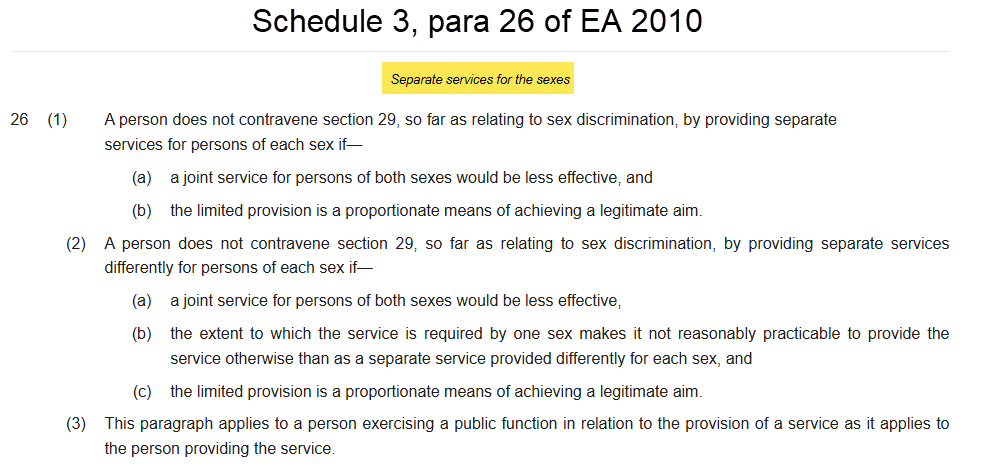
Schedule 3, Paragraph 26: allows for the provision of separate services for persons of each sex where joint services would be less effective and the separation is a proportionate means of achieving a legitimate aim.
Legitimate Aims: Examples of legitimate aims include:
- Ensuring the safety of vulnerable patients, particularly those with a history of trauma or violence.
- Addressing specific needs related to biological sex, such as pregnancy, menstruation, or breastfeeding.
- Facilitating recovery in trauma-informed care settings, such as support groups for women who have experienced sexual violence.
For mental health professionals, this means that decisions about single-sex spaces must be evidence-based and justifiable. For example:
- A women-only ward may be necessary to protect female patients with a history of male violence.
- A trauma-focused support group for women who have experienced sexual violence may exclude men to create a safe environment for disclosure and healing.
However, the judgment also highlights that exclusions must not disproportionately disadvantage transgender individuals, who remain protected under the characteristic of gender reassignment.
(b) Challenges in Accommodating Transgender Patients
While the judgment supports the legality of single-sex spaces, it raises challenges in accommodating transgender individuals, particularly those with Gender Recognition Certificates (GRCs):
- Transgender Women with GRCs: Legally female but biologically male, transgender women with GRCs may qualify for access to women-only spaces under the EA 2010. However, their biological characteristics could raise concerns among other patients, particularly in high-risk environments like psychiatric wards.
- Transgender Men with GRCs: Legally male but biologically female, transgender men with GRCs may face exclusion from women-only spaces, even if their biology aligns with the criteria for inclusion.
These scenarios highlight the complexity of balancing competing rights and interests. Mental health providers must navigate these issues carefully to avoid discrimination while ensuring safety and comfort for all patients.
(c) Practical Steps for Implementation
To address these challenges, mental health services can take the following practical steps:
Risk Assessments:
- Conduct individualised risk assessments to determine whether a patient’s presence in a single-sex space poses a risk to others.
- Document the rationale for any exclusions to demonstrate compliance with the proportionality test under the EA 2010.
Clear Policies:
- Develop transparent policies outlining the criteria for admission to single-sex spaces, emphasising biological distinctions where relevant.
- Ensure that staff are trained to apply these policies consistently and fairly.
Alternative Arrangements:
- Provide alternative accommodations for patients who cannot access single-sex spaces due to their biological or legal status. For example:
- Offer private rooms or gender-neutral facilities where appropriate.
- Create mixed-gender spaces with robust safeguards to protect vulnerable patients.
Patient Engagement:
- Involve patients in discussions about single-sex spaces to understand their concerns and preferences.
- Foster an environment of trust and respect, ensuring that all patients feel heard and valued.
(d) Exemptions and Protections
The EA 2010 includes specific exemptions that allow for exclusions based on biological sex or gender reassignment in certain circumstances:
Communal Accommodation (Schedule 23, Paragraph 3): This exemption permits both sex discrimination and gender reassignment discrimination in the context of communal accommodation, such as shared hospital wards.
Women’s Services (Schedule 3, Paragraph 27): This provision allows for the exclusion of individuals whose presence might undermine the effectiveness of women-only services, such as rape crisis centres or domestic violence refuges.
These exemptions provide mental health providers with flexibility to make case-by-case decisions while ensuring compliance with equality law.
(e) Avoiding Unlawful Discrimination
While single-sex spaces are legally permissible, mental health providers must ensure that exclusions do not constitute unlawful discrimination:
Gender Reassignment Protections: The EA 2010 protects individuals with the characteristic of gender reassignment from discrimination, harassment, and victimisation. For example: Refusing to admit a transgender woman to a women-only ward solely because she is biologically male could amount to unlawful gender reassignment discrimination. Failing to use a patient’s preferred pronouns or name could constitute harassment under the EA 2010.
Reasonable Adjustments: Providers must consider reasonable adjustments to accommodate transgender patients, such as allowing them to use facilities that align with their gender identity where feasible.
(f) Ethical Considerations
The judgment emphasises the importance of ethical decision-making in mental health practice:
Confidentiality: GRC status is confidential, meaning providers may not always know whether a patient holds a GRC. Decisions should therefore focus on observable characteristics and documented risks rather than assumptions about legal status.
Patient autonomy: Respecting a patient’s gender identity is essential for building trust and delivering effective care. Providers should engage with patients to understand their preferences and needs.
Safety and comfort: Ensuring the safety and comfort of all patients, including those with vulnerabilities related to sex or gender, is paramount.
Gender-Specific Care: Who Qualifies and Why It Matters
In accordance with our disclaimer, you sue yourself if you apply anything here that may be have been inadvertently erroneous and which leads to damage or loss.
Gender-specific care is a cornerstone of equitable healthcare, particularly in mental health settings where tailored interventions can significantly impact outcomes. The UK Supreme Court judgment in For Women Scotland Ltd v The Scottish Ministers ([2025] UKSC 16) clarifies that “woman” in the Equality Act 2010 (EA 2010) refers to biological sex, which has profound implications for how gender-specific care is delivered. This section explores who qualifies for such care, why it matters, and the challenges of ensuring inclusivity while maintaining biological distinctions.
(a) What Is Gender-Specific Care?
Gender-specific care refers to services or interventions designed to address the unique needs of individuals based on their biological sex or gender identity. Examples include:
- Perinatal mental health services: Support for pregnant women and new mothers experiencing mental health issues.
- Trauma-informed Care: Services for women who have experienced male violence, such as domestic abuse or sexual assault.
- Men’s Mental Health Programs: Initiatives addressing issues like suicide prevention or substance abuse, which disproportionately affect men.
These services are often justified by differences in biology, societal roles, or lived experiences tied to being male or female.
(b) Who Qualifies for Gender-Specific Care Under the EA 2010?
The Supreme Court judgment affirms that protections and services tied to biological sex—such as pregnancy, maternity, and breastfeeding—are limited to biological females. This means:
- Biological females: Women and girls who are biologically female qualify for services explicitly tied to their biology, such as perinatal mental health care.
- Transgender women with GRCs: While legally female, transgender women with Gender Recognition Certificates (GRCs) do not qualify for services tied to biological distinctions unless they meet additional criteria (e.g., retaining female reproductive anatomy).
- Transgender men with GRCs: Legally male but biologically female, transgender men with GRCs may face exclusion from services explicitly designed for biological females, even if they retain the capacity to become pregnant.
This distinction is critical because many gender-specific services are inherently tied to biological realities e.g.
- Only biological females can become pregnant, give birth, or breastfeed.
- Women who have experienced male violence may require female-only spaces to feel safe.
(c) Why Does Gender-Specific Care Matter?
Gender-specific care matters because it addresses systemic inequalities and vulnerabilities faced by specific groups. For example:
Pregnancy and maternity protections: Pregnancy-related mental health issues, such as postpartum depression, are unique to biological females. Excluding biological females from these services would undermine the purpose of protections tied to pregnancy and maternity under the EA 2010.
Trauma-informed care: Many women who have experienced male violence require female-only environments to feel safe and supported. Mixed-gender settings may deter survivors from accessing care, reducing the effectiveness of trauma-informed interventions.
Data Collection and policy-making: Policies aimed at addressing systemic disadvantages faced by women often rely on data about biological sex. Including transgender women with GRCs in gender-specific data could distort statistics, making it harder to target interventions effectively.
(d) Challenges in Providing Inclusive Care
While the judgment clarifies who qualifies for gender-specific care based on biological distinctions, it also highlights challenges in ensuring inclusivity:
Transgender men with GRCs: Transgender men with GRCs (legally male but biologically female) may face exclusion from services tied to biological sex, such as perinatal mental health care. This creates a gap in care for transgender men who are pregnant or postpartum, potentially exacerbating their vulnerability.
Balancing inclusivity and effectiveness: Mental health providers must balance the need for inclusivity with the effectiveness of gender-specific services. For example, admitting transgender women with GRCs to women-only trauma groups could undermine the safety and comfort of other participants, particularly if their presence raises concerns.
Confidentiality around GRC status: GRC status is confidential, meaning providers may not always know whether a patient holds a GRC. Decisions about eligibility for gender-specific care must therefore focus on observable characteristics (e.g., biological capacity) rather than assumptions about legal status.
(e) Practical Steps for Implementation
To address these challenges, mental health providers can take the following steps:
Clear Eligibility Criteria:
- Develop transparent policies outlining who qualifies for gender-specific care, emphasising biological distinctions where relevant.
- Ensure staff are trained to apply these policies consistently and fairly.
Inclusive Pathways:
- Create inclusive pathways for transgender patients who do not qualify for gender-specific services based on biology.
- For example, provide alternative support for transgender men who are pregnant or postpartum.
Patient Engagement:
- Involve patients in discussions about gender-specific care to understand their needs and preferences.
- Foster an environment of trust and respect, ensuring that all patients feel heard and valued.
Risk Assessments:
- Conduct individualised risk assessments to determine whether a patient’s inclusion in gender-specific care poses risks to others.
- Document the rationale for any exclusions to demonstrate compliance with the proportionality test under the EA 2010.
(f) Legal Protections for Transgender Individuals
The judgment emphasises that interpreting “sex” as biological does not disadvantage transgender individuals, who remain protected under the characteristic of gender reassignment. For example:
- Direct Discrimination: Refusing to admit a transgender woman to a women-only group solely because she is biologically male could constitute unlawful gender reassignment discrimination.
- Indirect Discrimination: Policies that disproportionately exclude transgender individuals must be justified as a proportionate means of achieving a legitimate aim.
Mental health providers must ensure that any exclusions are lawful and do not disproportionately disadvantage transgender individuals.
Protections for Transgender Individuals: Upholding Equality in Mental Health Services
The UK Supreme Court judgment in For Women Scotland Ltd v The Scottish Ministers ([2025] UKSC 16) clarifies that “sex” in the Equality Act 2010 (EA 2010) refers to biological sex, not gender identity or legal sex as defined by a Gender Recognition Certificate (GRC). However, the judgment explicitly affirms that this interpretation does not disadvantage transgender individuals, who remain protected under the characteristic of gender reassignment. For mental health professionals, this means that while biological distinctions are relevant in certain contexts, transgender patients must still be safeguarded from discrimination, harassment, and exclusion. Below, we explore how these protections operate in practice and their implications for mental health services.
In accordance with our disclaimer, you sue yourself if you apply anything here that may be have been inadvertently erroneous and which leads to damage or loss.
(a) Legal Protections Under the EA 2010
The EA 2010 provides robust protections for transgender individuals through the characteristic of gender reassignment. Key points include:
- Definition of gender reassignment: Section 7 of the EA 2010 defines “gender reassignment” as applying to anyone who is proposing to undergo, is undergoing, or has undergone a process (or part of a process) of reassigning their sex. Importantly:
- A person does not need to have obtained a GRC to qualify for protection.
- Medical intervention is not required; the characteristic applies to anyone who identifies as transgender, regardless of whether they pursue hormonal or surgical treatments.
- Prohibition of discrimination: The EA 2010 prohibits direct discrimination, indirect discrimination, harassment, and victimisation on the basis of gender reassignment. For example:
- Refusing to admit a transgender woman to a women-only ward solely because she is biologically male could constitute unlawful direct discrimination.
- Failing to use a patient’s preferred pronouns or name could amount to harassment under the EA 2010.
- Separate protections from sex discrimination: The Supreme Court emphasised that gender reassignment is a distinct and separate protected characteristic from sex. This means that protections for transgender individuals are not contingent on how “sex” is interpreted in the EA 2010.
(b) Practical Implications for Mental Health Services
Mental health providers must ensure that their practices align with the protections afforded to transgender individuals under the EA 2010. Below are key areas of focus:
- Access to services: Transgender individuals must have equal access to mental health services, regardless of their biological sex or GRC status.
- A transgender woman without a GRC should not be excluded from a women-only trauma group unless there is a legitimate and proportionate reason for doing so.
- A transgender man with a GRC should not face barriers to accessing perinatal mental health care if he retains the biological capacity to become pregnant.
- Respect for gender identity: Respecting a patient’s gender identity is essential for building trust and delivering effective care. Providers should:
- Use the patient’s preferred name and pronouns unless there is a compelling reason not to do so.
- Ensure that staff are trained to understand and affirm transgender identities.
- Avoiding indirect discrimination:
- Policies or practices that disproportionately disadvantage transgender individuals may constitute indirect discrimination unless they can be objectively justified e.g. A blanket policy requiring all patients to use facilities that correspond to their biological sex could disadvantage transgender individuals and may not be lawful.
- Reasonable adjustments: Providers must consider reasonable adjustments to accommodate transgender patients. For example:
- Offering private rooms or gender-neutral facilities where appropriate.
- Allowing transgender patients to use facilities that align with their gender identity, provided this does not undermine the safety or dignity of others.
(c) Balancing Competing Rights
While the EA 2010 protects transgender individuals, mental health providers must also balance these rights with the needs of other patients. Key considerations include:
- Single-Sex spaces: Paragraphs 26–28 of Schedule 3 allow for the provision of single-sex spaces based on biological distinctions, provided they meet the proportionality test. However, exclusions must not disproportionately disadvantage transgender individuals e.g. A women-only ward may exclude a transgender woman with a GRC if her presence poses a specific risk to other patients, but this decision must be based on evidence rather than assumptions.
- Risk assessments:
- Conduct individualised risk assessments to determine whether a patient’s inclusion in a single-sex space poses risks to others.
- Document the rationale for any exclusions to demonstrate compliance with the proportionality test under the EA 2010.
- Patient engagement:
- Involve patients in discussions about single-sex spaces to understand their concerns and preferences.
- Foster an environment of trust and respect, ensuring that all patients feel heard and valued.
(d) Ethical Considerations
The judgment underscores the importance of ethical decision-making in mental health practice:
- Confidentiality: GRC status is confidential, meaning providers may not always know whether a patient holds a GRC. Decisions should therefore focus on observable characteristics and documented risks rather than assumptions about legal status.
- Patient autonomy: Respecting a patient’s gender identity is essential for building trust and delivering effective care. Providers should engage with patients to understand their preferences and needs.
- Safety and comfort: Ensuring the safety and comfort of all patients, including those with vulnerabilities related to sex or gender, is paramount.
(e) Examples of Potential Challenges
Below are examples of scenarios that highlight the complexities of balancing competing rights:
- Transgender women without a GRC: A transgender woman without a GRC seeks admission to a women-only trauma group. While she is legally male, excluding her solely on this basis could constitute unlawful gender reassignment discrimination unless there is a legitimate and proportionate reason for doing so.
- Transgender men with a GRC: A transgender man with a GRC requires access to perinatal mental health care. While he is legally male, his biological capacity to become pregnant means he qualifies for pregnancy-related protections under the EA 2010. Excluding him from these services could constitute unlawful discrimination.
- Shared Accommodation: A female patient objects to sharing a ward with a transgender woman who is biologically male. While such objections must be taken seriously, they must be based on specific risks rather than general discomfort or prejudice.
(f) Training and Awareness
To uphold the protections afforded to transgender individuals, mental health providers must prioritise training and awareness among staff. Key areas of focus include:
- Understanding legal protections: Staff should be familiar with the protections provided under the EA 2010, particularly the distinction between “sex” and “gender reassignment.”
- Promoting inclusivity: Training should emphasise the importance of creating inclusive environments that respect and affirm transgender identities.
- Addressing bias: Providers must address implicit biases that may lead to discriminatory practices or attitudes toward transgender patients.
Ethical Considerations for Psychiatrists: Navigating Complex Cases
For psychiatrists, the UK Supreme Court judgment in For Women Scotland Ltd v The Scottish Ministers ([2025] UKSC 16) underscores the delicate balance required when navigating issues of sex, gender identity, and equality law. While the ruling clarifies that “woman” in the Equality Act 2010 refers to biological sex, it also reaffirms the protections afforded to transgender individuals under the characteristic of gender reassignment. This legal framework places mental health professionals at the intersection of competing rights, clinical ethics, and patient care, requiring thoughtful and nuanced decision-making.
At the heart of these ethical considerations is the psychiatrist’s duty to provide equitable, compassionate, and lawful care. This means respecting a patient’s gender identity while also acknowledging the biological realities that may shape their needs or vulnerabilities. For example, imagine a transgender woman seeking admission to a women-only trauma group. On one hand, excluding her solely because she is biologically male could constitute unlawful gender reassignment discrimination. On the other hand, admitting her without considering the potential impact on other participants—many of whom may have experienced male violence—could undermine the safety and effectiveness of the group. Striking this balance requires not only legal knowledge but also deep empathy and clinical judgment.
Confidentiality adds another layer of complexity. A patient’s Gender Recognition Certificate (GRC) status is confidential, meaning psychiatrists often cannot rely on this information to determine eligibility for services. Instead, decisions must be based on observable characteristics and documented risks. For instance, if a transgender man (i.e. a biological woman) with a GRC seeks access to perinatal mental health care, his biological capacity to become pregnant may qualify him for pregnancy-related protections under the Equality Act 2010. However, ensuring he receives appropriate care without inadvertently “outing” him as transgender requires sensitivity and discretion. Psychiatrists must tread carefully to avoid breaching confidentiality while meeting their duty to provide inclusive and effective treatment.
Patient autonomy is another cornerstone of ethical practice. Respecting how a patient identifies—including their preferred name, pronouns, and gender expression—is essential for building trust and fostering a therapeutic alliance. Yet, this respect must coexist with the realities of biological distinctions in certain contexts. Take, for example, a transgender woman who requests access to a women-only psychiatric ward. If her presence poses specific risks to other patients, such as triggering past trauma or creating safety concerns, then exclusion may be justified under the Equality Act 2010. However, this decision must be based on evidence rather than assumptions or prejudice. It also requires clear communication with the patient, ensuring they understand the rationale behind any restrictions and feel supported in finding alternative care options.
The ethical challenges extend beyond individual cases to systemic issues within mental health services. Psychiatrists are often called upon to advocate for policy changes that promote equity and inclusivity while remaining compliant with equality law. For example, how should a hospital address the needs of transgender men who require pregnancy-related care? Should single-sex wards adopt flexible policies to accommodate transgender patients while maintaining safety for all? These questions demand collaboration between clinicians, policymakers, and patients to develop solutions that are both practical and principled.
Training and awareness are critical to navigating these complexities. Psychiatrists must stay informed about the legal protections afforded to transgender individuals, as well as the distinctions between sex and gender reassignment under the Equality Act 2010. They must also cultivate cultural competence, learning to recognise and address biases that may influence their interactions with transgender patients. This includes understanding the lived experiences of transgender individuals, many of whom face significant barriers to accessing mental health care, including stigma, discrimination, and a lack of provider knowledge.
Ultimately, the goal is to create an environment where all patients feel safe, respected, and valued. This means going beyond compliance with equality law to embrace a patient-centreed approach that prioritizes dignity and compassion. It also means recognising the limits of current frameworks and advocating for reforms that better serve the needs of diverse populations. For psychiatrists, this is not just a legal obligation but a moral imperative—one that calls for courage, humility, and a steadfast commitment to doing what is right, even when the path forward is fraught with uncertainty.
In accordance with our disclaimer, you sue yourself if you apply anything here that may be have been inadvertently erroneous and which leads to damage or loss.
Risk Assessments and Vulnerability: A Delicate Balance
In mental health settings, risk assessments are inseparable from safe and effective care. They help clinicians make informed decisions about patient placement, treatment plans, and the management of shared spaces. However, when it comes to balancing the rights and vulnerabilities of patients in relation to sex and gender identity, these assessments become particularly delicate. The UK Supreme Court judgment in For Women Scotland Ltd v The Scottish Ministers ([2025] UKSC 16) underscores the importance of clarity and proportionality in such decisions, especially when addressing concerns about safety, privacy, and dignity.
Consider the case of a female patient with a history of male violence who objects to sharing a psychiatric ward with a transgender woman who is biologically male. On the surface, this objection might seem straightforward—a request to protect her from potential triggers or risks. But dig deeper, and the situation reveals layers of complexity. Is the objection based on specific, documented risks posed by the transgender woman, or is it rooted in broader discomfort or prejudice? How does one balance the need to respect the transgender woman’s legal status as female with the duty to ensure the safety and comfort of other patients? These are the kinds of questions that keep mental health professionals awake at night.
At the heart of these dilemmas lies the principle of proportionality. Under the Equality Act 2010 (EA 2010), exclusions based on biological sex must be justified as a proportionate means of achieving a legitimate aim. This means that any decision to exclude a patient from a single-sex space—or to place them in a particular ward—must be grounded in evidence rather than assumptions. For example, if a transgender woman has no history of violent behaviour or conduct that could reasonably be deemed threatening, excluding her solely because she is biologically male may not meet the proportionality test. Conversely, if there is credible evidence that her presence poses a specific risk to others, exclusion may be justified—but only after thorough documentation and consideration of alternative arrangements.
The challenge is compounded by the fact that Gender Recognition Certificate (GRC) status is confidential. Psychiatrists often do not know whether a patient holds a GRC, which means decisions must focus on observable characteristics and documented risks. For instance, a transgender man with a GRC who retains female reproductive anatomy may qualify for pregnancy-related protections under the EA 2010. However, placing him in a women-only ward could raise concerns among other patients, particularly if his presence is perceived as undermining the ward’s purpose. Here, the psychiatrist must weigh the need for inclusivity against the potential impact on the safety and effectiveness of the service.
Patient engagement is another critical factor in this delicate balancing act. Mental health professionals have a duty to involve patients in discussions about their care, including decisions about placement and accommodation. This means listening to their concerns while also explaining the rationale behind any decisions. For example, if a female patient objects to sharing a ward with a transgender woman, the psychiatrist must explore the basis of her concerns. Is it grounded in past trauma or a specific fear, or is it rooted in bias or misinformation? By fostering open dialogue, clinicians can build trust and work collaboratively with patients to find solutions that respect everyone’s needs.
Risk assessments must also account for the unique vulnerabilities of transgender patients. Many transgender individuals face significant barriers to accessing mental health care, including stigma, discrimination, and a lack of provider knowledge. For some, being excluded from a service they feel entitled to—or being placed in an environment where they feel unsafe—can exacerbate feelings of marginalisation and distress. Psychiatrists must remain vigilant to these risks, ensuring that their decisions do not inadvertently harm the very people they are trying to protect.
Training and awareness play a crucial role in navigating these complexities. Clinicians need to understand the legal protections afforded to transgender individuals under the EA 2010, as well as the distinctions between sex and gender reassignment. They must also develop cultural competence, learning to recognise and address biases that may influence their interactions with transgender patients. This includes understanding the lived experiences of transgender individuals, many of whom have faced rejection, violence, or trauma simply for being who they are. By cultivating empathy and self-awareness, psychiatrists can make more informed and compassionate decisions.
Ultimately, the goal of risk assessments relevant to this matter, is to create an environment where all patients feel safe, respected, and valued. This means going beyond compliance with equality law to embrace a patient-centred approach that prioritises dignity and compassion. It also means recognising the limits of current frameworks and advocating for reforms that better serve the needs of diverse populations. For psychiatrists, this is not just a legal obligation but a moral imperative—one that calls for courage, humility, and a steadfast commitment to doing what is right, even when the path forward is fraught with uncertainty.
In practice, this might mean developing flexible policies that accommodate the needs of both biological females and transgender patients. For example, a women-only ward could adopt a case-by-case approach to admissions, considering factors such as a patient’s history, behaviour, and specific vulnerabilities. Similarly, mental health services could invest in creating gender-neutral spaces or private rooms for patients who do not feel comfortable in single-sex environments.
Broader Implications for Mental Health Policy and Practice
The UK Supreme Court judgment in For Women Scotland Ltd v The Scottish Ministers ([2025] UKSC 16) has far-reaching implications for mental health policy and practice, shaping how services are delivered, how patients are protected, and how professionals navigate the delicate balance between competing rights. While the ruling clarifies that “woman” in the Equality Act 2010 refers to biological sex, it also underscores the need for mental health providers to adapt their policies and practices to ensure compliance with equality law while fostering inclusivity and equity. This broader context calls for reflection, collaboration, and action at both organisational and systemic levels.
At its core, the judgment highlights the importance of clarity and consistency in the application of equality law. For mental health professionals, this means revisiting existing policies to ensure they align with the legal distinction between biological sex and gender identity. Take, for example, perinatal mental health services, which are inherently tied to biological females. The ruling confirms that these services can focus exclusively on women who are biologically female, as pregnancy and childbirth are experiences rooted in biology. However, this clarity also raises questions about how to accommodate transgender men with Gender Recognition Certificates (GRCs) who retain the capacity to become pregnant. If such individuals are excluded from pregnancy-related care, gaps in support could emerge, potentially exacerbating vulnerabilities for a group already facing significant barriers to accessing mental health services. Addressing these gaps requires not only legal compliance but also creative solutions that prioritise patient needs.
The judgment also prompts a re-examination of how mental health services approach single-sex spaces and gender-specific care. Single-sex wards, trauma-focused groups, and other gender-specific interventions are often justified by concerns about safety, privacy, and dignity. The ruling supports the legality of providing these spaces based on biological distinctions, provided they meet the proportionality test. However, the practical implementation of this principle is fraught with challenges. How should a hospital respond when a transgender woman seeks admission to a women-only trauma group? What considerations should guide decisions about shared accommodation or communal facilities? These scenarios demand policies that are not only lawful but also compassionate and flexible enough to account for individual circumstances. Mental health providers must strike a delicate balance—ensuring the safety and comfort of all patients while avoiding decisions that might inadvertently disadvantage transgender individuals.
Training and awareness are critical to navigating these complexities. Clinicians, administrators, and support staff need to understand the nuances of the Equality Act 2010, particularly the distinctions between sex and gender reassignment. They must also develop cultural competence, learning to recognise and address biases that may influence their interactions with transgender patients. For many mental health professionals, this means unlearning assumptions and embracing a more nuanced understanding of gender identity and its intersection with mental health. It also means fostering an environment where open dialogue is encouraged—where patients feel safe raising concerns and clinicians feel empowered to seek guidance when faced with ethical dilemmas.
The broader implications extend beyond individual cases to systemic issues within mental health services. Policymakers and regulators have a vital role to play in ensuring that frameworks for care remain equitable and inclusive. For example, how should national guidelines address the needs of transgender men who require pregnancy-related mental health support? What measures can be taken to reduce stigma and discrimination against transgender individuals in mental health settings? These questions call for collaboration between stakeholders—patients, clinicians, advocacy groups, and policymakers—to develop solutions that are both practical and principled. Advocacy is particularly important, as the voices of those directly affected by these policies can illuminate blind spots and drive meaningful change.
Moreover, the judgment underscores the need for better data collection and analysis to inform policy and practice. When data are broken down by legal sex rather than biological sex, the result can distort our understanding of social and medical phenomena. For instance, if transgender men with GRCs are categorised as legally male, their experiences of pregnancy and childbirth may be overlooked in research and planning. This lack of visibility can lead to gaps in service provision and missed opportunities to address the unique needs of diverse populations. Mental health providers must advocate for data practices that capture the complexity of gender identity while respecting the biological realities that shape certain experiences.
Ultimately, the goal of these efforts is to create a mental health system that is fair, inclusive, and responsive to the needs of all patients. This means going beyond compliance with equality law to embrace a patient-centred approach that prioritises dignity and compassion. It also means recognising the limits of current frameworks and advocating for reforms that better serve the needs of diverse populations. For mental health professionals, this is more just a legal obligation but a moral imperative—one that calls for courage, humility, and a steadfast commitment to doing what is right, even when the path forward is fraught with uncertainty.
In practice, this might mean developing flexible policies that accommodate the needs of both biological females and transgender patients. For example, a women-only ward could adopt a case-by-case approach to admissions, considering factors such as a patient’s history, behaviour, and specific vulnerabilities.
Is there anything new here?
The UK Supreme Court judgment on the meaning of “woman” in the Equality Act 2010 might feel like it hasn’t changed much on the surface. After all, many of the rules about single-sex spaces, gender-specific care, and protections for transgender people were already part of equality law. Mental health services, for example, were already required to balance the needs of different groups and ensure no one was unlawfully excluded or discriminated against. So, what’s really new here?
What the judgment does is provide clarity where there was confusion before. Before this ruling, there was a lot of debate about whether “woman” in the Equality Act meant biological sex or gender identity. Some interpreted it broadly to include transgender women with Gender Recognition Certificates (GRCs), while others stuck strictly to biology. This lack of agreement led to inconsistent practices and uncertainty for mental health professionals trying to do the right thing. Now, the court has made it clear: “woman” refers to biological sex. This doesn’t mean transgender people lose their protections—they are still covered under the characteristic of gender reassignment—but it does mean that certain services tied to biology, like pregnancy care, can focus on biological females without fear of legal challenge.
This clarity matters because it allows mental health providers to make decisions with more confidence. For instance, if a transgender woman seeks admission to a women-only trauma group, clinicians now know they can consider her biological sex alongside other factors, like safety risks or past trauma experienced by other patients. Similarly, when a transgender man who is pregnant needs perinatal mental health support, services can focus on his biological capacity to become pregnant without worrying they’re misinterpreting the law.
But beyond legal clarity, the judgment will highlight the importance of empathy and flexibility in mental health care. While the law provides a framework, real-life situations are rarely black and white. A transgender woman seeking access to a biological-women-only space might have deep personal reasons for needing that support. At the same time, other patients might feel unsafe sharing a ward or group with someone whose presence triggers past trauma. Balancing these competing rights requires not just legal knowledge but also compassion, open dialogue, and creative problem-solving.
Another key takeaway is the need for better training and awareness among mental health professionals. The judgment makes it clear that transgender individuals retain strong protections under the Equality Act, particularly against discrimination and harassment. But these protections only work if staff understand them. For example, failing to use a patient’s preferred name or pronouns could amount to harassment, even if it’s unintentional. Training programs need to go beyond the basics of equality law and help clinicians develop cultural competence—understanding the lived experiences of transgender individuals and how these intersect with mental health.
Finally, the judgment underscores the importance of systemic change. Individual clinicians can only do so much within the systems they work in. Policymakers and regulators need to step up and address gaps in guidance, data collection, and service provision. For example, how do we ensure that transgender men who become pregnant receive appropriate care without being excluded from pregnancy-related protections? What measures can be taken to reduce stigma and discrimination in mental health settings? These are big questions that require collaboration between patients, clinicians, advocacy groups, and policymakers.
In the end, the judgment doesn’t rewrite the rules—it refines them. The clarity is what’s new!
Conclusion: Toward Equitable Mental Health Care for All
The UK Supreme Court judgment in For Women Scotland Ltd v The Scottish Ministers ([2025] UKSC 16) has clarified the legal framework surrounding the interpretation of “sex” in the Equality Act 2010 (EA 2010), reaffirming that “woman” refers to biological sex rather than gender identity or legal status as defined by a Gender Recognition Certificate (GRC). For mental health professionals, this ruling provides both clarity and complexity, requiring careful navigation of competing rights, ethical considerations, and practical challenges. As we reflect on the implications of this judgment, it becomes clear that achieving equitable mental health care for all requires a multifaceted approach—one that balances legal compliance with compassion, inclusivity, and a steadfast commitment to patient-centred care.
At its core, the judgment underscores the importance of recognising biological distinctions in areas such as single-sex spaces, gender-specific care, and pregnancy-related protections. These distinctions are not about exclusion but about ensuring that services remain effective and targeted to those they are designed to support. For example, perinatal mental health services are inherently tied to biological females, as pregnancy and childbirth are experiences rooted in biology. Similarly, women-only trauma groups may be necessary to create safe environments for survivors of male violence. However, these biological distinctions must coexist with robust protections for transgender individuals under the characteristic of gender reassignment, ensuring that no one is left behind in the pursuit of safe and effective care.
Achieving this balance requires mental health professionals to expand their understanding of equality law and its intersection with clinical practice. It means developing policies that are transparent and evidence-based while remaining flexible enough to account for individual circumstances. It also means fostering an environment of trust and respect, where patients feel heard, valued, and supported in their unique journeys. For instance, when a transgender woman seeks admission to a women-only ward, clinicians must weigh the need to respect her legal status as female against the duty to ensure the safety and comfort of other patients. Such decisions must be guided by empathy, proportionality, and clear communication, ensuring that all parties understand the rationale behind any restrictions or accommodations.
Training and awareness are critical to navigating these complexities. Clinicians, administrators, and support staff need to understand the legal protections afforded to transgender individuals, as well as the distinctions between sex and gender reassignment under the EA 2010. They must also develop cultural competence, learning to recognise and address biases that may influence their interactions with transgender patients. This includes understanding the lived experiences of transgender individuals, many of whom face significant barriers to accessing mental health care, including stigma, discrimination, and a lack of provider knowledge. By cultivating empathy and self-awareness, mental health professionals can make more informed and compassionate decisions.
The broader implications of the judgment extend beyond individual cases to systemic issues within mental health services. Policymakers and regulators have a vital role to play in ensuring that frameworks for care remain equitable and inclusive. For example, how should national guidelines address the needs of transgender men who require pregnancy-related mental health support? What measures can be taken to reduce stigma and discrimination against transgender individuals in mental health settings? These questions call for collaboration between stakeholders—patients, clinicians, advocacy groups, and policymakers—to develop solutions that are both practical and principled. Advocacy is particularly important, as the voices of those directly affected by these policies can illuminate blind spots and drive meaningful change.
Ultimately, the goal is to create a mental health system that is fair, inclusive, and responsive to the needs of all patients. This means going beyond compliance with equality law to embrace a patient-centred approach that prioritises dignity and compassion. It also means recognising the limits of current frameworks and advocating for reforms that better serve the needs of diverse populations. For mental health professionals, this is not just a legal obligation but a moral imperative—one that calls for courage, humility, and a steadfast commitment to doing what is right, even when the path forward is fraught with uncertainty.
In practice, this might mean developing flexible policies that accommodate the needs of both biological females and transgender patients. For example, a women-only ward could adopt a case-by-case approach to admissions, considering factors such as a patient’s history, behaviour, and specific vulnerabilities. Similarly, mental health services could invest in creating gender-neutral spaces or private rooms for patients who do not feel comfortable in single-sex environments. These measures require creativity, collaboration, and a willingness to adapt—but they are essential for delivering equitable care in an increasingly complex world.
In the end, the work of a mental health professional is as much about listening as it is about diagnosing or treating. By fostering open dialogue with patients and colleagues, mental health professionals can navigate these challenges with integrity and grace, ensuring that no one is left behind in the pursuit of safe and effective care. The journey ahead will not be easy, but it is one that holds the promise of a more just and compassionate system—one that truly serves the needs of all.